 PADEL RULES
Padel Singles Rules: How to Play 1v1 Padel
6 min read
Quick Answer
The FIP rulebook only covers doubles: there is no official padel singles format or singles court. You can still play 1v1 informally on a standard 20m × 10m court, using the full court or an agreed half-width zone, with the doubles rules for scoring, serving and walls.
Settling an argument? Send this rule to your padel group.
Padel is overwhelmingly a doubles sport — but you can play it one-on-one. The FIP Rules of Padel are written for pairs and include no singles format, no singles court and no singles-specific rules, so 1v1 padel is an informal variant: players borrow the doubles rules and agree on the court area before they start.
This guide explains how 1v1 padel is usually set up, which doubles rules carry over, and why most padel is still played four-on-court.
The Singles Court
The biggest difference between singles and doubles is the court area, and the rulebook gives no guidance on it.
No Official Singles Court
The only court the FIP rulebook defines is the 20m × 10m doubles court. There is no FIP specification for a narrower singles court, so any 1v1 layout is a local arrangement, not a regulation court.
Because the rulebook is silent on singles, everything below describes common conventions that players agree on, not official rules.
Playing 1v1 on a Standard Court
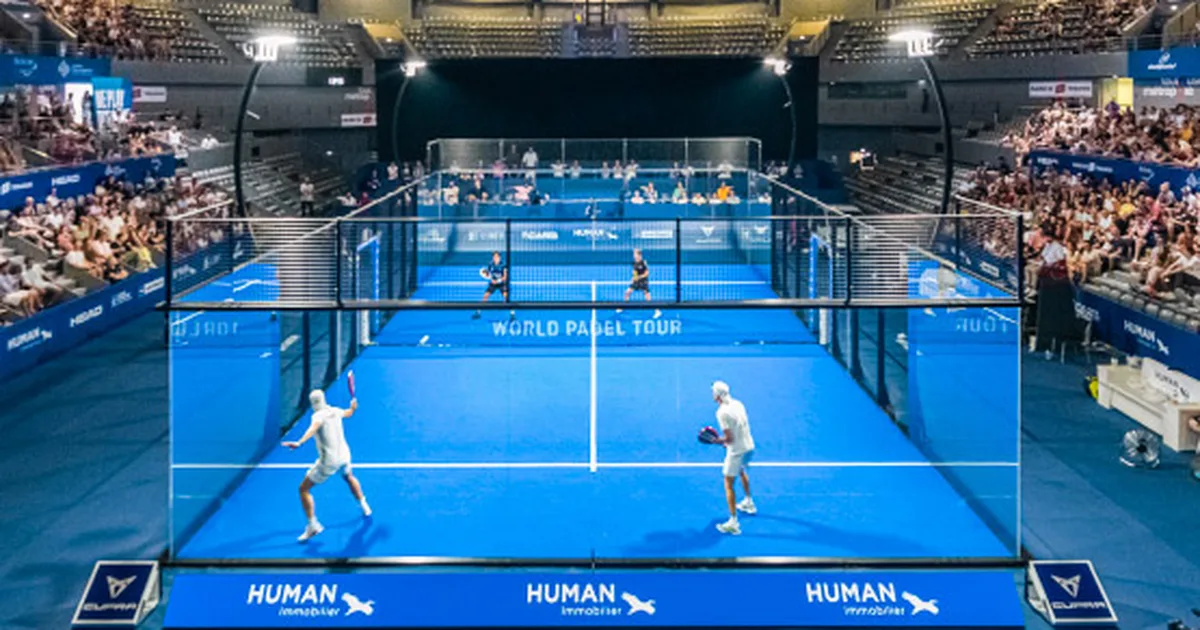
In practice, 1v1 padel is played on a regular 20m × 10m doubles court. A common set-up restricts the playing area:
- Valid width: Only the area between the centre service line and the near side wall on each side — effectively the inner service boxes — is used for service. For rallies after the serve, players typically agree to use the full court width or restrict play to the inner zone.
- Balls landing outside the agreed zone are treated as out.
There is no official standard for how to mark or enforce the narrower zone. In informal play, players simply agree before the match which area counts. At club events that offer 1v1, the organiser sets the rules.
Scoring: Identical to Doubles
Padel singles uses the same scoring system as doubles:
- Points: 15, 30, 40, Game
- Deuce rules: Advantage, Star Point, or Golden Point — agreed before the match
- Sets: First to 6 games with a 2-game lead; tie-break at 6-6
- Match format: Best of three sets (super tie-break may replace the third set in some events)
There is no scoring variation specific to singles.
Serve Rules in Singles
The serve rules are the same as doubles:
- The server stands behind the service line, bounces the ball, and strikes it at or below waist height.
- The serve must land in the diagonally opposite service box.
- Each server gets two attempts per point (first serve and second serve).
- A serve that clips the net and lands in the correct box is a let and is replayed.
The only practical difference is that the server has no partner at the net. After serving, the server must move forward to cover the net position alone — a significant tactical challenge.
Service Order
In singles, the two players alternate serving every game, just as pairs alternate in doubles. Within a game, the same player serves all points.
Wall Play: All Walls in Play
Wall play in singles is identical to doubles. Every wall on the court — back glass, side walls, and metallic mesh — is in play:
- After the ball bounces on the floor, it can rebound off any number of walls and still be played.
- The ball must bounce on the floor before hitting a wall on your side; otherwise it is out.
- Shots like the contrapared (hitting the ball off your own back wall to send it over the net) are legal.
- Out-of-court play is permitted where the venue allows it.
The walls are arguably even more important in singles because the lone player relies on reading rebounds to cover the full depth of the court without a partner to share defensive duties.
Full-Court vs Half-Court 1v1
There are two common ways to play padel one-on-one. Neither is an FIP format; both borrow the doubles rules.
Full-Length 1v1
The set-up described above: the full 20m length, diagonal serves into the normal service boxes, and the doubles rules for scoring, serving and wall play. The playing width is either the whole court or an agreed half.
Half-Court (Mini Singles)
Some players use just one half of a court (10m × 10m or even 10m × 5m) for a casual 1v1 game. It is a fun drill or warm-up exercise, played with house rules for the service and the lines.
If you enter a club 1v1 event, check the organiser’s rules on court area and format before you play.
Why Padel Singles Is Rare
Padel was invented as a doubles sport, and almost everything about the game reflects that:
- Court size: The standard 20m × 10m court is designed for four players. One player covering 10m of width alone makes rallies physically exhausting and tactically one-dimensional.
- Wall dynamics: The glass-and-mesh enclosure creates rally patterns — angles, lobs, rebounds — that reward team coordination. In singles, many of those tactical layers disappear.
- Social culture: Padel’s growth has been driven by its social, accessible, doubles-first identity. Most clubs, leagues, apps, and tour events are built around doubles.
- Court economics: A doubles booking fills four player slots per court hour; singles fills two. Clubs have little incentive to promote singles play.
That said, 1v1 is a useful training format: you have to cover the whole court and read every rebound yourself.
Tactical Differences in Singles
Playing 1v1 changes the game significantly:
- Court coverage is everything. Without a partner, you must recover to a central position after every shot. Fitness and footwork matter even more than in doubles.
- The serve-and-volley is critical. After serving, the player must rush the net — there is no partner already positioned there. A weak serve that allows the returner to attack makes the server immediately vulnerable.
- Lobs are devastating. In doubles, one partner can cover the lob while the other holds the net. In singles, a good lob over the lone net player forces a full retreat and often gives up the point.
- Wall play becomes defensive. With no partner to set up attacking volleys, players rely on the back glass more for survival than for orchestrated plays.
Related Rules
Was this page helpful?
Thanks for your feedback!
Free beginner PDF + rule updates
Get the 4-page beginner guide to the 2026 padel rules, then one short email a week for four weeks and a monthly newsletter.
More in Basic Rules
Ball Hits a Player in Padel: Who Wins the Point?
What happens if the ball hits a player in padel? FIP 2026 rules for your body, your partner, an opponent and the serve, with a decision chart.
What Happens When the Ball Goes Out of the Court in Padel?
Ball out of the court in padel: when it is a lost point, when you can run out and play it, why over the back wall is lost, and ceiling hits (FIP 2026).
Can the Ball Bounce Twice in Padel? The One-Bounce Rule
No. In padel the ball may touch your floor only once before you hit it. What counts as a bounce, glass vs mesh, serve vs rally, under the FIP 2026 rules.
Padel Faults & Lets: Every Way to Lose a Point (2026)
Padel faults, lets and lost points under the 2026 FIP rules: serve faults, net serves, interference, double hits, net touches, and glass vs mesh.