 PADEL RULES
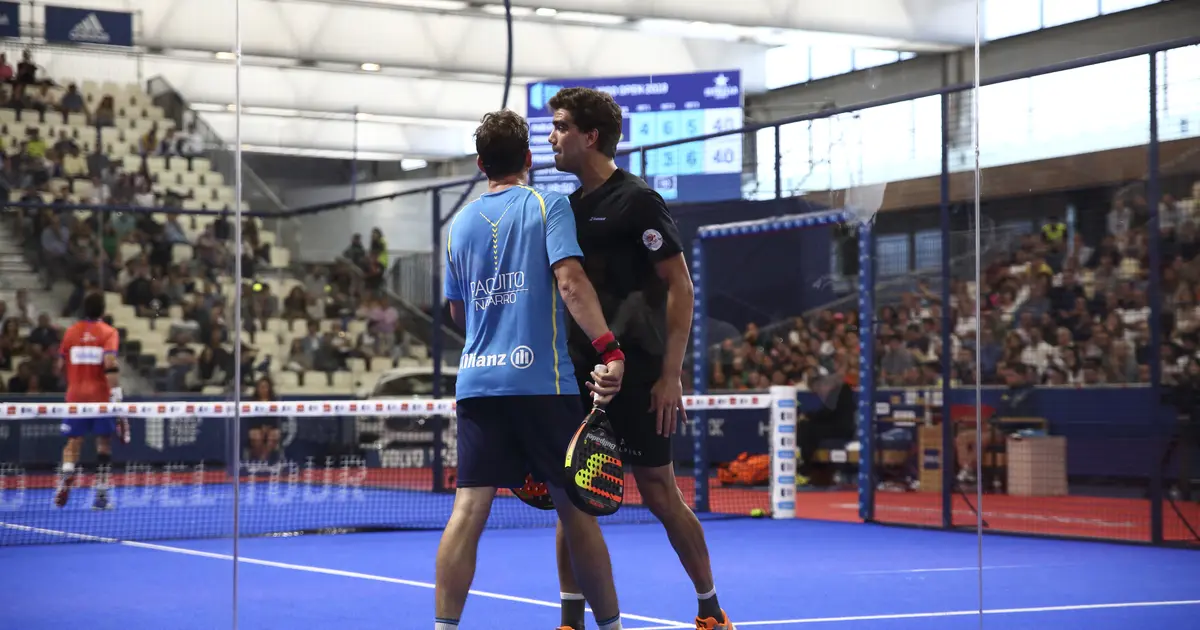
What Happens When the Ball Goes Out of the Court in Padel?
4 min read
Settling an argument? Send this rule to your padel group.
When the ball leaves the court, who wins the point depends on where it went out. A ball that bounces in your half and then leaves the court is your point lost on most courts (FIP Rule 13.1 d). Only on a court where out-of-court play is authorised can you run out and play a ball that went over a side wall or through a door (Rule 13.1 e). A ball that goes out over the back wall is a lost point on every court. And a shot that leaves without first bouncing in the opponents’ court loses the point for the player who hit it (Rule 13.1 g).
Where the ball went out decides the point
| Situation | Result | FIP rule |
|---|---|---|
| Opponents’ shot bounces in your half, then leaves over any wall or through a door. Court without authorised out-of-court play | You lose the point | 13.1 d |
| Same, on a court with authorised out-of-court play, out over a side wall or through a door (por 3) | Still in play: run out and hit it before it bounces again or touches anything | 13.1 e, 16 |
| Same, out over the back wall (por 4), on any court | You lose the point | 13.1 e |
| A shot leaves the court without bouncing in the opponents’ court first | The player who hit it loses the point | 13.1 g |
| A serve bounces in the box and goes out through a door, on a court without out-of-court play | Fault | 7.1 f |
| The ball hits the ceiling or a light before bouncing in the opponents’ court | The player who hit it loses the point | 13.1 g |
| The ball bounces in the opponents’ court, then hits the ceiling or a light | Correct return: the hitter wins the point | 14.1 d |
When can you play the ball from outside?
Only when the court meets the FIP conditions for out-of-court play (Rule 16): two access openings on each side and, beside them, an obstacle-free safety area at least 3 m deep (4 m recommended), 4 m long on either side and 3 m high (The Court › Safety area & out-of-court play). A court with one wide door per side, or with a light pole or bench inside that area, is played without out-of-court play.
2026 rule change: The 2021 rulebook asked for a safety area at least 2 m deep. The 2026 rulebook requires 3 m and recommends 4 m. A court built to the old minimum may no longer qualify for out-of-court play.
On an authorised court:
- Beat the second bounce. The ball has already bounced once in your half. You lose the point if it bounces again, or touches the ground outside or anything that isn’t part of the court, before you hit it (13.1 e).
- Make a normal correct return. A return hit from outside is valid if it meets the usual conditions (14.1 j): it must bounce in the opponents’ court, directly or after hitting a wall on your own side, and must not hit their walls or mesh first (13.1 g). The rulebook does not prescribe a route back into the court.
- The door post. Above 0.92 m, the vertical post between the two doors is a neutral zone that any of the four players may touch or hold (13.1 b).
Ceiling and lights
The ceiling, the lights and anything else above the court are not part of the court (Rule 12.4). A lob that touches them before bouncing in the opponents’ court is the hitter’s point lost (13.1 g). A ball that bounces in the opponents’ court first and then hits them is a correct return (14.1 d), so the hitter wins the point.
See also: out-of-court play · ball in play · court dimensions · the smash: por 3 and por 4
Related Padel Rules
Was this page helpful?
Thanks for your feedback!
Free beginner PDF + rule updates
Get the 4-page beginner guide to the 2026 padel rules, then one short email a week for four weeks and a monthly newsletter.
More in Basic Rules

Ball Hits a Player in Padel: Who Wins the Point?
What happens if the ball hits a player in padel? FIP 2026 rules for your body, your partner, an opponent and the serve, with a decision chart.
Can the Ball Bounce Twice in Padel? The One-Bounce Rule
No. In padel the ball may touch your floor only once before you hit it. What counts as a bounce, glass vs mesh, serve vs rally, under the FIP 2026 rules.
Padel Faults & Lets: Every Way to Lose a Point (2026)
Padel faults, lets and lost points under the 2026 FIP rules: serve faults, net serves, interference, double hits, net touches, and glass vs mesh.

Hitting the Ball Twice in Padel: The Double Hit Rule
Can you hit the ball twice in padel? What FIP Rules 13.1i, 13.1j, 13.1o and 14.1h say about double hits, both partners hitting and carried balls.