 PADEL RULES
Padel Serve Rules — Technique, Faults & Tactical Guide (2026)
7 min read
Quick Answer
The server stands behind the service line, bounces the ball, then strikes it at or below waist height — no overhand serves allowed. The ball must land diagonally in the opponent's service box, and each server gets two attempts per point.
Every padel point begins with the serve, and while it will never be the wrist-snapping weapon it is in tennis, a well-placed serve sets the tone for the rally that follows. The FIP Rules of Padel 2026 (Rule 6) govern exactly how the serve must be executed — understanding them is essential whether you are stepping on court for the first time or fine-tuning a match-day game plan. For a technique-focused breakdown of how to serve in padel, see our dedicated guide.
The Serve Sequence Step by Step
1. Position
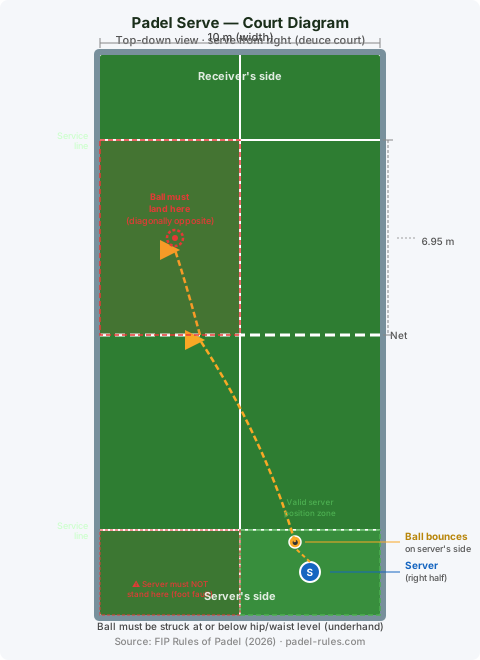
Stand behind the service line with at least one foot on the ground behind that line. Under the 2026 rules, only one foot is required behind the line — the other foot can be anywhere, including on the line or ahead of it, as long as you do not touch the service line itself, the imaginary centre-line extension, or your own reception box before striking the ball.
2026 rule change — foot position: The 2021 rules required both feet behind the service line. The January 2026 FIP revision relaxed this to one foot, reducing trivial foot-fault disputes that disrupted the flow of play at every level.
2. Ball Bounce
Drop the ball from hand height and let it bounce once on the ground within your service half — between the centre-line extension and the side wall. Do not throw the ball upward like a tennis toss; a simple release from waist or chest height is all you need. Most players bounce the ball near their front foot so the timing between drop and strike stays consistent.
3. The Strike
Contact must be made at or below hip level. The FIP rule wording says “hip level” — in practice, think belt-buckle height. The racket face should be level or slightly open (tilted back) to create a low, controlled trajectory. If any part of the racket head is above hip height at the moment of contact, the serve is a fault.
4. Trajectory and Landing
The ball must clear the net and land inside the diagonally opposite service box (right-side serve lands in the receiver’s left box, and vice versa). If the ball clips the net cord and still drops into the correct box, it is a let and you replay the serve.
2026 rule change — ball trajectory: The ball may not cross the service line or the imaginary centre-line extension before it is struck. This was added in the January 2026 revision to close a technical loophole where servers let the ball drift forward before contact, effectively shortening the distance the serve had to travel. The new rule standardises the serve motion across all levels.
Two Attempts and Lets
You get two serves per point — a first serve and, if that faults, a second serve. Two consecutive faults on the same point (a double fault) give the point to the receivers.
If a let occurs on the first serve, the entire service point restarts with two serves. If the let occurs on the second serve, only the second serve is replayed.
A let is also called when the server delivers the ball before the receiver signals readiness.
Starting Side and Service Order
The first serve of every game is from the right side (the deuce court). Sides alternate with each point — right, left, right, left. After a let, the serve is replayed from the same side.
Teams alternate serving games. Within a team, each player serves in turn: player A1 serves game 1, then B1 serves game 2, A2 serves game 3, B2 serves game 4, and the cycle repeats. For the full rotation system, see Service Order.
Common Faults
A serve is faulted when:
- The ball lands outside the correct service box
- The server’s foot crosses the service line, centre line, or touches their own reception box before striking
- The ball crosses the service line or imaginary centre-line extension before being struck
- The ball is struck above hip level
- The ball is not bounced before being struck
- The ball hits a wall or fence on the server’s side before going over the net
For the complete fault list and let rules, see faults and lets. For server and receiver positioning, see position of players. For how the receiving team plays the serve, see return of serve.
Serve Tactics by Level
Beginner — Keep It Simple and Low
Your first serves should be slow and aimed at the centre of the service box. Resist the temptation to blast the ball — a simple, low serve that lands mid-box is harder to attack than a fast serve that bounces high off the back glass, giving the receiver time and height to swing freely.
The most common beginner mistake is striking the ball too high. If your racket is above your hip at contact, the serve is a fault. Practice the motion in front of a mirror: keep the entire swing below your belt, and focus on a smooth pendulum action rather than speed.
Intermediate — Introduce Variety
Once your basic serve is reliable, start varying between a flat serve (faster, less spin) and a slice serve (side spin that kicks the ball off the side wall). A well-disguised slice serve that catches the side glass is one of the most effective weapons in recreational padel, because the ball changes direction unpredictably after contact with the wall.
Target the receiver’s body — a serve aimed directly at the hip is difficult to return cleanly because the receiver has no room to extend the arm and generate their own pace. Alternate body serves with wide serves to keep opponents guessing.
Advanced — The Serve as a Setup Shot
At professional level, players like Arturo Coello use the serve primarily to set up the third-shot attack. The server places the ball to force a weak, lifted return, and the server’s partner — already positioned at the net — cuts the volley down for a winner. The serve itself rarely wins the point outright; it is the tactical opener in a two-shot sequence.
Read the receiver’s positioning before you toss. If they crowd the T, serve wide into the side glass. If they cheat wide, serve down the centre line. Varying placement by even thirty centimetres changes the angle the receiver must cover, and at match speed that difference is enough to draw an error.
Padel Serve vs Tennis Serve
In tennis, the serve is often the most dominant shot in the game — professionals routinely serve above 200 km/h. In padel, the underhand, below-hip restriction caps serve speed at roughly 80—100 km/h even among top professionals. This is by design: padel prioritises the rally over the serve, making the sport more accessible to newcomers and more tactically demanding at every level. For a detailed comparison, see Padel vs Tennis — Key Rule Differences.
Choosing the Right Racket for Your Serve
The underhand serve rewards racket control over raw power. A round-shaped racket with a low balance point makes it easier to keep the strike below hip level and direct the ball accurately into the service box. Beginners who struggle with serve faults often benefit from switching to a lighter frame (350—365 g) — see our padel racket buying guide for a breakdown of weight, shape, and balance. If you are just starting, our best padel racket for beginners 2026 guide picks the top options for serve consistency and all-round control. A fresh grip or overgrip also prevents the racket from twisting in your hand during the serve motion.
New to the sport? See What is Padel? for a complete introduction.
Related Padel Rules
Stay in the loop
Get padel rule updates and tournament news — no spam.
More in Basic Rules
What Happens If the Ball Hits a Player in Padel?
If the ball hits a player's body in padel, that player's team loses the point — with limited exceptions. Full FIP rule breakdown with scenarios.
What Happens When the Ball Goes Out of the Court in Padel?
When the ball leaves the padel court through an open door or over the fence, the point may continue if a player can retrieve it.
Can the Ball Bounce Twice in Padel?
No — if the ball bounces twice on your side of the court, you lose the point. Learn the one-bounce rule, wall rebounds, and the exceptions every padel.
Padel Fault Rules and Lets
A fault is an invalid serve — two faults lose the point. A let means the serve is replayed with no penalty. Covers every fault type and the let rule with real-match scenarios.