 PADEL RULES
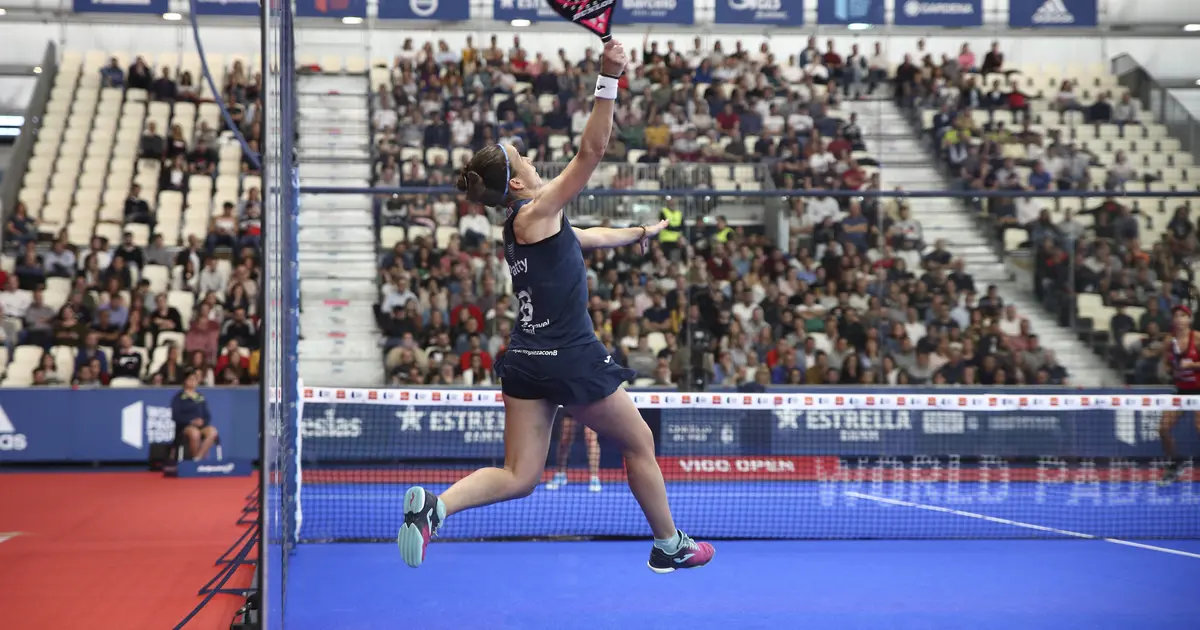
Can You Play Padel Alone? Solo Drills and 1v1 Options
9 min read
Quick Answer
Not a match: the FIP Rules of Padel are written for two pairs (Rule 3.1) and have no singles format. You can practise alone, though: self-fed glass rebounds, serves to targets, volleys against the glass and footwork patterns all work on an empty court. With one other person you can play informal 1v1, and club apps and social sessions help you find the other three.
Settling an argument? Send this rule to your padel group.
You can’t play a padel match alone, but you can practise alone. Padel is a doubles game: the FIP Rules of Padel describe two pairs, one on each side of the net, and contain no singles format. On an empty court with a basket of balls, though, you can train almost every shot that involves the glass, plus your serve and your footwork.
This page covers what the rules say, six solo drills that work on a court, what 1v1 padel is (and isn’t), and how to find the other three players.
What the rules say: padel is played in pairs
The rulebook assumes four players throughout:
“Each pair of players will be on either side of the net on the court.” (FIP Rule 3.1)
The ball “will be hit alternately by each pair of players” (Rule 12.1), scoring is counted per pair (Rule 1), and there is no singles court: the only court in the rulebook is the 20 m × 10 m doubles court. So:
| Players | What you can do | Official? |
|---|---|---|
| 1 | Solo practice: glass rebounds, serves, volleys against the glass, footwork | Practice only |
| 2 | Informal 1v1, or one player feeds while the other drills | Not an FIP format |
| 3 | Rotating 2-vs-1 games or drills with one feeder | Not an FIP format |
| 4 | A real match, two pairs | Yes (Rules 3–15) |
Six solo drills you can do on an empty court
All six need only a racket, a basket or bag of balls and a court. Check that your club lets you book a court for solo practice. The volumes are suggestions, not a programme: stop a set when your technique starts to fall apart.
| Drill | Trains | Suggested volume |
|---|---|---|
| 1. Self-fed back-glass rebound | Reading the back glass, timing | 3 × 10 forehands, 3 × 10 backhands |
| 2. Self-fed side glass and corner | Angles off the side glass | 3 × 8 per side |
| 3. Contrapared rescue | Playing into your own glass | 3 × 6 |
| 4. Serves to targets | Serve accuracy under the 2026 rules | 10 per target, both boxes |
| 5. Volley rally against the glass | Racket control, reactions | 5 × 1 minute |
| 6. Shadow footwork pattern | Moving between net and back court | 6 × 30 s, 30 s rest |
1. Self-fed back-glass rebound
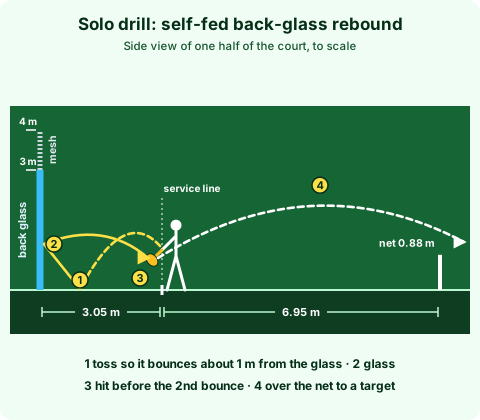
- Setup: stand side-on, just behind the service line (3.05 m from the back glass) with a few balls in your pocket. Put a target, such as an empty ball tube or a towel, deep in the opposite court.
- How it runs: toss the ball underhand so it bounces about 1 m in front of the glass and hits the glass around waist height. Take the racket back before the ball reaches the glass, let it come off, and hit it over the net before it bounces a second time (in a match that second bounce loses the point, FIP Rule 13.1c).
- Make it harder: toss harder so the ball comes further off the glass and you must move back towards the service line to meet it; or alternate forehand and backhand.
For the full technique of playing off the glass, see padel wall play technique.
2. Self-fed side glass and corner
- Setup: stand behind the service line, close to one side wall, with the side glass on your hitting side.
- How it runs: throw the ball so it bounces near the back corner and hits the side glass. Move so the ball comes off the glass towards you, not into your body, and play it down the line. Once that is steady, throw it into the corner so it hits side glass then back glass, and wait out of the corner, towards the middle.
- Do both sides: the forehand side and the backhand side read very differently.
3. Contrapared rescue
- Setup: stand about 2 m from your own back glass, facing it.
- How it runs: drop or throw the ball so it lands close to the back glass and barely comes off. Hit it upwards into your own back glass so it rebounds over the net. This is legal: a shot may hit the wall in your own court first and then bounce in the opponents’ court (Rule 14.1b). But if it touches the metal mesh on your side, you lose the point (Rule 13.1l), so aim low on the glass, well below the 3 m line where the mesh starts.
4. Serves to targets
- Setup: place three targets in the diagonal service box: near the centre line, in the middle, and in the corner next to the side glass.
- How it runs: serve 10 balls at each target from each side and count how many land in the box. Under the 2026 rules (Rule 6), you start with at least one foot behind the service line, bounce the ball inside your own box, hit it at or below waist height with at least one foot on the ground, and send it diagonally into the receiver’s box.
- Technique: how to serve in padel covers grip, spin and targets; serve rules covers every fault.
2026 rule change: the 2021 rules asked the server to stand with both feet behind the service line; the 2026 edition asks for one foot (Rule 6.1). Rule 6.2 also now says the bounced ball “may not cross the service line or the imaginary line until it is struck”. If your bounce drifts over the line before you hit it, that serve is a fault, so practise a bounce that stays in your box.
5. Volley rally against the glass
- Setup: stand 2–3 m from the back glass, facing it, in a low ready position.
- How it runs: volley the ball softly against the glass and keep the rally going without letting it bounce. Work forehand only, then backhand only, then alternate. Control first, speed later.
- No court? Any solid flat wall works. Solo padel wall drills has seven variations for home practice.
6. Shadow footwork pattern
- Setup: no ball. Start in the volley position, about 2–3 m from the net.
- How it runs: split step, then move sideways to an imaginary volley on each side, then turn and retreat diagonally to the back glass as if for a lob, then come forward again to the net. Each pattern lasts about 30 seconds.
- Why: in doubles you and your partner move as a unit; doing the pattern alone lets you groove the turns and recovery steps. See padel footwork for the split step and recovery.
Ball machines fit here too, if your club has one: they feed the same ball again and again, which makes them good for volleys, bandejas and back-glass work. Availability varies a lot by club, so ask.
When you have a second player, move on to padel drills for beginners, which are designed for a feeder and a player.
1v1 padel: an informal variant
With two people you can play “singles” on a normal court. The FIP rules don’t define it, so you agree the details first. Most players keep the doubles scoring, the diagonal serve and the wall rules, and some narrow the playing area because one player covering 10 m of width is hard work. Padel singles rules explains the usual set-ups (full court or half court).
It is useful practice for consistency and fitness, but it is not an official format, and the tactics (net position with a partner, covering the middle) don’t carry over.
Finding players when you’re short of four
- Open matches in booking apps. Apps such as Playtomic let clubs list open matches that you can join. Playtomic gives each player a level that adjusts after competitive matches, which helps you join games at your level.
- Club social sessions and group coaching. LTA Padel recommends clubs and group coaching as ways to meet players, and notes the growing number of player-run social groups that organise their own sessions.
- Local competitions. LTA Padel notes that if you enter without a partner, the organisers will try to find one for you.
If you don’t yet know where to play, see how to find a padel court.
What happens if…?
…your partner doesn’t turn up for a tournament match? Can you play alone against the pair? No. The rules describe a match between two pairs (Rule 3.1). The tournament umpire awards a walkover against players who are not on court ready to play 10 minutes after the official start time, unless the umpire considers it force majeure (Rule 2.1).
…you play 1v1 and serve straight ahead instead of diagonally? There is no official singles rule to break, so it is whatever you agreed. If you follow the FIP serve rule, the serve must go diagonally into the receiver’s box (Rule 6.5), and most 1v1 games keep that.
…in the back-glass drill the ball bounces twice before you hit it? In a match that point is lost (Rule 13.1c). In practice, let it go and feed again: the drill only works if you train to the same standard. The glass itself never counts as a bounce.
…your contrapared hits the glass, then the mesh, then goes over the net? In a match you lose the point: your shot touched the metal fence on your own side (Rule 13.1l). Off the glass only, it is a correct return (Rule 14.1b).
…in serve practice your bounce rolls over the service line before you hit it? Under the 2026 rules it is a fault (Rule 6.2). Count it as a miss in your target tally.
Related guides
- Padel drills for beginners: 10 drills for two or more players
- Padel wall play technique: how to play off the back and side glass
- Padel wall rules: which wall contacts are legal
- Padel beginner training plan
- Padel rules for beginners
Was this page helpful?
Thanks for your feedback!
Get the free padel rules PDF for beginners
Four printable pages on the 2026 FIP rules: serve, scoring, the Star Point, the walls and the rules beginners get wrong.
Free beginner PDF + rule updates
Get the 4-page beginner guide to the 2026 padel rules, then one short email a week for four weeks and a monthly newsletter.
More in Beginner Guides
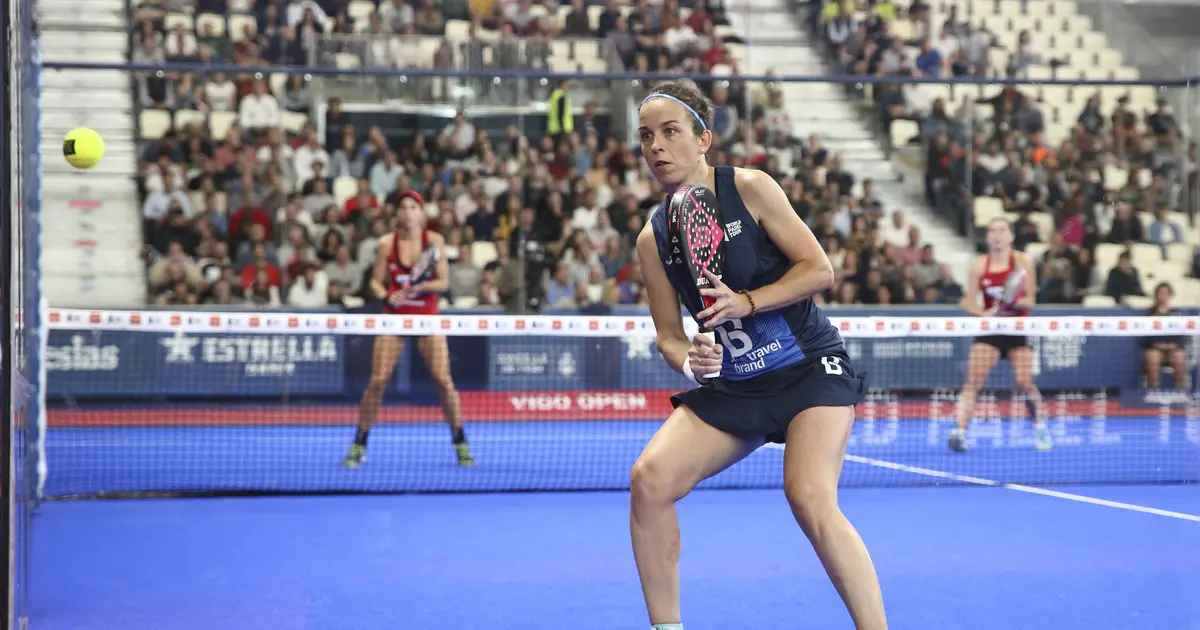
Padel Doubles Tactics for Beginners: How to Play as a Pair
Padel doubles tactics for beginners: move as a pair, win the net, lob to get it back, play through the middle, call the ball and defend off the glass.
How Long Does a Padel Match Last? Times & Formats
How long a padel match lasts: what fits in a 60- or 90-minute court booking, how the scoring format changes length, and the FIP time limits (Rule 2).
How to Find and Book a Padel Court
Find and book a padel court near you with Playtomic, Matchi, Google Maps and club sites. First-timer tips on pricing, equipment hire and what to expect.
How to Improve at Padel: Practice Tips, Drills, Mindset
Practical advice on how to improve at padel. Covers practice drills, shot selection, positioning, the mental game, and common mistakes that hold players.