 PADEL RULES
How Long Does a Padel Match Last? Times & Formats
8 min read
Quick Answer
A padel match has no fixed length: it ends when a pair wins two sets. Club courts are usually booked in 60- or 90-minute slots, and 90 minutes is the safe choice for best of three, especially if you agree a super tie-break as the decider. Pro matches vary: Premier Padel reported a 6-1 6-4 semi-final won in under an hour, and a record match of 4 hours 12 minutes.
Settling an argument? Send this rule to your padel group.
A padel match has no fixed length: it ends when one pair wins two sets (FIP Rule 1). Club courts are usually booked in 60- or 90-minute slots, and 90 minutes is the safe choice for a best-of-three match, especially if you agree a super tie-break as the decider. Professional matches vary a lot: Premier Padel has reported a 6-1 6-4 semi-final won in under an hour and a record match of 4 hours 12 minutes.
Three things decide the length: how many games are played, how deuce is settled, and how much time passes between points and games. The rulebook controls the last two, so this page goes through them with numbers.
What fits in a 60- or 90-minute booking
The rules do not set a time for a match, so these are planning guides. Your own pace decides.
| Booking | What normally fits | Tip |
|---|---|---|
| 60 minutes | A short warm-up and one set, or mini sets to 4 games | Best of three with a full third set is unlikely to fit |
| 90 minutes | Warm-up and best of three, with a super tie-break at one set all | Agree the decider before you start |
| 120 minutes | Best of three with a full third set and a relaxed warm-up | Useful for evenly matched groups who always go to three sets |
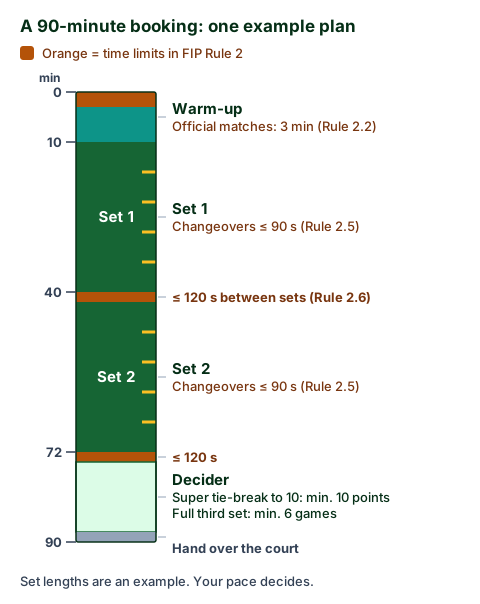
Your booked time is not all playing time. Warm-up, changeovers and handing the court to the next group all come out of it. If your sets usually take longer than half an hour, a 90-minute slot will only fit a third set as a super tie-break.
How the scoring format changes the length
FIP Rule 1 gives the competition (or you and your opponents) several choices. Some put a cap on how long a game or the decider can last. None of them makes padel points themselves shorter.
Settling deuce at 40–40
| Method (FIP Rule 1) | What happens at 40–40 | Points in a game |
|---|---|---|
| Option 1: Advantage | Play on until a pair wins two points in a row | At least 4, no maximum |
| Option 2: Star Point | Two advantage chances, then one deciding point at “deuce 3” | 4 to 11 |
| Option 3: Golden point | One deciding point at the first 40–40 | 4 to 7 |
Full details are on our Star Point and scoring system pages.
2026 rule change: The Star Point is new in the 2026 rulebook. Before 2026 the FIP rules offered only advantage or the golden point. FIP added the Star Point to put a cap on long advantage sequences, and Premier Padel uses it from the 2026 season.
Deciding the match at one set all
| Decider (FIP Rule 1) | Minimum to finish | Notes |
|---|---|---|
| Full third set (default) | 6 games (at least 24 points) | Tie-break at 6–6, first to 7 points by 2 |
| Third set without tie-break | 6 games, no maximum | Only if established beforehand (Option 1.4); play on until a 2-game lead |
| Match tie-break to 7 | 7 points | Alternative score method 1b, replaces the third set |
| Super tie-break to 10 | 10 points | Alternative score method 1c, replaces the third set |
| Mini sets to 4 games | 4 games per set | Alternative score method 1a; tie-break at 4–4 |
The rulebook’s default is best of three full sets. The shorter methods are options the competition chooses; in a friendly, agree them before the first serve. See our tie-break rules for how tie-breaks are served and when ends change.
FIP time limits that add to the clock (Rule 2)
In a friendly nobody times you, but in official matches these are the maximums:
| Moment | Time allowed | Rule |
|---|---|---|
| Warm-up (courtesy rally) | 3 minutes, obligatory | 2.2 |
| Between points | 20 seconds maximum | 2.4 |
| Change of ends after game 1 of a set | No rest, play is continuous | 2.5 |
| Change of ends after games 3, 5, 7… | 90 seconds maximum | 2.5 |
| Change of ends in a tie-break (every 6 points) | Continuous; 20 seconds | 2.5, 2.10 |
| End of a set | 120 seconds maximum | 2.6 |
| Treatment of an injury | One 3-minute break | 2.14 |
| Not on court 10 minutes after the start time | Walkover | 2.1 |
The rest time runs from the end of one point until the serve of the next (Rule 2.7), so walking to the other end is included.
“A maximum of twenty (20) seconds is allowed between points.” (FIP Rule 2.4)
2026 rule change: The warm-up is now 3 minutes. The 2021 rulebook allowed 5 minutes. The warm-up after a suspension is also shorter: none for a stop of up to 5 minutes, 1 minute for 5–20 minutes and 3 minutes for longer (Rule 2.11). See all 2026 padel rule changes.
For penalties when these limits are exceeded, see padel match timings; for when exactly you change ends, see changes of sides.
Worked examples
A 6–4 6–3 social match: how much rest do the rules allow? That is 19 games and at least 76 points. In set 1 (10 games) you change ends after games 1, 3, 5, 7 and 9: no rest after game 1, up to 90 seconds at the other four, so up to 6 minutes. Then up to 120 seconds at the end of the set. In set 2 (9 games) the changes after games 3, 5 and 7 add up to 4.5 minutes, and game 9 ends the match. That is at most 12.5 minutes of breaks (Rules 2.5, 2.6), plus a 3-minute warm-up in an official match. For comparison, Premier Padel reported a 6-1 6-4 men’s semi-final (17 games) at the 2026 Rome Major that took under an hour.
It is one set all and only 20 minutes of your booking are left. A full third set needs at least 6 games, about 24 points. A super tie-break needs at least 10 points. The rulebook’s default is the full set, so a super tie-break only applies if all four of you agree to it (Rule 1, Alternative score methods 1c). Settling this before the first serve avoids the argument.
Every game in your group goes to deuce. With advantage there is no limit to a game. With the Star Point a game ends by its 11th point at the latest, with the golden point by its 7th (Rule 1, Options 2 and 3). Choosing one of these is the only rule-based way to cap a long game.
The set reaches 6–6. A tie-break is played: first pair to 7 points with a 2-point lead wins the set 7–6, and ends change every 6 points without a rest (Rule 1, Tie-break; Rule 5.2). It is at least 7 points, and it continues until someone leads by 2.
Rain stops play for 25 minutes. When play resumes you get a 3-minute warm-up, because the stop was longer than 20 minutes (Rule 2.11c), and the match restarts at exactly the same score (Rule 2.12).
Does the Star Point make pro matches short? No. The longest match in Premier Padel history, 4 hours 12 minutes, was played in 2026: Ari Sanchez and Andrea Ustero beat Paula Josemaria and Bea Gonzalez 5-7 7-6(8) 7-6(6) in the Rome Major semi-final. That is 38 games, including two tie-breaks. The Star Point caps a game, not the number of games.
How long are professional padel matches?
It varies too much for a meaningful average. The two published extremes from Premier Padel’s 2026 Rome Major show the range: a 6-1 6-4 semi-final in under an hour and the 4 hour 12 minute record, which beat the previous tour record of exactly 4 hours (Milano P1, 2024). Straight-sets matches are at the short end; three tight sets with tie-breaks at the long end.
Related pages
Was this page helpful?
Thanks for your feedback!
Get the free padel rules PDF for beginners
Four printable pages on the 2026 FIP rules: serve, scoring, the Star Point, the walls and the rules beginners get wrong.
Free beginner PDF + rule updates
Get the 4-page beginner guide to the 2026 padel rules, then one short email a week for four weeks and a monthly newsletter.
More in Beginner Guides
Can You Play Padel Alone? Solo Drills and 1v1 Options
You can't play a padel match alone: the rules are written for pairs. But you can practise solo. 6 on-court drills, 1v1 and how to find players.
Padel Doubles Tactics for Beginners: How to Play as a Pair
Padel doubles tactics for beginners: move as a pair, win the net, lob to get it back, play through the middle, call the ball and defend off the glass.
How to Find and Book a Padel Court
Find and book a padel court near you with Playtomic, Matchi, Google Maps and club sites. First-timer tips on pricing, equipment hire and what to expect.
How to Improve at Padel: Practice Tips, Drills, Mindset
Practical advice on how to improve at padel. Covers practice drills, shot selection, positioning, the mental game, and common mistakes that hold players.