 PADEL RULES
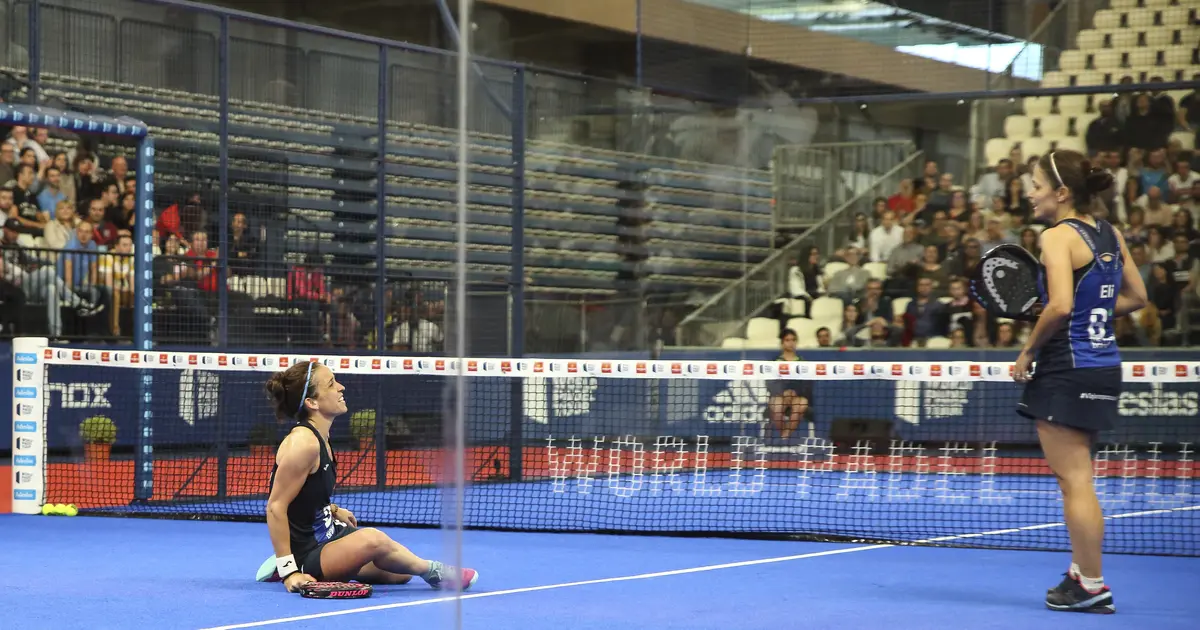
Changing Sides in Padel: When to Switch Ends (2026)
8 min read
Quick Answer
Pairs change ends after the 1st, 3rd and every following odd game of each set (FIP Rule 5.1) and every 6 points in a tie-break (Rule 5.2). There is no rest at the change after game 1. The other changes allow up to 90 seconds (Rule 2.5), and the end of a set up to 120 seconds (Rule 2.6). When a set ends, you change ends only if it had an odd number of games.
Settling an argument? Send this rule to your padel group.
In padel, the two pairs change ends after the 1st, 3rd and every following odd game of each set (FIP Rule 5.1), and every 6 points in a tie-break (Rule 5.2). There is no rest at the change after game 1. The later changes allow up to 90 seconds, and the end of a set up to 120 seconds (Rules 2.5 and 2.6). When a set ends, you only change ends if it had an odd number of games.
This page covers when you change ends and how long you get. For the tie-break itself see tie-break rules, for who serves after a change see service order, and for how games and sets are counted see the scoring system.
The rule: odd games in the set
“Players must change sides after the 1st, 3rd and every subsequent odd game in the set.” (FIP Rule 5.1)
The official Spanish text puts it as a count: pairs change ends “when the total number of games played in each set is an odd number” (cuando la suma de los juegos disputados de cada set sea número impar). So the score doesn’t matter, only the total. At 2–1 or 3–0 (3 games) you change; at 2–2 or 3–1 (4 games) you don’t. The count starts again at zero in every set.
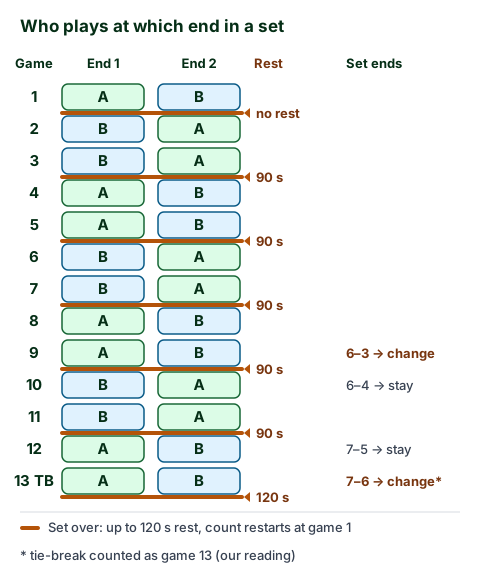
Which end each pair starts on is decided by the coin toss before the match (Rule 4). See choice of sides and service.
How long you get at each change
| Moment | Change ends? | Maximum time | Rule |
|---|---|---|---|
| After game 1 of a set | Yes | No rest: play is continuous | 2.5 |
| After games 3, 5, 7, 9, 11 | Yes | 90 seconds | 2.5 |
| After an even game (2, 4, 6 …) | No | 20 seconds, as between any two points | 2.4 |
| End of a set | Only if the set had an odd number of games | 120 seconds | 2.6, 5.1 |
| Start of a tie-break (after 12 games) | No | 20 seconds | 2.4 |
| Every 6 points in a tie-break | Yes | No rest (2.5), but 20 seconds for the change (2.10) | 2.5, 2.10, 5.2 |
Three details matter in practice:
- The clock runs from the last point to the next serve (Rule 2.7), not from when you reach the bench. Walking to the other end is part of the 90 seconds.
- No food or drink between points (Rule 2.5). Drink at the changes with a rest, from game 3 on, and between sets.
- Coaching: in pairs and team competitions an accredited coach may give advice, but only during rest times (Etiquette and conduct norms, “Advice & instructions”).
The tie-break: the rulebook contradicts itself
Rule 2.5 says that “during a tie-break, play will be continuous and the players will change ends without a rest period”. Rule 2.10 says “20 seconds will be granted for changes of side in a tie break”. Both sentences are in the 2026 English and Spanish texts, and both were already in the 2021 edition. The rulebook doesn’t explain how they fit together.
Read together, they mean you get up to 20 seconds to swap ends, which is the same limit as between any two points (Rule 2.4). It is not a rest: you don’t sit down, and the ban on drinking between points still applies. If a tournament or umpire applies it differently, their decision counts.
Worked examples
A 6–4 set (10 games). The pairs change after games 1 (no rest), 3, 5, 7 and 9 (up to 90 seconds each). Game 10 ends the set. 10 is even, so nobody changes ends. The pairs get up to 120 seconds and start set 2 at the same ends. The next change is after game 1 of set 2, with no rest.
A 6–3 set (9 games). Game 9 is odd and ends the set, so the pairs change ends, with the set-end allowance of up to 120 seconds (Rule 2.6). The rulebook doesn’t add the 90 seconds on top. The 2021 rulebook settled this case directly: change ends if the finished set had an odd total, stay if it was even.
A 7–6 set. The last change of the games is after game 11 (90 seconds). Game 12 makes it 6–6. That’s an even total, so the tie-break starts at the same ends. Inside the tie-break, the pairs change after point 6 and, if it goes that far, after points 12, 18 and so on. A 7–4 tie-break (11 points) has one change; an 8–6 tie-break (14 points) has two.
After the tie-break, the 2026 rulebook doesn’t say whether to change ends. Our reading: count the tie-break as one game, as Rule 17 does for ball changes. The set then has 13 games, an odd total, so you change ends and get up to 120 seconds. Our service order page reads it the same way.
A match tie-break (super tie-break to 10). Rule 5.2 only mentions “the tie break”, and the rulebook gives the match tie-break no separate rule for changing ends. It is played like a normal tie-break: change ends every 6 points. Check the competition rules if they say otherwise.
2026 rule change: Rule 5 is unchanged from 2021, and so are the 90 and 120 seconds. Two things around the changeovers are new. Rule 2.5 now bans food and drink between points. And there is now a dedicated penalty scale for time violations, such as overrunning a changeover: a warning first. After that, a serving player loses the first serve and a receiving player loses a point. Further violations cost more points, and serious cases can mean lost games or disqualification (“Continuous play or delays”). The 2021 rules had only one general scale for all offences: warning, then point, then disqualification.
What happens if nobody changes ends?
“All points won before the error was discovered are valid.” (FIP Rule 5.3)
Rule 5.3 has three parts:
- Correct the mistake as soon as it’s noticed, following the correct order.
- All points already played stand.
- If the mistake is noticed after a first-serve fault, the server has only one serve left.
“Following the correct order” means you go back to the schedule, not start a new one. Say you forgot to change after game 3 and notice during game 4. You change now, and you change again after game 5 as normal.
What happens if…?
1. We noticed in game 4, right after the server missed a first serve. Change ends straight away. The score in game 4 stands, and the server has one serve left (Rule 5.3). The next change is still after game 5.
2. Can I take a drink when we change after game 1? No. There is no rest after the first game of a set (Rule 2.5), and food and drink are not allowed between points. Your first drink of the set comes at the change after game 3.
3. Our changeover took two minutes. That’s over the 90-second limit. The first time, the umpire gives a warning for a time violation. A repeat costs the server the first serve, or a point if it’s a receiving player (“Continuous play or delays”). More on all time limits: padel match timings.
4. Bad light: the match has to stop. The umpire should stop it at an even number of games in the set. That way both pairs are on the same ends as before when play resumes (Rule 2.13).
5. A player needs treatment at a changeover. A player with an injury or a treatable medical condition gets one 3-minute break for treatment. It can be repeated at the next two changes of side, within the normal changeover time (Rule 2.14). See medical timeouts.
6. Does it matter who is winning? No. A set at 3–0 and a set at 2–1 have both had 3 games, so the pairs change ends in both cases. Only the total counts.
Related rules
- Tie-break rules: serving in the tie-break, super tie-break
- Service order: who serves first in each set, serving out of turn
- Scoring system: points, games and sets
- Padel match timings: every time limit in Rule 2
- Padel rules 2026: everything that changed in the 2026 rulebook
Was this page helpful?
Thanks for your feedback!
Free beginner PDF + rule updates
Get the 4-page beginner guide to the 2026 padel rules, then one short email a week for four weeks and a monthly newsletter.
More in Scoring & Match Structure

Alternative Scoring Methods
FIP Rule 1 permits three official alternative scoring formats — the Mini Set (4 games), Match Tie-Break (7 points), and Super Match Tie-Break (10 points).
Change of Balls
FIP rules (Rule 17) allow balls to be changed at scheduled intervals. Learn when changes happen, who controls the schedule, and what players can request.
Choice of Sides and Service: Decisions Before the Match
The coin toss decides who picks serve or end. Why serve advantage matters, how sun, wind and court bias affect the choice, and when to defer.

Padel Tie-Break Rules: Serve Order & Super Tie-Break
Padel tie-break rules (FIP 2026): first to 7 points by 2, who serves first, the 1-2-2 serve rotation, ends every 6 points, and the super tie-break to 10.