 PADEL RULES
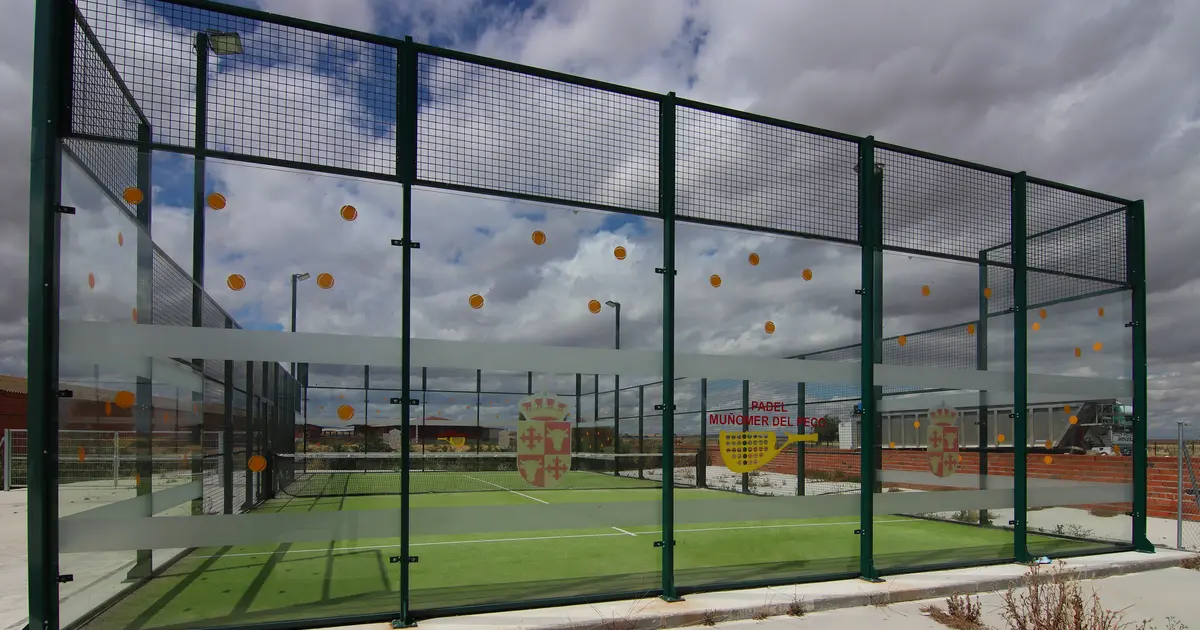
Padel Court Surface: FIP Rules for Floor, Colour & Lines
9 min read
Quick Answer
Under the 2026 FIP rules a padel court floor may be cement, synthetic material or artificial grass, as long as the ball bounces regularly. It must be one colour, preferably green, blue or terracotta, and clearly different from the walls. Level differences must be under 3 mm under a 3 m straightedge, and a floor without drainage may slope at most 1% from the centre to the edges. Lines are 5 cm wide, preferably white or black.
Settling an argument? Send this rule to your padel group.
The FIP rulebook doesn’t prescribe one surface. It sets a result: the floor must give the ball a regular bounce. Cement, synthetic material or artificial grass are all allowed, in one colour (preferably green, blue or terracotta) that stands out clearly from the walls. Two numbers make it measurable: level differences under 3 mm under a 3 m straightedge, and a slope of at most 1% on floors that don’t drain.
These rules sit in The Court › Ground surface, points 1–5, of the 2026 FIP Rules of Padel. The lines are in The Court › Dimensions. This page covers the floor itself. For the full court measurements see padel court dimensions, and for how a court is built (base, drainage, turf spec) see padel court construction.
The FIP surface rules at a glance
| Requirement | FIP 2026 | Where |
|---|---|---|
| Material | Cement, synthetic material or artificial grass | Ground surface, point 1 |
| Basic test | Must allow a regular bounce of the ball | Ground surface, point 1 |
| Colour | One colour for the whole floor; preferably green, blue or terracotta (or similar tones) | Ground surface, point 2 |
| Contrast | Clearly different from the wall colour | Ground surface, point 2 |
| Flatness | Level differences under 3 mm under a 3 m straightedge (1/1000) | Ground surface, point 3 |
| Slope (floors without drainage) | Max. 1%, from the centre towards the outer edges | Ground surface, point 4 |
| Synthetic and artificial grass | Must meet the FIP Courts Homologation Annex | Ground surface, point 5 |
| Lines | 5 cm wide, preferably white or black | Dimensions |
| Symmetry | Both halves absolutely symmetrical in surface and lines | Dimensions |
Materials: cement, synthetic or artificial grass
Point 1 lists three materials and attaches one condition to all of them: the floor must allow “a regular bounce of the ball”. Point 5 adds that synthetic and artificial-grass surfaces must meet the FIP Courts Homologation Annex, a separate FIP document that holds the technical test values. The rulebook itself doesn’t print them.
The official Spanish text lists wood as well (“cemento, madera, materiales sintéticos o césped artificial”). The English text does not. If you build to the English rules, you are inside both.
2026 rule change: The 2021 rulebook allowed porous concrete, cement, wood, synthetic materials, artificial grass “or any other” floor with a regular bounce. It accepted a black floor for indoor courts only, and it printed a table of test values for synthetic and grass floors (shock absorption, friction, ball rebound, sand infill) based on the Spanish standard UNE 41958 IN. The 2026 English text names only cement, synthetic material and artificial grass. It drops the black-floor clause and refers to the FIP Courts Homologation Annex instead of printing test values.
Colour and contrast
The whole floor must be one colour, preferably green, blue or terracotta or similar tones, and clearly different from the wall colour (point 2). Opaque walls in turn must be one uniform colour, clearly different from the floor (The Court › Sides).
Two other rules depend on the floor colour:
- Lines are “preferably white or black, for better contrast with the colour of floor surface” (The Court › Dimensions).
- Balls may be white, yellow or another colour with “an appropriate and clear contrast with the surface color” (The Ball, point 1). More on padel ball requirements.
Flatness and slope
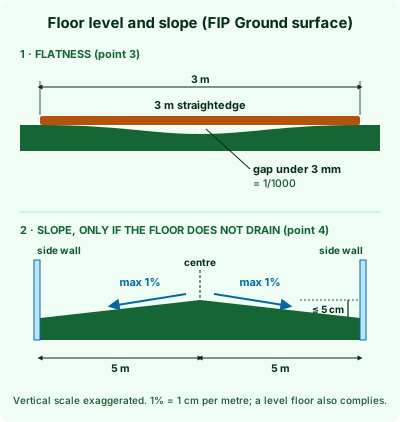
Flatness (point 3). Lay a 3 m straightedge anywhere on the court. The gap underneath must be less than 3 mm. The rulebook writes this as 1/1000. It is stricter than the UK construction code, which allows ±6 mm under the same 3 m straightedge (SAPCA 2.12.1). Anyone specifying a court to FIP rules should write the FIP figure into the contract.
Slope (point 4). A floor without drainage may fall at most 1% across the court, from the centre towards the outer edges, so rain runs off. 1% is 1 cm per metre: from the centre to a side wall (5 m) that is at most 5 cm. It is a maximum, so a level floor also complies. A porous floor that drains through its base needs no fall. The UK code expects a new porous court to be clear of ponding within 15 minutes of rain stopping (SAPCA 2.12.2).
Lines on the floor
| Line | Position | Rule |
|---|---|---|
| Service lines | Parallel to the net, 6.95 m from it on each side | Dimensions |
| Central service line | Splits the area between net and service line in two; extends at least 20 cm beyond the service line | Dimensions |
| Width (all lines) | 5 cm | Dimensions |
| Colour | Preferably white or black, contrasting with the floor | Dimensions |
There are no baselines or sidelines: the walls and fence mark the court. The rulebook doesn’t say how lines are made (painted or inlaid in the turf). The UK code asks for white lines (SAPCA 2.2), which is within the FIP “preferably white or black”. Exact court geometry is on padel court dimensions.
What the surface type means for play
The rules treat all three materials alike, but they don’t play alike.
- Sand-filled artificial grass is the norm. The UK code says most installations and tournaments use it, and specifies padel turf with a 10–15 mm pile, monofilament yarn preferred, silica sand infill and a ball rebound above 80% (SAPCA 2.13.1). The sand is what lets players slide. The code warns that the surface “will not perform” if it isn’t correctly sand-filled (SAPCA 2.13.4), and says regular brushing spreads the sand again for more consistent play (SAPCA 5.1.2). How much sand a court has varies from club to club and with the age of the turf.
- Cement and other hard synthetic floors have no loose sand layer to slide on, and no sand that can drift into heaps or wear thin.
- Shoes follow the floor: herringbone soles suit turf with plenty of sand; omni or hybrid soles suit turf with little sand or a hard floor. See what shoes for padel.
The floor during a point
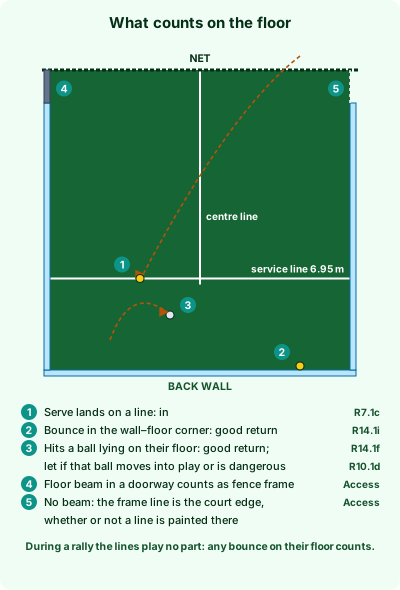
After a good bounce the ball stays in play off the walls and fence until it touches the floor a second time (Rules 12.3, 12.4). The floor cases players argue about are answered below. More on what keeps a ball alive: ball in play and wall play.
What happens if…?
…my serve lands right on the service line? It’s in. The lines count as part of the receiver’s box (Rule 7.1 c). The server’s feet are another matter: neither may touch the service line or the imaginary centre line (Rule 6.3). See serve rules.
…the ball lands exactly in the corner where the back glass meets the floor? That’s a good return (Rule 14.1 i). It may come out low and fast, but it’s in play and must be returned before it bounces a second time.
…my shot hits a spare ball lying on their side? Your return is good (Rule 14.1 f). If that spare ball then rolls so it could interfere or hurt someone, a let is played (Rule 10.1 d). If your shot hits a ball lying on your own side, you lose the point (Rule 13.1 l). Clear loose balls before the point.
…the ball skids off a wet patch or a bare spot in the turf? Play on. Rule 10 gives lets for a broken ball, something entering the court, an outside interruption or an object moving on the floor, not for an awkward bounce. If the floor becomes unsafe, stop and tell the umpire. If rain suspends a match, the restart warm-up is none (up to 5 minutes), 1 minute (5–20 minutes) or 3 minutes (over 20 minutes) (Rule 2.11).
…the ball hits the metal bar across a doorway? The bar counts as part of the fence frame (The Court › Access). If the ball bounces on the floor first and then hits it, the ball is still in play (Rules 12.3, 12.4). If your shot hits it before bouncing in the opponents’ court, that’s like hitting their fence first: you lose the point (Rule 13.1 g).
…our club court is grey, or black? That’s outside the colours the rulebook names (green, blue, terracotta or similar), and the 2021 allowance for black indoor floors is gone. It changes nothing about how points are played. It matters if the court is to be homologated or used for official competition.
Related court guides
Was this page helpful?
Thanks for your feedback!
Free beginner PDF + rule updates
Get the 4-page beginner guide to the 2026 padel rules, then one short email a week for four weeks and a monthly newsletter.
More in Court Dimensions
Padel Court Dimensions: Official FIP Measurements (2026)
Official padel court dimensions from the 2026 FIP rules: 20 × 10 m, service lines 6.95 m from the net, 88–92 cm net, wall heights and clear height.
Padel Wall Height: Back Glass, Mesh & Ceiling (FIP 2026)
How high are padel walls? Back wall 4 m (3 m glass + 1 m mesh), side walls 3–4 m, 6 m clear height, and what happens when the ball goes over (FIP 2026).
Padel Net Specifications: How Net Height Affects Play
FIP net height (88–92 cm) is lower than in tennis to encourage net play. How height affects strategy, why the slope matters, and what a compliant net is.
Padel Court Construction: How to Build One (2026)
How to build a padel court: the FIP 2026 requirements, land needed, base and drainage, glass and mesh, lighting, planning, and sourced UK cost figures.