 PADEL RULES
What Shoes for Padel? Padel vs Tennis vs Running Shoes
8 min read
Quick Answer
Wear padel shoes, or clay-court tennis shoes if you only play now and then. Most courts are artificial grass with sand, so pick the sole for your court: herringbone for lots of sand, omni or hybrid for little sand or a hard floor. Avoid running shoes: they lack sideways support. The FIP rules only require 'suitable' sports footwear.
Settling an argument? Send this rule to your padel group.
Wear padel shoes. If you only play now and then, clay-court tennis shoes do the job. Padel is mostly short sideways moves on artificial grass with sand on top, so you need a sole that grips through sand and a shoe that holds your foot when you stop sideways. Running shoes do neither well. The rulebook itself only asks for “suitable sports footwear”.
This page answers which kind of shoe and which sole. For specific models, see best padel shoes 2026 and best women’s padel shoes 2026. For a full step-by-step on fit and sizing, see the padel shoes buying guide.
Which shoes should you wear?
It depends on how often you play, then on your court.
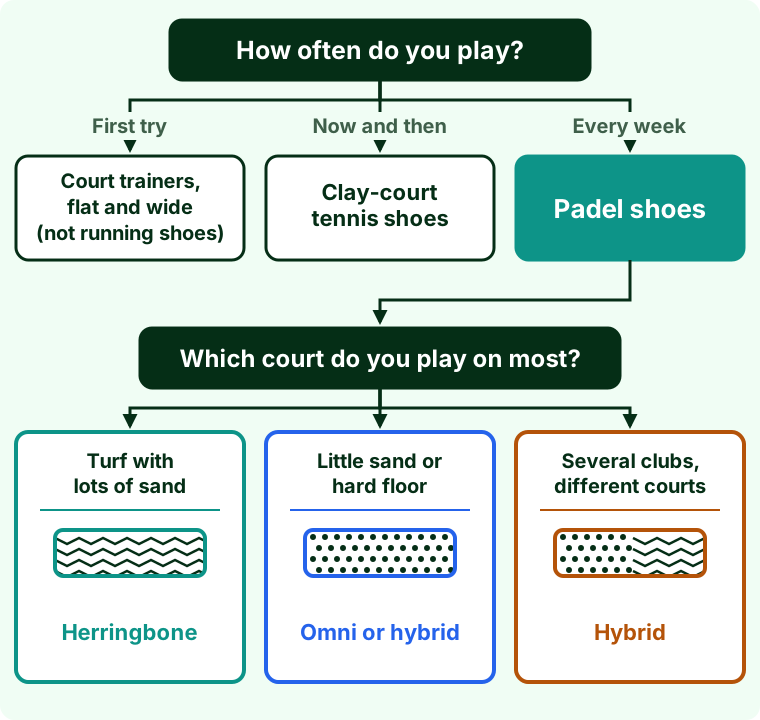
- Trying padel for the first time: LTA Padel says you can play in “any type of comfortable activewear and trainers”. Pick the flattest, widest pair you own: court or gym trainers, not running shoes.
- Playing now and then: HEAD says tennis shoes can be enough for occasional games. Clay-court tennis shoes are the closest match.
- Playing every week: buy padel shoes, and choose the sole for the court you use most (see the table below).
Padel vs tennis vs running vs indoor shoes
| Shoe | For padel? | Why |
|---|---|---|
| Padel shoes | Best | Sole made for sand-filled turf; built for sideways movement |
| Clay-court tennis shoes | Good stand-in | Same herringbone idea; works on sandy turf |
| All-court / hard-court tennis shoes | OK now and then | Good side support, but the tread is not designed for sand |
| Indoor court shoes (futsal, squash, handball) | Only on hard indoor floors | Flat gum soles made for smooth sports-hall floors, not sand |
| Running shoes | Avoid | Built to go forwards: soft, raised heel and little side support |
| Fashion trainers | Avoid | No court tread, no lateral support |
Why running shoes are the worst choice
Padel is not running. You split-step, shuffle sideways, stop and push back the other way, often on one foot. A running shoe is designed for the opposite: forward strides, with a thick, soft heel to absorb landings. When you stop sideways in one, the soft foam squashes on the outside edge and the shoe tips. HEAD lists running shoes as a typical mistake because they give “too little stability for sideways movement”, and ASICS warns that the wrong shoes can make you “twist your ankle or fall”.
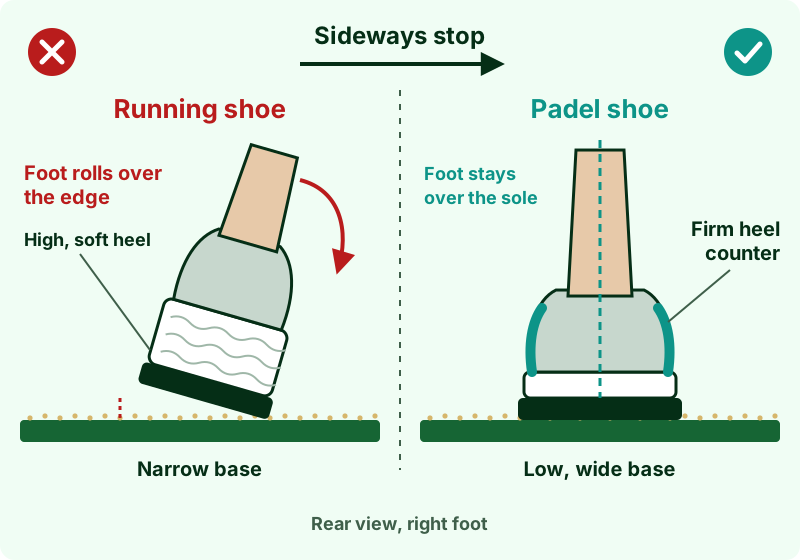
A padel shoe sits lower and wider, with a firm heel counter and reinforced sides. LTA Padel sums up what makes it different: lateral support “designed for fast, side-to-side movement”, a durable outsole for textured courts, and cushioning for pivots and jumps.
Which sole for which court?
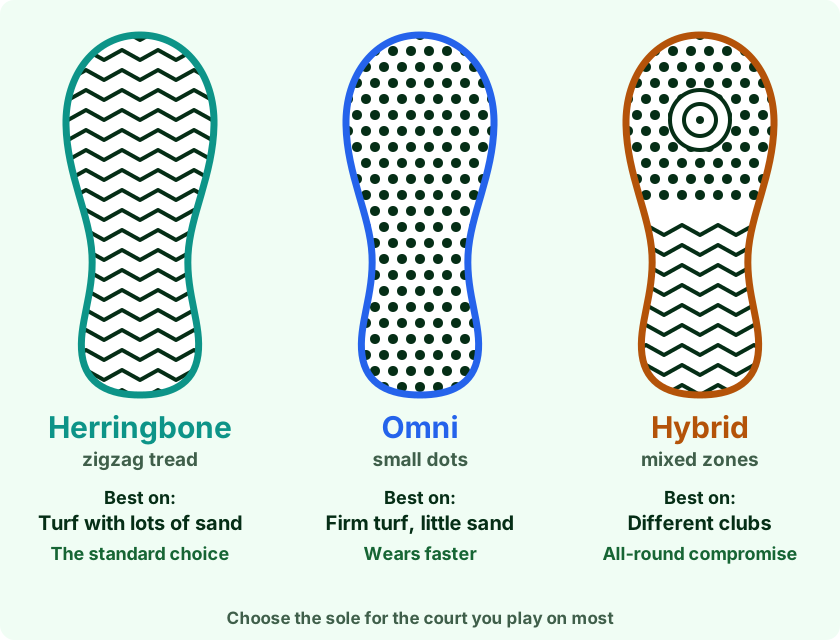
The FIP rulebook allows a court floor of cement, synthetic material or artificial grass, as long as it “allows a regular bounce of the ball” (FIP Rules, The Court › Ground surface, point 1). Most club courts are artificial grass with sand worked in. The amount of sand varies a lot between clubs, and with how old the turf is. That, not indoor vs outdoor, is what decides the sole.
| Your usual court | Herringbone | Omni | Hybrid |
|---|---|---|---|
| Artificial grass, lots of loose sand | Best | Can feel loose on thick sand | Works |
| Artificial grass, little sand or worn | Works | Works | Best |
| Cement or hard synthetic floor | Grips less on smooth floors | Best | Works |
| Several clubs, different courts | Works on most | Risky on sandy courts | Best single pair |
How to read your court: drag your foot across the turf. If you can see and feel loose sand, choose herringbone. If the carpet is almost bare or the floor is hard, choose omni or hybrid. ASICS describes herringbone as made for sandier courts and highly durable, and notes that omni gives great grip but wears out sooner. HEAD calls herringbone the main recommendation, especially for beginners.
Beyond the sole: 4 quick checks
You don’t need a lab to judge a shoe. In the shop, check these:
| Check | What you want | Quick test |
|---|---|---|
| Lateral stability | Firm heel counter, reinforced sides, low and wide base | Squeeze the heel: it should not fold. Shuffle sideways: your foot stays over the sole |
| Cushioning | Enough to soften jumps and stops, not so soft that the shoe wobbles | Stand on one leg and rock side to side: soft foam you sink into is less stable |
| Fit | Snug without pressure; HEAD says a padel shoe should fit closely “without pinching” | Lace up, lunge and stop: the heel must not lift and the foot must not slide sideways |
| Durable toe | A reinforced toe area | Low volleys and lunges drag the toe of your front foot; a bare mesh toe wears through first |
Try shoes on with the socks you play in. The buying guide has the full fit and sizing checklist.
When to replace padel shoes
HEAD puts the lifespan anywhere from 2–4 months for frequent players to a year or more for occasional players. Go by these signs rather than the calendar:
- The tread is worn smooth, usually first under the ball of the foot. HEAD: once no pattern is visible, the shoe is worn out.
- You slip on push-offs that used to feel safe.
- The midsole has gone flat: creased foam, and the forefoot feels hard.
- The upper no longer holds you: your foot slides over the edge or the heel counter has gone soft.
A worn padel sole loses the very thing you bought it for, so it is the first thing to check.
What the rules say about shoes
The FIP rulebook has one sentence on footwear, under the etiquette and conduct norms (Attire):
“Players will wear suitable sports clothing and footwear. Swim wear is not allowed.”
The same section says players may use the footwear they want, as long as it is regulation. There is no rule on sole pattern, sole colour or brand, and no non-marking requirement. For the penalty and club house rules, see padel shoe rules.
What happens if…?
…your shoe breaks in the middle of a match? You get extra time to fix it. FIP Rule 2 (Times), point 8: if a player’s clothing, shoes or equipment needs replacing for unforeseen reasons, “an additional period of time (within reason)” is allowed.
…you turn up to a tournament in running shoes? The rulebook bans no shoe type, so running shoes are not automatically illegal. Expect to play worse, not to be thrown out.
…you try to play barefoot or in sandals? That is not suitable sports footwear. Under the Attire rule it is penalised (the English text says “a fault being given”; the Spanish text says the player is warned), and a player who does not put it right is disqualified.
…your club says “non-marking soles only”? That is a club rule, not an FIP rule, and the club decides who uses its courts. Follow it. LTA Padel advises non-marking soles for indoor courts in any case.
…you play at a club with a hard indoor floor in herringbone shoes? You can, and it is legal. You will simply have less bite than with an omni or hybrid sole, so take care on sharp stops.
Read next
- Best padel shoes 2026: current models with checked specs
- Padel shoes buying guide: fit, sizing, weight, women’s lasts
- Padel shoe rules: what the FIP requires and club rules
- Indoor vs outdoor padel: how the two kinds of court play
- Padel footwork: how to move (and slide) on court
- Padel injury prevention: ankles, knees and warm-ups
Was this page helpful?
Thanks for your feedback!
Free beginner PDF + rule updates
Get the 4-page beginner guide to the 2026 padel rules, then one short email a week for four weeks and a monthly newsletter.
More in Padel Equipment
Adidas Padel Rackets & Shoes 2026 — Complete Brand Guide
Adidas padel in 2026: the Metalbone racket line, Barricade and Adizero shoes, brand history, and which Adidas gear suits your level.
Babolat Padel Rackets 2026 — Best Models & Technology Guide
The Babolat padel racket range for 2026: compare the Viper, Counter and Technical lines, with prices, player endorsements and our picks.
Padel Ball Specifications: Why Balls Matter
FIP padel ball specifications control bounce, durability and consistency. How balls differ from tennis, why altitude matters, why approved balls are used.

Best Padel Bags 2026: How to Choose + 5 Verified Picks
How to choose a padel bag: backpack or racket bag, racket capacity, thermal and shoe pockets. Plus 5 current bags with specs checked on makers' sites.