 PADEL RULES
Best Padel Shoes 2026: 8 Models by Court and Player Type
11 min read
Quick Answer
The best padel shoe is the one whose outsole suits your court and whose build suits how you move. On sandy artificial grass, pick a herringbone or hybrid sole; on cement or hard synthetic, an omni or hybrid sole. Then choose by need: Bullpadel Hack Vibram 26V for heavy use, NOX AT10 LUX for stability, NOX ML10 HEXA for a lighter feel, Babolat Movea 2 for heel cushioning.
Settling an argument? Send this rule to your padel group.
The best padel shoe for you is the one whose outsole matches your court and whose build matches how you move. On artificial grass with a lot of sand, choose a herringbone or hybrid sole. On cement or hard synthetic floors, choose an omni or hybrid sole. Then pick by need: durability, stability, a light feel, cushioning or a roomier fit. The eight shoes below are current models, sorted that way.
We checked every spec on the manufacturer’s own product page on 31 October 2026. We haven’t lab-tested these shoes and we don’t score or rank them. Where a maker doesn’t publish a figure, we say so. Some links are affiliate links (see the disclosure at the end).
New to padel footwear? What shoes to wear for padel explains why padel shoes differ from running or tennis shoes. Our padel shoes buying guide covers fit, cushioning and durability in depth.
Step 1: match the outsole to your court
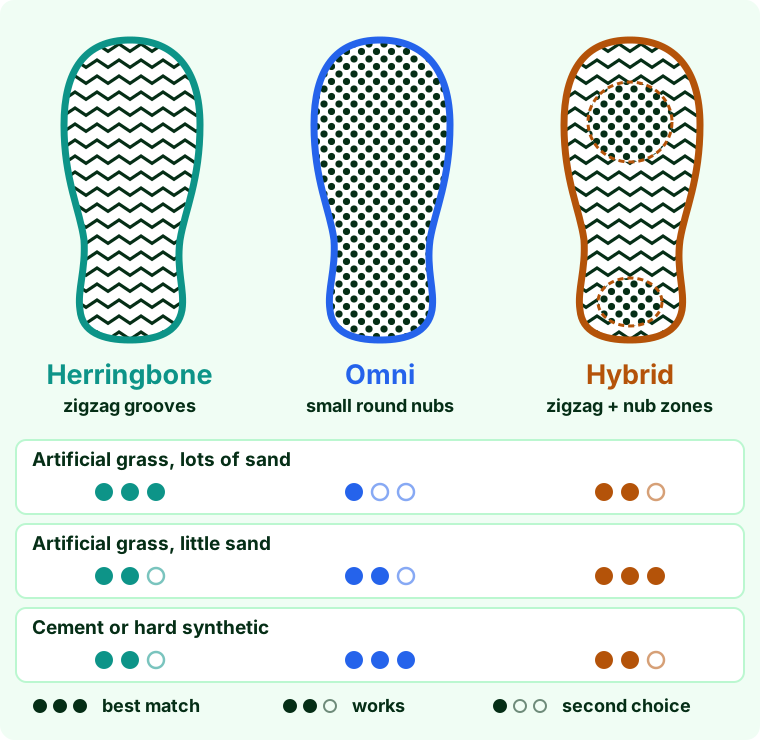
The FIP rules allow three kinds of court floor: cement, synthetic material or artificial grass, provided the ball bounces regularly (FIP Rules, The Court › Ground surface, point 1). Most club courts are artificial grass with sand worked into the pile, but the amount of sand varies a lot from court to court, and indoor clubs sometimes use harder synthetic floors. That is why the outsole pattern matters more than the brand.
| Outsole pattern | What it looks like | Best on | Trade-off |
|---|---|---|---|
| Herringbone (clay-type) | Zigzag grooves across the sole | Artificial grass with plenty of sand | Less suited to very hard, smooth floors |
| Omni | Many small round nubs | Cement, hard synthetic, artificial grass with little sand | Can feel loose on a thick layer of sand |
| Hybrid | Zigzag grooves with nub or pivot zones | Mixed courts; worn or low-sand grass | A compromise, not the specialist at either extreme |
This is a rule of thumb, not a law. A new court with fresh sand plays very differently from a worn indoor court. If you mostly play at one club, look at the floor and choose for that. If you play wherever you can get a court, a hybrid sole is the safest single pair.
Step 2: pick by what you need
| You want… | Look for | Shortlist |
|---|---|---|
| A sole that lasts (you play a lot) | Hard-wearing rubber compound, toe reinforcement | Bullpadel Hack Vibram 26V |
| Stability and lateral support | Reinforced upper, stability chassis, wide sole contact | NOX AT10 LUX, Wilson Rush Pro 5 Padel |
| A lighter, more flexible shoe | Unreinforced mesh upper | NOX ML10 HEXA |
| Heel cushioning | Cushioning insert under the heel, higher drop | Babolat Movea 2, adidas Crazyquick BOOST Padel |
| Easy pivoting | Pivot or rotation zones in the forefoot | Wilson Bela Tour, adidas Crazyquick BOOST Padel |
| More room (average to slightly wide feet) | A maker-stated medium or roomy fit | HEAD Motion Pro 1.5 Padel |
Fit beats every feature: a shoe that slips at the heel or crushes your toes is the wrong shoe, whatever its outsole. How to judge fit, cushioning and when to replace a pair is in the buying guide.
The shortlist: 8 padel shoes with verified specs
| Shoe | Best for | Outsole (as the maker describes it) | Key build details | Weight |
|---|---|---|---|---|
| Bullpadel Hack Vibram 26V | Heavy use | Vibram, hybrid design | Injected rubber toe cap, double heel stabiliser, light mesh upper | Not listed |
| NOX AT10 LUX (2026) | Stability | Herringbone with small lugs | Higher drop (AGG), polymer-reinforced Airmesh, sock collar, OrthoLite insole | Not listed |
| NOX ML10 HEXA (2026) | Light, flexible feel | Herringbone with small lugs | Unreinforced mesh upper, TPU heel, same midsole system as the AT10 LUX | Not listed |
| Wilson Rush Pro 5 Padel | Quick cuts, lateral control | Duralast high-abrasion rubber (pattern not stated) | TPU Stability Chassis, EndoFit midfoot, TPU Speed Plate, dual-density midsole | Not listed |
| Babolat Movea 2 | Heel cushioning | Michelin padel sole, studs for sand and artificial turf | KPRS-X heel insert, Strap-Lock, 10 mm drop, standard fit | Not listed |
| Wilson Bela Tour | Pivoting | “Vortex” rotation zones in forefoot and heel | 4D Support Chassis, Fused 8 Foam EVA midsole, traditional fit | Not listed |
| adidas Crazyquick BOOST Padel | Cushioning | Adiwear, multi-directional with forefoot pivot point | BOOST midsole, Slingframe, Adituff toe, regular fit | Not listed |
| HEAD Motion Pro 1.5 Padel | Average to slightly wide feet | Motion Tread, for artificial grass or synthetic turf | Medium fit with room in toe box and midfoot, softer upper | Not listed |
None of the eight makers publishes a shoe weight on these product pages, so we don’t give one.
Heavy use: Bullpadel Hack Vibram 26V
Bullpadel’s shoe for players who “demand the most from their footwear and use it intensively”, worn by Paquito Navarro. The outsole is a high-durability Vibram compound in a hybrid design, with an injected-rubber toe cap and a double stabiliser at the heel. The upper is a light, breathable technical mesh. Bullpadel doesn’t state a sole pattern, surface, weight or drop. Manufacturer specs (Spanish).
Fits: players on court several times a week who wear through soles and toe caps.
Check availability at Padel Market →
Stability: NOX AT10 LUX (2026)
Agustín Tapia’s line. NOX describes a herringbone outsole with small lugs for grip “on any court surface”, a wider sole contact area for lateral stability, and a higher heel-to-toe drop (its AGG technology) meant to ease the ready position and reduce calf load. Cushioning comes from an EVA “popcorn” layer and an injected phylon midsole, with an OrthoLite insole. The upper is polymer-reinforced Airmesh with an elastic sock collar. NOX says the model is certified by the INESCOP footwear technology centre. Manufacturer specs.
Fits: players who want a locked-in, supportive shoe for lots of side-to-side movement.
Check availability at Padel Market →
Light and flexible: NOX ML10 HEXA (2026)
Miguel Lamperti’s line shares the AT10 LUX’s outsole (herringbone with small lugs), midsole and higher drop. The difference is the upper: an unreinforced mesh that NOX says prioritises flexibility, with polymer reinforcement only on the toe cap and eyelets and a TPU heel. The colourway we checked has a gum-rubber outsole. Manufacturer specs.
Fits: players who find stiffer shoes heavy and prefer a softer, more flexible upper.
Check availability at Padel Market →
Quick cuts: Wilson Rush Pro 5 Padel
Wilson’s Rush tennis shoe adapted for padel. A TPU Stability Chassis and EndoFit midfoot support hold the foot for lateral control. A TPU Speed Plate and a dual-density midsole aim at quick transitions. The outsole is Wilson’s Duralast high-abrasion rubber; Wilson doesn’t describe the tread pattern, so check the sole in the shop against the court you play on. Manufacturer specs.
Fits: fast, aggressive movers who want a firm, supportive platform.
Check availability at Padel Market →
Heel cushioning: Babolat Movea 2
The Movea 2 uses a sole developed with Michelin, which Babolat says has studs “suitable for sand and artificial turf”. A KPRS-X EVA insert under the heel absorbs impact, and a Strap-Lock band wraps the foot for support. Babolat lists a 10 mm drop and a standard fit. Manufacturer specs.
Fits: players who land hard on their heels or want a softer feel on long matches.
Pivoting: Wilson Bela Tour
Designed with Fernando Belasteguin. The outsole has “vortex” designs in the forefoot and heel to help rotation and pivoting in every direction. A one-piece 4D Support Chassis limits supination. The midsole is Fused 8 Foam EVA and the fit is “traditional”. This is an older model that Wilson still lists, at a reduced price, so stock and colours may be limited. Manufacturer specs.
Fits: net players who pivot a lot and want a traditional, stable fit.
Cushioning: adidas Crazyquick BOOST Padel
The top model of adidas’s first dedicated padel shoe range, on sale since December 2024. It has a BOOST midsole for energy return, an Adiwear outsole that adidas describes as multi-directional with a forefoot pivot point, Slingframe construction for stability and an Adituff toe. adidas lists a regular, true-to-size fit. Manufacturer specs.
Fits: players who want a cushioned midsole with a dedicated padel sole.
Check availability at Padel Market →
Roomier fit: HEAD Motion Pro 1.5 Padel
HEAD lists a medium fit with “ample room in the toe box and midfoot for average to slightly wider feet”, a softer, more flexible upper than before, and a Motion Tread outsole designed for artificial grass or synthetic turf. It is aimed at all-court players. It was out of stock on HEAD’s US site when we checked. Manufacturer specs.
Fits: players who find narrow padel shoes pinch across the forefoot.
Women’s versions exist for several of these lines. For women-specific lasts and sizing see best women’s padel shoes.
What the FIP rules say about padel shoes
The FIP rulebook has no technical footwear specification: no sole type, colour or weight. The only footwear rule is in the Attire section of the etiquette and conduct norms:
“Players will wear suitable sports clothing and footwear. Swim wear is not allowed.” — FIP Rules of Padel (2026), Attire
If a player doesn’t comply, the umpire gives a fault, and a player who doesn’t put it right is disqualified. The same section says players may use the footwear, clothing and rackets they want, provided they are regulation. So brand is free, and so is the sole pattern.
Non-marking soles are often described as an FIP requirement. They aren’t in the 2026 rulebook. Clubs can set their own footwear rules to protect their courts, so check with your venue. For what the FIP says about rackets, see best padel rackets 2026.
What happens if…?
…I turn up to a tournament in running shoes or flip-flops? The umpire decides whether your footwear is “suitable sports footwear”. If it isn’t, you get a fault and must change; if you don’t, you are disqualified (Attire). Swimwear is banned outright.
…my sole comes away in the middle of a match? You get extra time, “within reason”, to replace your shoes (Rule 2.8). That is on top of the normal 20 seconds between points and 90 seconds at a change of ends.
…I slip on loose sand and fall? If the fall affects your ability to carry on straight away, the umpire can give you up to 5 minutes to recover (Rule 2.17). The rally is not replayed just because you slipped: if the ball bounces twice before you return it, the point is lost (Rule 13.1c).
2026 rule change: Rule 2.17 is new in the 2026 edition. After an unusual incident such as an involuntary fall or being hit by the ball, the umpire can allow up to 5 minutes for the player to recover. See padel rules 2026 for all the changes.
…my foot slides under the net into my opponents’ half while I chase a drop shot? You lose the point. A player, their racket or anything they wear or carry must not touch any part of the opponents’ court while the ball is in play (Rule 13.1a).
…my opponents’ shot hits my shoe? You lose the point. The ball hitting any part of a player or their equipment other than the racket, after the opponents have played it, costs the point (Rule 13.1k).
Related equipment guides
- What shoes to wear for padel
- Padel shoes buying guide
- Best women’s padel shoes 2026
- Best padel rackets 2026
- Padel court construction and surfaces
- NOX padel guide
- Wilson padel guide
- Bullpadel guide
Affiliate disclosure: we earn a small commission at no extra cost to you if you buy through our links.
Was this page helpful?
Thanks for your feedback!
Free beginner PDF + rule updates
Get the 4-page beginner guide to the 2026 padel rules, then one short email a week for four weeks and a monthly newsletter.
More in Padel Equipment
Adidas Padel Rackets & Shoes 2026 — Complete Brand Guide
Adidas padel in 2026: the Metalbone racket line, Barricade and Adizero shoes, brand history, and which Adidas gear suits your level.
Babolat Padel Rackets 2026 — Best Models & Technology Guide
The Babolat padel racket range for 2026: compare the Viper, Counter and Technical lines, with prices, player endorsements and our picks.
Padel Ball Specifications: Why Balls Matter
FIP padel ball specifications control bounce, durability and consistency. How balls differ from tennis, why altitude matters, why approved balls are used.

Best Padel Bags 2026: How to Choose + 5 Verified Picks
How to choose a padel bag: backpack or racket bag, racket capacity, thermal and shoe pockets. Plus 5 current bags with specs checked on makers' sites.