 PADEL RULES
Padel Court Side Walls: FIP Layouts, Mesh & Rules (2026)
10 min read
Quick Answer
The FIP allows two side-wall layouts. Both are 4 m high over the 2 m nearest each back wall (3 m wall + 1 m mesh) and 3 m high everywhere else. Variant 1 steps down to a 2 m wall with 1 m of mesh for the next 2 m; Variant 2 keeps a 3 m wall for the first 4 m. The central 12 m is metal mesh.
Settling an argument? Send this rule to your padel group.
The FIP Rules of Padel (2026) allow two side-wall layouts. In both, the side is 4 m high over the 2 m nearest each back wall (3 m of wall plus 1 m of metal mesh) and 3 m high along the rest of the side, with 12 m of mesh in the middle. The only difference is the panel between 2 and 4 m from each back wall: a 2 m wall with 1 m of mesh on top (Variant 1, stepped) or a 3 m wall with nothing above it (Variant 2, crystal).
This page covers the side enclosure only. For the full court (20 × 10 m, net, service lines, clear height) see padel court dimensions; for the back wall see glass wall height; for building a court see padel court construction.
The two legal layouts, to scale
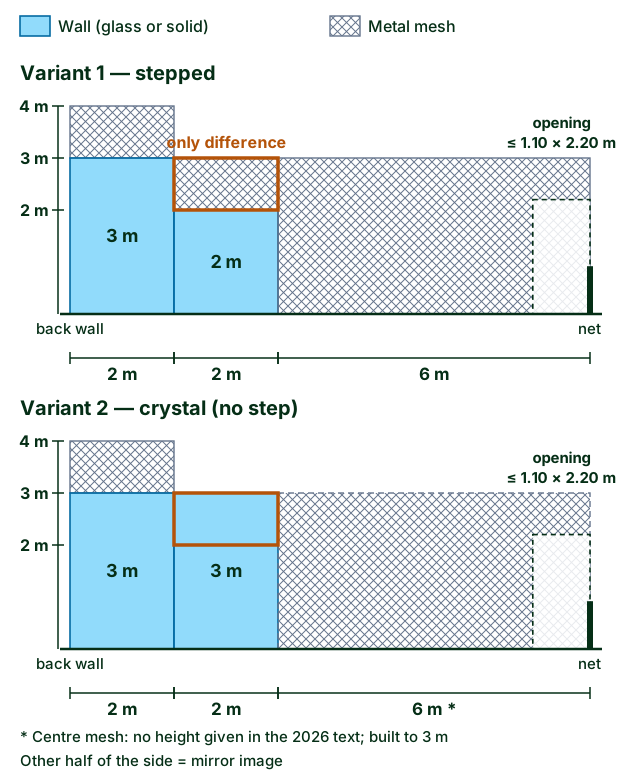
The rulebook describes each side from the back wall towards the centre, and the two halves mirror each other at the net. All measurements are taken from the inside of the court (FIP, The Court › Sides).
| Distance from each back wall | Variant 1 (stepped) | Variant 2 (crystal, no step) |
|---|---|---|
| 0–2 m | 3 m wall + 1 m mesh = 4 m | 3 m wall + 1 m mesh = 4 m |
| 2–4 m | 2 m wall + 1 m mesh = 3 m | 3 m wall, no mesh = 3 m |
| Central 12 m (4–16 m) | Mesh, 3 m | Mesh (height not stated, see below) |
| Total length of each side | 20 m | 20 m |
So on every legal court, the outline is the same: a 4 m “shoulder” in each corner and 3 m everywhere else. What changes is what the ball meets between 2 and 3 m high, 2–4 m from each back wall: mesh in Variant 1, wall in Variant 2. There are four such panels per court (one in each corner zone).
Variant 2’s central mesh. The 2026 text only says the mesh reaches 4 m “at the extreme two (2) meters”. It gives no height for the 12 m of central mesh. Courts are normally built with 3 m there, the same as Variant 1, and the 2021 edition (which listed this layout next to a twin with 4 m mesh along the whole side) treats the two as different, which only makes sense if the centre stays below 4 m.
Typo in the English rulebook: “6 m” should be 16 m
The English 2026 edition says the Variant 1 mesh rises “up to 3 meters in the center 6 meters and up to 4 meters at both ends”. That cannot be right: 2 + 2 + 6 + 2 + 2 = 14 m, not 20 m. The Spanish original reads:
“hasta 3 metros de altura en los 16 metros centrales y hasta 4 metros de altura en los dos metros extremos” (FIP Reglas del Pádel 2026, Laterales)
That is “up to 3 m high over the central 16 m and up to 4 m over the 2 m at each end”. 2 + 16 + 2 = 20 m. The 16 m includes the two 2 m steps (wall to 2 m, mesh from 2 to 3 m) and the 12 m with no wall at all. The 2021 Spanish edition has the same “16 metros centrales” wording.
What changed in 2026
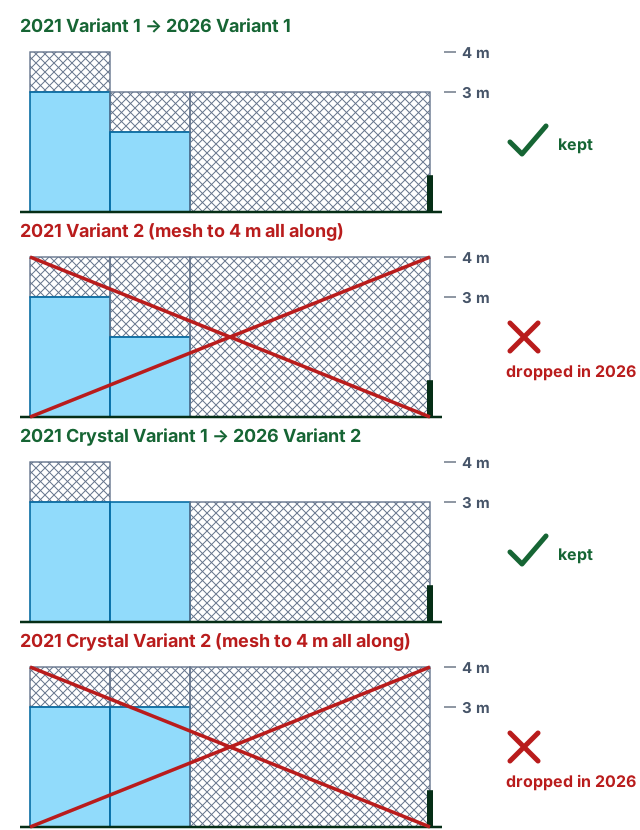
2026 rule change: The 2021 rulebook allowed four side layouts: the stepped wall and the 4 m crystal wall, each in a version with 4 m mesh only at the ends and a version with mesh up to 4 m along the whole side. The 2026 edition keeps only the two versions with 4 m at the ends. It also lowers the recommended mesh wire from 1.6–3 mm to 2–3 mm (4 mm maximum unchanged), replaces the named EU glass standard (EN 12150-1) with a reference to FIP’s Courts Homologation Annex, and drops the 2021 note recommending a white plate above the legal mesh height. The FIP does not explain the changes.
The maximum access openings also grew in 2026 (from 2.00 to 2.20 m wide for one per side, from 1.00 to 1.10 m for two per side). See the full list of 2026 rule changes.
Wall and mesh requirements
Walls (FIP, The Court › Sides) may be glass, brick or any other material, transparent or opaque, as long as the surface is “hard and completely smooth” and gives a uniform bounce. Opaque walls must be one uniform colour, clearly different from the floor. Each wall may carry at most one logo, which must not disturb the players’ view. Glass must meet the tempered-glass standards in the FIP Courts Homologation Annex.
Mesh must meet these specifications:
| Requirement | FIP 2026 |
|---|---|
| Opening | Diamond (rhomboid) welded mesh; diagonal 5–7.08 cm |
| Wire | 2–3 mm recommended, 4 mm maximum |
| Tension | Tight enough “to bounce on it” |
| Position | Always in line with the inner face of the wall |
| Welded mesh | Every weld point protected on both sides; if not interlaced, square (not diamond) openings with horizontal wires inside and vertical wires outside |
| Twisted mesh | Tensioners on the outside of the court, protected; no sharp joins |
| Surface | Flat and vertical, and kept that way |
| Top of the frame | Free of cables, electrical boxes, lights or anything not part of the structure |
The FIP describes the mesh as the part of the enclosure “where the bounce is not uniform”. It is not dead: the ball bounces off it, just less predictably than off glass.
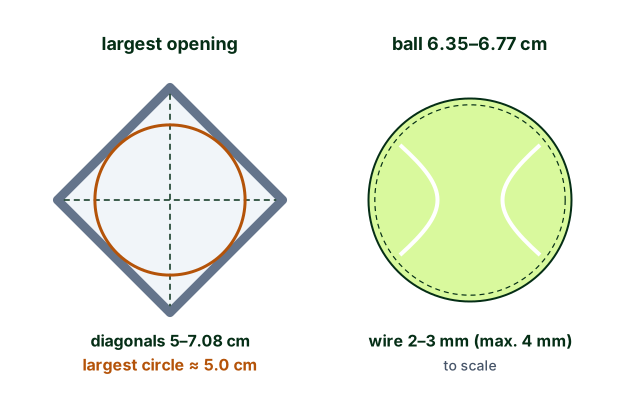
Why a ball should not pass through intact mesh. The biggest circle that fits in a diamond with both diagonals at the 7.08 cm maximum is about 5.0 cm across (7.08 ÷ √2). A padel ball measures 6.35–6.77 cm (FIP, The Ball). So when a ball goes through the side, it went through a gap, a tear or a loose join, which is exactly the case Rule 15.1a covers. The Spanish text says “hueco o desperfecto” (gap or defect).
Access openings in the side
Openings go in one or both sides, one or two per side, with or without doors, and must be symmetrical about the centre of the side (FIP, The Court › Access).
| Openings per side | Minimum (width × height) | Maximum |
|---|---|---|
| One | 1.05 × 2.00 m | 2.20 × 2.20 m |
| Two (each) | 0.72 × 2.00 m | 1.10 × 2.20 m |
- Door handles must be on the outside and must not stick into the court.
- Without a door, a bar fixed to the floor across the opening counts as part of the fence frame. If there is no bar, the vertical line of the frame marks the edge of the court, painted line or not.
- For out-of-court play, each side needs two openings and a clear area beside them. The sides and top of each opening, and the net posts, must be padded with at least 2 cm of cushioning (The Court › Safety area).
Gate design and the safety area are covered in court access.
Side-wall rules: what happens if…?
The general wall rules (floor first, then any wall; your own glass yes, your own mesh no) are explained in padel wall rules. These are the cases that depend on how the side is built.
1. You play the ball into your own side, 3 m from your back wall and about 2.5 m high, and it floats over the net. On a Variant 2 court that spot is glass, so the shot is good if it lands in the opponents’ court (Rule 14.1b). On a Variant 1 court the same spot is the mesh above the 2 m step, and touching your own mesh loses the point (Rule 13.1l). Know which variant you are on.
2. Your lob bounces and wedges in the opponents’ side mesh, or goes through a hole in it. Your point:
“If after bouncing in the opponent’s court the ball goes out of court through a hole in the metallic fence or gets stuck in said hole.” (Rule 15.1a)
If the ball went into their mesh without bouncing first, you lose the point (Rule 13.1g).
3. The ball clips the metal post or frame where glass meets mesh. Rule 12.4: “The mesh and frame in its entirety will be considered as part of the fence.” On your side it counts as your mesh (point lost, 13.1l). On the opponents’ side, after the bounce, it is in play like the rest of the mesh (14.1c).
4. After bouncing, the ball comes to rest on the flat top of a side wall. This happens on brick or concrete walls with a flat top. The hitter wins the point (Rule 15.1b).
5. After bouncing, the ball leaves over the 3 m side or through the opening. Without authorised out-of-court play, the receivers lose the point (Rule 13.1d). With it, they may run out and play the ball before it bounces again or touches anything outside the court (Rule 13.1e). When out-of-court play is authorised, the vertical post between two doors is a neutral zone above 0.92 m: any player may touch or hold it (Rule 13.1b). Full procedure: out-of-court play.
6. Your club’s side mesh goes higher than the layout allows. The 2021 rulebook recommended a white plate at 3 or 4 m on such courts, with a ball hitting it counted as out. The 2026 edition removed that note and says nothing about it. Agree a local rule before you play, or follow the tournament’s rules.
Related court guides
- Padel court dimensions: every measurement of the court
- Glass wall height: the 4 m back wall
- Padel court construction: building a court
- Court access: openings, doors and the safety area
- Padel wall rules: how glass and mesh are played
Was this page helpful?
Thanks for your feedback!
Free beginner PDF + rule updates
Get the 4-page beginner guide to the 2026 padel rules, then one short email a week for four weeks and a monthly newsletter.
More in Court Dimensions
Padel Court Dimensions: Official FIP Measurements (2026)
Official padel court dimensions from the 2026 FIP rules: 20 × 10 m, service lines 6.95 m from the net, 88–92 cm net, wall heights and clear height.
Padel Wall Height: Back Glass, Mesh & Ceiling (FIP 2026)
How high are padel walls? Back wall 4 m (3 m glass + 1 m mesh), side walls 3–4 m, 6 m clear height, and what happens when the ball goes over (FIP 2026).
Padel Net Specifications: How Net Height Affects Play
FIP net height (88–92 cm) is lower than in tennis to encourage net play. How height affects strategy, why the slope matters, and what a compliant net is.
Padel Court Construction: How to Build One (2026)
How to build a padel court: the FIP 2026 requirements, land needed, base and drainage, glass and mesh, lighting, planning, and sourced UK cost figures.