 PADEL RULES
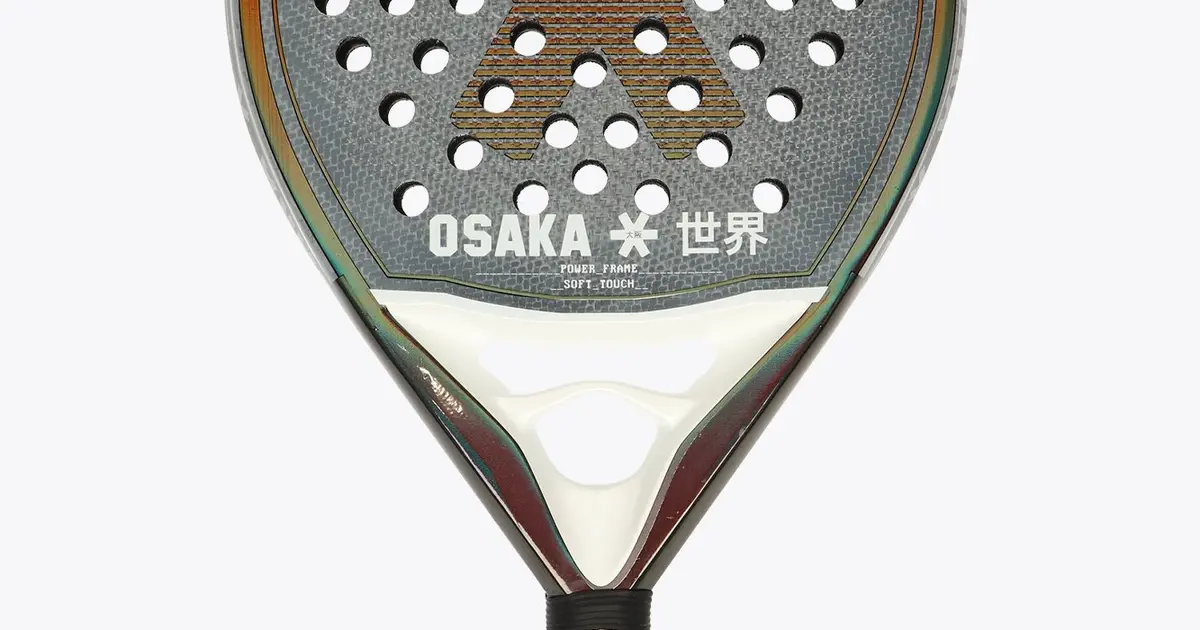
Best Padel Racket for Beginners (2026): What to Buy
10 min read
Quick Answer
Buy a round racket with a low balance, a soft EVA or foam core and a fibreglass face, at a weight you can swing comfortably for a whole match. Round shape and low balance put a large sweet spot in the middle of the face, so off-centre hits still go over the net. An entry-level or mid-range racket is enough; pro-level carbon models make learning harder, not easier.
Settling an argument? Send this rule to your padel group.
The best padel racket for a beginner is a round racket with a low balance, a soft core and a fibreglass face, at a weight you can swing comfortably for a whole match. That combination puts a large sweet spot in the middle of the face, so the off-centre hits every new player makes still go back over the net. You don’t need an expensive racket: an entry-level or mid-range model is the right tool while you learn.
This page explains why each of those specs matters, what you get at each budget level, when to upgrade, and gives four current models with the specs their makers publish. For a general racket shortlist and the full FIP racket rules, see best padel rackets 2026. For grip, materials and buying second-hand in depth, see the padel racket buying guide.
Not sure which racket fits you? Try our free padel racket finder: five questions, up to three verified picks.
The beginner racket at a glance
| Spec | What to buy | Why it helps a beginner |
|---|---|---|
| Shape | Round | Largest, most central sweet spot |
| Balance | Low (head-light) | Quick at the net, easier on wrist and elbow |
| Core | Soft EVA or foam | Comfortable, helps the ball off the face on slow swings |
| Face | Fibreglass | Flexible and forgiving; carbon is stiffer |
| Weight | Whatever you can swing freely for 90 minutes | A tired arm ruins technique |
| Level label | “Beginner”, “initiation” or similar on the maker’s page | Makers already sort their range by level |
Why round and low balance: the beginner sweet spot
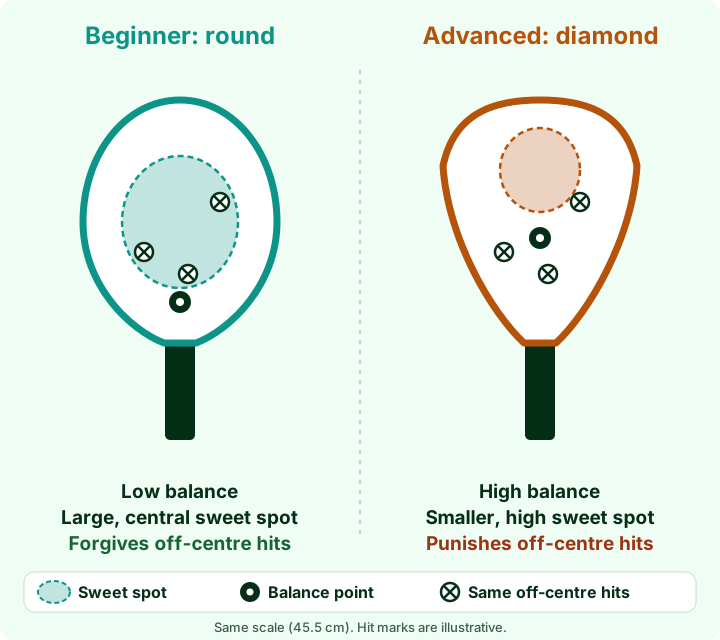
When you start, you won’t hit the middle of the face every time. A round head keeps the sweet spot big and centred, so a ball that lands a few centimetres off still comes off cleanly. A diamond moves the sweet spot up towards the tip. On a well-timed smash that gives extra power; on a mis-hit near the throat, the ball dies in the net.
Balance is where the weight sits along the racket. Round rackets usually have a low balance, closer to the hand. That makes the racket feel lighter than its weight, quicker to bring up for a volley, and kinder to the wrist and elbow. A high-balance diamond carries more weight in the head, which helps experienced players drive overheads but makes every swing harder work. If you have had elbow pain, low balance and a soft core matter even more.
Shape and balance go together, so a round racket labelled “low balance” covers both at once. More detail in padel racket shapes explained and diamond vs round.
Core and face: soft and fibreglass
- Core. Most rackets use EVA rubber sold as soft, medium or hard; some use foam. A soft core feels comfortable and gives the ball more help when you don’t swing fast, which is most of the time as a beginner. Brands use their own names (HR3, SoftEva, Black EVA), so look for the word “soft” or the maker’s own hardness scale rather than the brand name.
- Face. Fibreglass flexes more than carbon and is the usual face on beginner rackets. Carbon is stiffer and more precise for fast swings, but it gives less help on slow ones. See carbon vs fibreglass.
- Frame. Many beginner rackets now have a carbon or carbon-reinforced frame with a fibreglass face. That’s fine: the face and core set how the racket feels on impact.
Weight: there is no “right” number
The FIP rules set no weight limit for rackets. The adult rackets in our shortlist are listed at roughly 340–370 g, and junior models go lighter. Choose the weight you can swing freely for a full match. If you are stuck between two weights, take the lighter one: the rules allow you to add weight later to distribute it (The Padel Racket, point 8), but you can’t take it off.
Budget tiers: what extra money buys
We don’t list prices: they change by shop, country and week. What changes between tiers is the materials, and that is what matters.
| Tier | Typical build | Good for a beginner? |
|---|---|---|
| Entry level | Round, soft EVA, fibreglass face, fibreglass or carbon-reinforced frame | Yes, the right tool for your first months |
| Mid-range | Round or teardrop, soft–medium EVA, fibreglass or soft carbon face, carbon frame | Yes, and it lasts into your improving phase |
| Top end / pro models | Teardrop or diamond, harder core, high-K carbon face, often high balance | No: less forgiving and harder on the arm |
Two practical points. First, a pro player’s signature racket is built for their swing speed, not yours. Second, most brands sell an entry and a performance version of the same family. Read the level on the maker’s page instead of guessing from the name.
Is my racket legal? The FIP rules in brief
A racket is legal if it meets the FIP racket limits, so check the maker’s specs rather than assuming. The FIP rules (The Padel Racket section) limit the size, not the weight or shape: at most 45.5 cm long, 26 cm wide and 38 mm thick, with holes of 9–13 mm in the centre of the face. Two points matter in your first games:
“The racket must have a non-elastic cord of a maximum length of 35 cm fixed into the handle which must be put around the wrist as protection against accidents. Its use is obligatory.” — FIP Rules, The Padel Racket, point 9
2026 rule change: Rule 13.1r is new in the 2026 edition. If a player’s safety cord breaks or they drop the racket, their pair “will immediately lose the point in dispute”. Earlier editions made the cord compulsory but set no point penalty. Check the cord on any racket you buy or borrow.
The full table of limits, with a diagram, is in best padel rackets 2026, and what each spec means is in padel racket specifications. The basics of play are in padel rules for beginners, and more on the cord in wrist strap rules.
What happens if…?
…I buy the diamond racket my favourite pro uses? It is legal, but it fights you while you learn. The sweet spot is smaller and higher, the balance is high, and the core is usually harder. You will mis-hit more and tire sooner. Start round and move towards a diamond later, if your game becomes attacking.
…a racket labelled for beginners is a diamond? It can happen: a brand’s entry-level family may include a power version as well as a round control version. If you want the forgiving option, check the shape and balance, not just the level label.
…two “low balance” rackets list different figures? Don’t compare balance numbers across brands. Brands measure and label balance differently: some give centimetres or millimetres, some only a word, and Babolat describes the Counter Vertuo 2.6’s balance as “uniform” rather than low, medium or high. Compare within one brand’s range, or by the shape and the maker’s own label.
…I borrow a club racket and the wrist cord is missing or frayed? The cord is compulsory (The Padel Racket, point 9). If it breaks during a point, or the racket leaves your hand, your pair loses that point (Rule 13.1r). Ask for another racket.
…my racket touches the net while I volley? You lose the point. Players, their rackets and anything they wear or carry must not touch the net or posts while the ball is in play (Rule 13.1a). The rule is the same whatever racket you use. See faults and lets.
Four beginner-friendly rackets (2026)
We picked these as examples of the profile described above, not as a ranking. Specs come from the product pages listed under Sources at the end of this page (last updated 13 November 2026). Where a maker doesn’t publish a figure, we say so. We haven’t lab-tested these rackets and we don’t score them. Some links are affiliate links (see the disclosure at the end).
| Racket | Maker’s level | Shape | Balance | Weight | Core | Face |
|---|---|---|---|---|---|---|
| NOX X-Hero 2026 | Beginner (“Iniciación”) | Round | Not listed | 350–360 g | HR3 White EVA | 3K fibreglass |
| Bullpadel Indiga CTR 25 | Not confirmed (control model) | Round | Low | 360–370 g | SoftEva | Polyglass (fibreglass) |
| Bullpadel Indiga W 26 | Initiation (women’s line) | Round | Low | 350–360 g | SoftEva (in tech list) | Polyglass (in tech list) |
| Babolat Counter Vertuo 2.6 | Not listed | Round | “Uniform” | 350 g ±10 g | Black EVA | Fibreglass |
NOX X-Hero 2026
A round racket aimed at beginner and control players: listed at 350–360 g, with an HR3 White EVA core, 3K fibreglass faces and a carbon frame. NOX doesn’t give a numeric balance. Manufacturer specs.
Check availability at Padel Market →
Bullpadel Indiga CTR 25
Bullpadel’s round, low-balance control model: listed at 360–370 g, with a SoftEva inner core and a Polyglass outer layer. A 2026 edition, the Indiga CTR 26, also exists. The specs here are for the 2025 model, so check the newer edition’s page if that’s the one you find in the shop. Manufacturer specs.
Bullpadel Indiga W 26
The women’s version of the same family: round, low balance, initiation level and a defensive game type. Bullpadel lists SoftEva, Polyglass and Carbon Tube among its technologies without saying which part each one is used in. Its Spanish product page lists the weight as 350–360 g. Manufacturer specs · Spanish page with weight. For more options, see best padel rackets for women beginners.
Check availability at Padel Market →
Babolat Counter Vertuo 2.6
Round, 350 g ±10 g, 38 mm thick, with a Black EVA core, fibreglass face and carbon frame. Babolat describes the balance as “uniform” and aims it at counter-attacking players; it doesn’t give a formal level. The fibreglass face and round shape fit the beginner profile above. Manufacturer specs (Spanish).
Buying for a child? Junior rackets are lighter: see best padel rackets for kids.
When to upgrade
Keep your beginner racket until most of these are true:
- You hit the centre of the face most of the time, including on the backhand.
- You play regularly and the racket now feels slow or “dead” on volleys and overheads.
- You know whether you prefer to defend and place the ball, or to attack at the net.
Then move one step: the same round shape with a carbon face, or a teardrop with medium balance if you attack more. Our best intermediate padel rackets page covers that step.
Replace the racket sooner if the frame or face cracks, or the faces come away from the frame. Replace the cord if it is worn, since a broken cord now costs the point. A worn grip is not a reason to buy a new racket: a new overgrip fixes it.
Related guides
- Best padel rackets 2026
- Padel racket buying guide
- Padel racket specifications
- Best intermediate padel rackets
- Best padel rackets for women beginners
- Padel racket shapes explained
- Your first padel lesson
Affiliate disclosure: we earn a small commission at no extra cost to you if you buy through our links.
Was this page helpful?
Thanks for your feedback!
Free beginner PDF + rule updates
Get the 4-page beginner guide to the 2026 padel rules, then one short email a week for four weeks and a monthly newsletter.
More in Padel Equipment
Adidas Padel Rackets & Shoes 2026 — Complete Brand Guide
Adidas padel in 2026: the Metalbone racket line, Barricade and Adizero shoes, brand history, and which Adidas gear suits your level.
Babolat Padel Rackets 2026 — Best Models & Technology Guide
The Babolat padel racket range for 2026: compare the Viper, Counter and Technical lines, with prices, player endorsements and our picks.
Padel Ball Specifications: Why Balls Matter
FIP padel ball specifications control bounce, durability and consistency. How balls differ from tennis, why altitude matters, why approved balls are used.

Best Padel Bags 2026: How to Choose + 5 Verified Picks
How to choose a padel bag: backpack or racket bag, racket capacity, thermal and shoe pockets. Plus 5 current bags with specs checked on makers' sites.