 PADEL RULES
Best Padel Racket for Intermediate Players (2026)
11 min read
Quick Answer
Move one step up from your beginner racket, not three. If you win points by defending and placing the ball, keep a round shape and move to a carbon or carbon-fibreglass face. If you split defence and attack, a teardrop with medium balance is the usual step. Keep a soft-to-medium core and a weight you can swing for a whole match. Diamonds with a high balance are for players whose overheads are already consistent.
Settling an argument? Send this rule to your padel group.
The best padel racket for an intermediate player is one step up from a beginner racket, chosen for how you win points. If you defend and place the ball, keep a round shape and move to a carbon or carbon-fibreglass face. If you mix defence and attack, a teardrop with medium balance is the usual step. A high-balance diamond only makes sense once your overheads are consistent.
This page explains what changes from a beginner racket, how to choose shape, balance, core and weight, and how to measure balance yourself. It ends with five 2026 rackets whose makers list them for intermediate players, with specs checked on the makers’ own websites. Still learning the basics? See best padel rackets for beginners. For an all-levels overview and the full FIP racket table, see best padel rackets 2026.
Beginner vs intermediate racket: what changes
| Spec | Beginner racket | Intermediate racket | Why it changes |
|---|---|---|---|
| Shape | Round | Round (control) or teardrop (all-round) | You hit the centre more often, so you can trade some forgiveness for a higher hitting zone |
| Balance | Low | Low to medium | A little more weight in the head adds pace to volleys and overheads |
| Core | Soft | Soft to medium | A firmer core feels more direct when you swing faster |
| Face | Fibreglass | Carbon-fibreglass mix or carbon | Stiffer and more precise; less help on slow swings |
| Surface | Usually smooth | Often rough or textured | Helps you grip the ball for spin, and it is legal |
| Weight | What you can swing freely | Same rule; listed 355–375 g in this guide | No FIP limit; balance changes how heavy it feels |
Choose your upgrade path
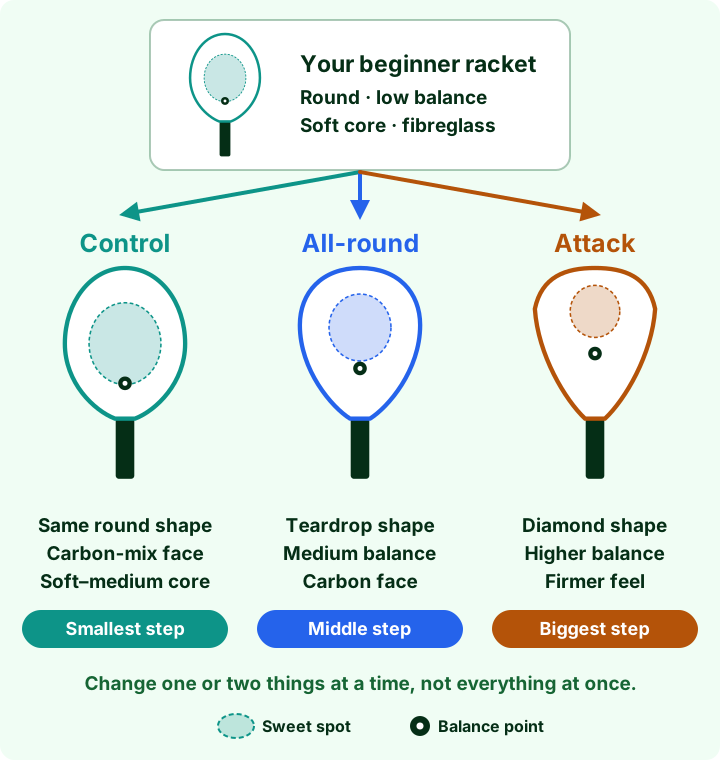
The mistake to avoid is changing everything at once. A soft, round, fibreglass racket and a hard, high-balance, carbon diamond feel like different sports. Change one or two things and keep the rest.
Step 1: How do you win points?
- Control: you defend from the back glass, lob and wait for the error. Stay round. Upgrade the face (carbon-fibreglass mix or soft carbon) and, if you like, the core from soft to medium. This is the smallest step. Example: Babolat’s round range moves from the beginner Counter Vertuo to the intermediate Counter Veron with the same shape and core and a Carbon Flex face.
- All-round: you defend, then move up and volley when you can. A teardrop with medium balance puts the sweet spot a little higher without giving up much control. This is the middle step. See padel racket shapes.
- Attack: you finish points at the net with smashes and bandejas. A diamond puts the sweet spot and the weight high in the head. It rewards clean contact and punishes the rest. If you go this way, look for a model its maker lists for intermediate or intermediate–advanced players rather than a pro’s signature diamond. Compare diamond vs round.
Step 2: Balance
Balance is where the weight sits along the racket. A low balance feels light and quick at the net; a high balance carries more momentum into overheads but reacts more slowly and loads the wrist and elbow. Shape usually predicts balance, but not always: Bullpadel lists the round Ionic Control 26 with a high balance. Read the balance on the spec sheet, not just the shape.
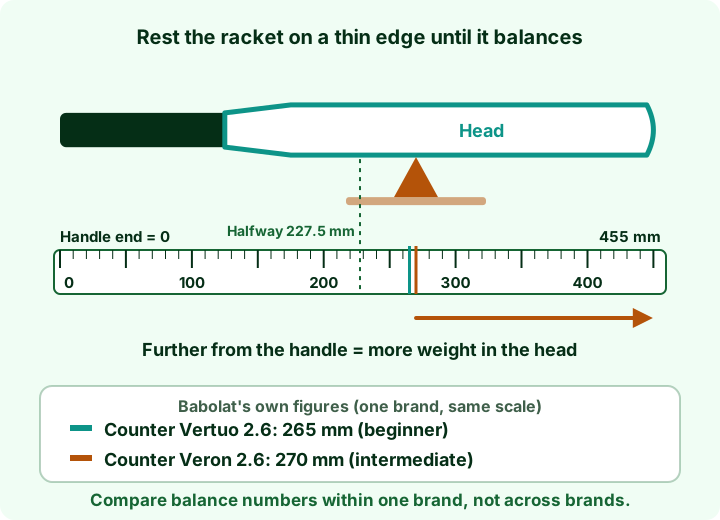
You can check balance yourself: rest the racket on a thin edge until it balances and measure from the end of the handle. A point further from the handle means more weight in the head. Brands measure and label balance differently, so only compare numbers within one brand. Babolat’s step from Vertuo (265 mm) to Veron (270 mm) shows how small a sensible step is.
Step 3: Core and face
- Core. EVA rubber is sold as soft, medium or hard, under brand names such as HR3, EV50, MultiEva or Black EVA. A firmer core feels more direct on fast swings and gives less help on slow ones. Compare the hardness each brand gives, not the marketing name.
- Face. Many intermediate rackets mix carbon and fibreglass: Babolat calls it Carbon Flex, NOX uses aluminised fibreglass (ALUTEX). Full carbon is stiffer still. The “K” figure (3K, 12K, 15K) describes the carbon weave, not quality. More in carbon vs fibreglass.
- Surface. Rough and 3D-textured faces help you grip the ball for spin. They are legal (see the rules below).
Step 4: Weight
The FIP rules set no weight limit. The five intermediate rackets below are listed at 355–375 g. Choose a weight you can swing freely for a whole match. A heavier, head-heavy racket tires your arm sooner, and a tired arm ruins the technique you upgraded for. If you have had elbow pain, stay at the lower end of balance and core hardness.
Ready to upgrade?
You are probably ready when you hit the centre of the face most of the time, including on the backhand, your beginner racket feels slow on volleys and overheads, and you know whether you prefer to defend or attack. If you are not there yet, a new overgrip is cheaper than a new racket.
What the FIP rules say about your racket
Any racket from a mainstream brand is legal. The rules (The Padel Racket section of the FIP Rules of Padel) limit size, not weight or shape:
| What | FIP rule | Point |
|---|---|---|
| Total length | Max 45.5 cm | 3, 4 |
| Head | Max 26 cm wide, 38 mm thick (2.5% tolerance on thickness) | 3, 5 |
| Holes | 9–13 mm in the centre; up to 20 mm within 4 cm of the edge | 6 |
| Faces | Flat; smooth or rough | 7 |
| Add-ons | Only to limit wear or vibration or to distribute weight; reasonable size; nothing reflective or noisy | 8 |
| Wrist cord | Non-elastic, max 35 cm, worn around the wrist, compulsory | 9 |
“The racket must have a non-elastic cord of a maximum length of 35 cm fixed into the handle which must be put around the wrist as protection against accidents. Its use is obligatory.” — FIP Rules, The Padel Racket, point 9
2026 rule change: Rule 13.1r is new in the 2026 edition. If a player’s safety cord breaks or they drop their racket, their pair “will immediately lose the point in dispute”. Earlier editions made the cord compulsory but set no point penalty.
More on the cord in wrist strap rules.
What happens if…?
…my new racket’s strap can be removed? Some can: Babolat says its strap system lets you resize the strap or remove it completely, and NOX’s Smartstrap is designed to be swapped for washing or replacement. That’s for maintenance. In play the cord is compulsory (The Padel Racket, point 9), and if it breaks or the racket leaves your hand, your pair loses the point (Rule 13.1r).
…I add lead tape or counterweights to make it more head-heavy? Allowed, as long as it only distributes weight (or limits wear or vibration), is reasonable in size and position, and is not reflective or noisy (point 8). Add a few grams at a time: it raises the balance as well as the weight.
…my racket has a rough or 3D-textured face? Legal. Both faces must be flat but “may be smooth or rough” (point 7). Rough faces are common on intermediate models: all three NOX Future rackets below have one.
…the model name says “Advanced” but the spec sheet says intermediate? Trust the spec sheet. NOX’s Equation Soft Advanced 2027 is a round, medium-balance, 355–365 g racket with a soft HR3 core and 3K fibreglass faces, and NOX’s own level field says “Intermediate”. The reverse also happens: signature models with soft, round shapes can be listed as advanced.
…I buy the diamond my favourite pro uses? It’s legal, but it is built for their swing speed. You’ll get a smaller, higher sweet spot and a heavier-feeling head. If you want to attack, try a diamond its maker lists for intermediate–advanced players first, such as the NOX Future Attack 15K below.
Five intermediate rackets with verified specs (2026)
We picked these as examples of each upgrade path, not as a ranking. Each one is listed by its maker for intermediate (or intermediate–advanced, or “medium”) players. Every spec comes from the manufacturer’s own product page, checked on 5 November 2026. Where a maker doesn’t publish a figure, we say so. We haven’t lab-tested these rackets, we don’t score them and we don’t list prices. Some links are affiliate links (see the disclosure at the end).
| Racket | Path | Maker’s level | Shape | Balance | Weight | Core | Face |
|---|---|---|---|---|---|---|---|
| NOX Future Control by Miguel Lamperti | Control | Intermediate | Round | Not listed | 355–365 g | HR3 White EVA | ALUTEX aluminised fibreglass, rough |
| Babolat Counter Veron 2.6 | Control | Intermediate (“dynamic power”) | Round | 270 mm | 365 g ±10 g | Black EVA | Carbon Flex |
| Bullpadel Ionic Control 26 | Control | Game level “Medium” | Round | High | Not listed | MultiEva (tech list) | Glaphite (tech list) |
| NOX Future Hybrid 15K by Ramiro Valenzuela | All-round | Intermediate | Teardrop | Not listed | 355–365 g | EV50 | 15K carbon, rough |
| NOX Future Attack 15K by Martín Abud | Attack | Intermediate–advanced | Diamond | Not listed | 355–365 g | EV50 | 15K carbon, rough |
NOX Future Control by Miguel Lamperti
Round, 355–365 g, carbon frame, HR3 White EVA core and ALUTEX aluminised-fibreglass faces with a rough surface. NOX lists it as intermediate level, medium feel and a control playing style, “for players who prioritize precision, consistency and control”. Manufacturer specs.
Babolat Counter Veron 2.6
Round, 365 g ±10 g, 270 mm balance, Black EVA core, carbon frame and a Carbon Flex face that mixes carbon and fibreglass. Babolat’s round-racket guide places the Counter Veron at intermediate level (“dynamic power”), between the beginner Counter Vertuo and the advanced Counter Viper. Manufacturer specs · Babolat’s level guide.
Bullpadel Ionic Control 26
Round, with a balance Bullpadel lists as high, a “Medium” game level and a defensive game type. Bullpadel names MultiEva, Glaphite, 3Dgrain, Carbon Tube and XForce among its technologies, without saying which part each is used in, and doesn’t give a weight on the product page. It’s the example of a round racket that isn’t head-light. Manufacturer specs.
Check availability at Padel Market →
NOX Future Hybrid 15K by Ramiro Valenzuela
Teardrop, 355–365 g, carbon frame, high-density EV50 core and 15K carbon faces with a rough surface. NOX lists it as intermediate level, medium feel and an all-round style, for players who “build the point from the back of the court and accelerate when an opportunity to attack arises”. Manufacturer specs.
NOX Future Attack 15K by Martín Abud
The attacking member of the same family: diamond, 355–365 g, EV50 core, 15K carbon faces, rough surface. NOX lists it as intermediate–advanced, medium feel, attack style. It is the gentlest route into a diamond in this list, not a beginner racket. Manufacturer specs.
Ready for the next step after this? See best padel rackets for advanced players.
Related guides
- Best padel rackets 2026
- Best padel rackets for beginners
- Best padel rackets for advanced players
- Best women’s padel rackets 2026
- Padel racket buying guide
- Padel racket specifications
Affiliate disclosure: we earn a small commission at no extra cost to you if you buy through our links.
Was this page helpful?
Thanks for your feedback!
Free beginner PDF + rule updates
Get the 4-page beginner guide to the 2026 padel rules, then one short email a week for four weeks and a monthly newsletter.
More in Padel Equipment
Adidas Padel Rackets & Shoes 2026 — Complete Brand Guide
Adidas padel in 2026: the Metalbone racket line, Barricade and Adizero shoes, brand history, and which Adidas gear suits your level.
Babolat Padel Rackets 2026 — Best Models & Technology Guide
The Babolat padel racket range for 2026: compare the Viper, Counter and Technical lines, with prices, player endorsements and our picks.
Padel Ball Specifications: Why Balls Matter
FIP padel ball specifications control bounce, durability and consistency. How balls differ from tennis, why altitude matters, why approved balls are used.

Best Padel Bags 2026: How to Choose + 5 Verified Picks
How to choose a padel bag: backpack or racket bag, racket capacity, thermal and shoe pockets. Plus 5 current bags with specs checked on makers' sites.