 PADEL RULES
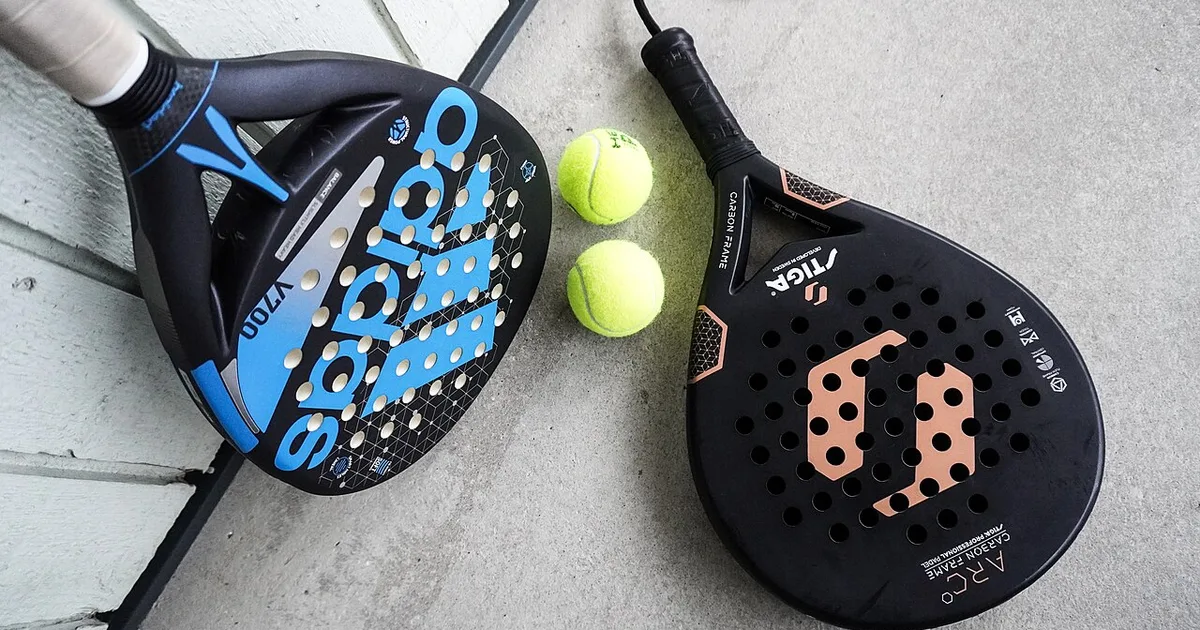
Best Padel Racket for Advanced Players (2026): 6 Picks
14 min read
Quick Answer
If you finish points overhead and hit the centre of the face consistently, choose a diamond with a high balance at around 360–375 g. If you build points as much as you finish them, a hybrid or teardrop with a lower balance is the better advanced racket. Compare balance within one brand, fine-tune it with the maker's counterweights (legal under FIP racket point 8), and check the 2027 versions already on sale.
Settling an argument? Send this rule to your padel group.
The best padel racket for an advanced player depends on how you win your points. If you finish points overhead and hit the centre of the face consistently, choose a diamond with a high balance, at around 360–375 g. If you build points as much as you finish them, a hybrid or teardrop with a lower balance will serve you better. At this level, the details matter more than the shape name: compare balance within one brand, and fine-tune it with counterweights, which the FIP rules allow.
This page is for experienced, competitive players. It covers how to choose between diamond and hybrid shapes, how balance and weight work for power players, how to tune a racket legally, and six current pro-line models. We checked every spec on the manufacturer’s own website on 5 November 2026. We haven’t lab-tested these rackets and we don’t score them. Still improving? See best intermediate padel rackets. For rackets at every level, see best padel rackets 2026.
The advanced racket at a glance
| Spec | Power player (finisher) | All-court advanced player |
|---|---|---|
| Shape | Diamond | Hybrid or teardrop |
| Balance | High (head-heavy) | Low to medium |
| Weight | Upper end of the range you can swing fast; pro lines list 360–375 g | Same range; balance matters more than grams |
| Core | Medium to hard EVA, or foam | Medium EVA |
| Face | Carbon, with a rough finish for spin | Carbon, with a rough finish for spin |
| Tuning | Counterweights at the top for more momentum | Counterweights only to correct the feel |
| Trade-off | Smaller, higher sweet spot; slower at the net; more load on the arm | Less free power on smashes |
Diamond, hybrid or teardrop?
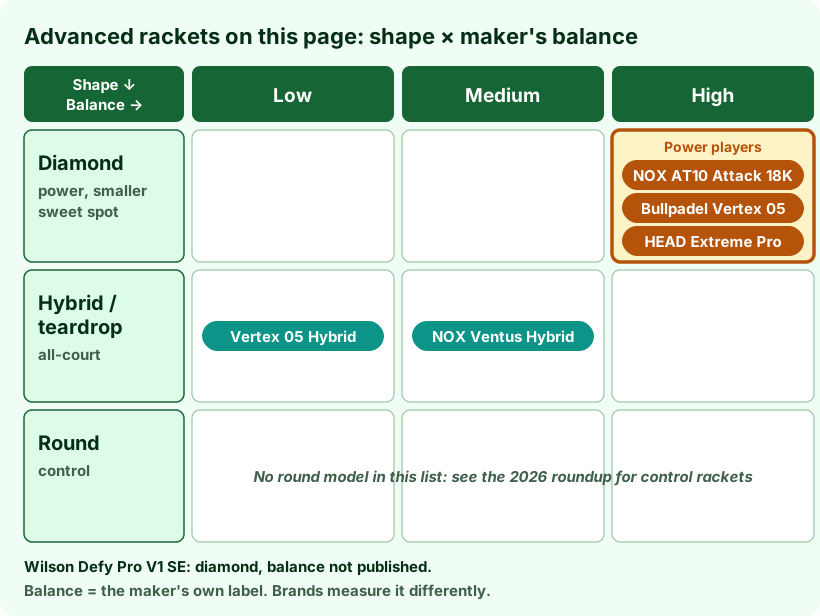
Diamond rackets are widest near the top, so the sweet spot sits higher and the balance is usually high. That suits players who finish at the net with smashes, víboras and flat attacking shots. In doubles that is often, but not always, the player on the left. The cost is a smaller sweet spot and a heavier-feeling racket in fast exchanges at the net.
Hybrid has no standard definition. Brands use it for shapes between the classic three, and the label alone tells you little. The two “hybrids” on this page show why. Bullpadel lists the Vertex 05 Hybrid with the shape “Hybrid” and a low balance. NOX’s Ventus Hybrid 12K XTREM is listed with a teardrop shape and “balanced weight distribution”. Ignore the name and read two specs: shape and balance.
Teardrops and hybrids suit advanced players who defend from the back glass, build with the bandeja and still need to finish. They also fit the right-side (drive) player, or a pair that swaps roles. The shapes are explained in depth in padel racket shapes, and positions in left vs right side.
Balance and weight for power players
Balance is the distance from the end of the handle to the racket’s balance point. A higher balance puts more mass in the head. That adds momentum on overheads, but the racket reacts more slowly at the net and asks more of your wrist, elbow and shoulder.
Don’t compare balance numbers across brands. Even within one brand, small differences change the label:
| Racket | Maker’s balance figure | Maker’s label |
|---|---|---|
| Bullpadel Vertex 05 Hybrid | ≈ 25 cm | Low |
| Bullpadel Vertex 05 | ≈ 25.4 cm | High |
| HEAD Extreme Pro 2026 | 270 mm | High |
A few millimetres separate Bullpadel’s “low” from its “high”, while HEAD’s “high” is 270 mm: brands don’t measure or label balance the same way. Use the numbers to compare models from the same maker, and the words to compare across makers.
Weight. The FIP rules set no weight limit. Every pro-line racket on this page that lists a weight is in the 360–375 g band; HEAD gives exactly 370 g for the Extreme Pro 2026. Within that band, pick the heaviest racket you can still swing fast at the end of a third set. Weight you can’t accelerate adds no power.
Handle length moves the balance too. NOX gives its AT10 Genius Attack an “Oversize Grip” 30 mm longer than standard. NOX says it adds room for two-handed shots and shifts the balance towards the head. If you choke up on the grip, you lose some of that effect.
Tuning a racket: counterweights and lead tape
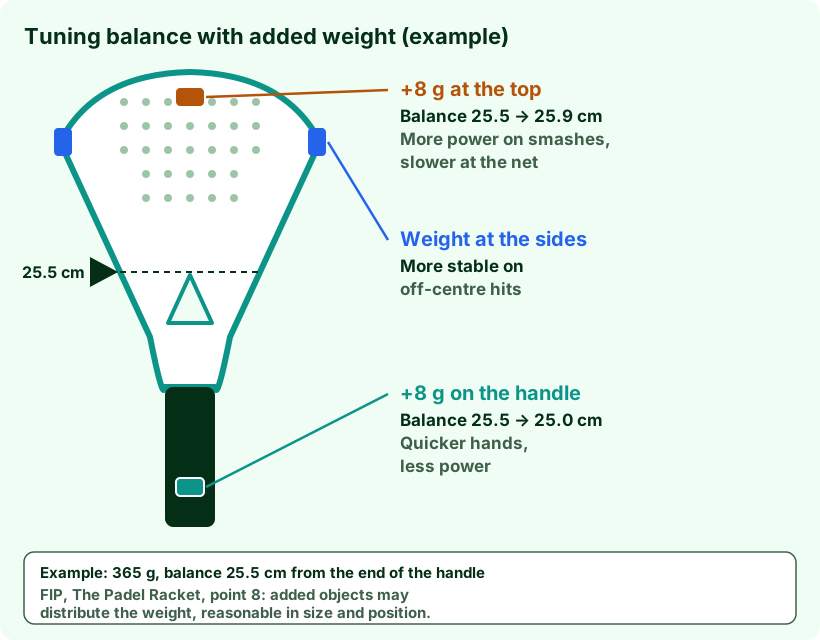
Most advanced players can’t change the shape of their racket, but they can change its balance. The FIP rules allow it: added objects are permitted if they are used “to distribute the weight” and are “reasonable in size and positioning” (The Padel Racket, point 8).
- Top of the frame: raises the balance. In the example, 8 g at 43 cm moves a 365 g racket from 25.5 to 25.9 cm: more momentum on smashes, slower at the net.
- Sides of the head: barely change the balance but make the head more stable when you hit off-centre.
- Handle: lowers the balance. The same 8 g near the end of the handle moves it to 25.0 cm: quicker hands, less power.
The pro lines now build this in. NOX’s “Weight Balance” system takes 2 g and 4 g pieces (up to 8 g on the Ventus models). Bullpadel’s “CustomWeight” uses 3 g gel plates, with room for up to four at the top of the Vertex 05 (12 g). Add weight a few grams at a time. A heavier head also means more load on the arm, so stop if you feel elbow pain.
Core and face at the advanced level
- Core. Most pro lines use multi-layer EVA (NOX MLD Black EVA, Bullpadel Multieva). HEAD and Wilson use foam in their attacking diamonds: HEAD lists “Power FOAM”, and Wilson “Power Foam” with a composition of 83% foam and 17% carbon. Compare hardness with each maker’s own scale. NOX, for example, rates the AT10 Genius Attack 18K 2026 “Intermediate” touch and the Ventus Hybrid “Medium-Hard”.
- Face. All six rackets here have carbon faces: 12K, 15K, 18K or UD (unidirectional) carbon. The K number describes the weave, not the level. See carbon vs fibreglass.
- Surface. Every model here has a textured face for spin (NOX Dual Spin, Bullpadel Top Spin, HEAD Extreme Spin, Wilson Spin² Texture). Rough faces are legal: both sides must be flat “but may be smooth or rough” (point 7).
What the FIP rules mean for an advanced racket
All the rackets on this page are sold as regulation rackets. These are the limits that matter when you start to customise or buy unusual designs. The rules are in the “The Padel Racket” section of the FIP Rules of Padel (2026 edition).
| What | FIP limit | Point |
|---|---|---|
| Total length | Max 45.5 cm, head + handle | 3, 4 |
| Handle | Max 20 cm long, 50 mm wide, 50 mm thick | 2 |
| Head | Max 26 cm wide, 38 mm thick (2.5% tolerance when measured) | 3, 5 |
| Holes | Centre: cylindrical, 9–13 mm. Within 4 cm of the edge: other shapes allowed, max 20 mm | 6 |
| Faces | Flat; smooth or rough | 7 |
| Added weight, protectors, dampeners | Only to limit wear or vibration or to distribute weight; reasonable size and position; nothing reflective or noisy | 8 |
| Wrist cord | Non-elastic, max 35 cm, compulsory | 9 |
| Devices | Nothing visible or audible that communicates with, warns or instructs the player during a game | 10 |
| Weight, shape, balance | Not regulated | — |
2026 rule change: Rule 13.1r is new in the 2026 edition: if a player “breaks their safety cord or drops their racket, the pair will immediately lose the point in dispute”. Earlier editions made the cord compulsory but set no point penalty. Hard swings put the most strain on the cord, so check it and its anchor regularly. More in wrist strap rules.
All points with a to-scale diagram: padel racket specifications.
What happens if…?
…I add 12 g of lead tape to the top of my diamond? Legal, if the tape is reasonable in size and position: point 8 allows objects that distribute the weight. Your balance and swing weight go up. The shape and the position of the sweet spot don’t change.
…my racket has an extra-long handle? Legal, as long as the handle is no longer than 20 cm and the whole racket no longer than 45.5 cm (points 2–4). Wilson lists the Defy Pro V1 SE at 455 mm, which is exactly the maximum length.
…my racket has bigger holes at the top of the face? Legal if they are within 4 cm of the edge and no wider than 20 mm. Holes in the centre area must be cylindrical and 9–13 mm (point 6). Wilson’s “Duo Grid” pattern, with larger holes at the top, works within this rule.
…I fit a motion sensor to the handle? Point 10 bans any visible or audible device that could communicate with, warn or instruct you during a game. A device that lights up, beeps or vibrates is out. For a silent tracker, check with your competition’s organiser first. It must also meet point 8: reasonable in size and position.
…my racket flies out of my hand on a full-power smash? Your pair loses the point straight away (Rule 13.1r). If the ball was hit with the thrown racket, the point is lost under Rule 13.1m anyway. See faults and lets.
…I win the point off the frame of my racket? It counts. Rule 13.1k only costs you the point when the ball hits your body or equipment other than the racket.
Six advanced rackets with verified specs (2026)
We picked these to cover the advanced profiles: four attacking diamonds (two EVA, two foam) and two all-court hybrids. This is not a ranking. Specs are from each manufacturer’s product page, checked on 5 November 2026; where a maker doesn’t publish a figure, we say so. Several brands already sell their 2027 rackets, so check the maker’s page before you buy. Some links are affiliate links (see the disclosure at the end).
| Racket | Shape | Balance (maker) | Weight | Core | Face | Maker’s level / style |
|---|---|---|---|---|---|---|
| NOX AT10 Genius Attack 18K Alum 2026 | Diamond | High, adjustable | 360–375 g | MLD Black EVA | 18K Alum carbon | Professional / aggressive |
| Bullpadel Vertex 05 | Diamond | High, ≈ 25.4 cm | 365–375 g | Multieva | X-Tend Carbon 12K | Professional / versatile |
| HEAD Extreme Pro 2026 | Diamond | High, 270 mm | 370 g | Power FOAM | UD carbon | Not listed / “Finisher” |
| Wilson Defy Pro V1 SE | Diamond | Not listed | Not listed | Power Foam | 15K carbon | “Pro-level” / attack |
| Bullpadel Vertex 05 Hybrid | Hybrid | Low, ≈ 25 cm | 365–375 g | Multieva | X-Tend Carbon 12K | Professional / multipurpose |
| NOX Ventus Hybrid 12K XTREM 2027 | Teardrop | “Balanced” | 360–375 g | MLD Black EVA | 12K Alum XTREM carbon | Professional / all-round |
Attack, EVA core: NOX AT10 Genius Attack 18K Alum 2026
Agustín Tapia’s attacking racket: diamond, high balance, 360–375 g, MLD Black EVA core, 18K aluminised carbon faces, a carbon frame and the Dual Spin finish. NOX lists the level as “Professional”, the touch as “Intermediate” and the style as “Aggressive”. It has the 30 mm Oversize Grip and takes 2 g and 4 g counterweights. NOX already sells a 2027 version with the same shape, weight range, core and face. Manufacturer specs. More on the brand: NOX padel.
Fits: left-side finishers who want to tune their balance.
Check availability at Padel Market →
Attack with more control: Bullpadel Vertex 05
Juan Tello’s racket in Bullpadel’s 2026 Pro Line: diamond, high balance (≈ 25.4 cm), 365–375 g, Multieva core, X-Tend Carbon 12K faces and a Top Spin finish. Bullpadel lists the level as “Professional” and the style as “Versatile”, calling it its “most balanced option”, with an “Intermediate” touch. The CustomWeight system takes up to four 3 g plates at the top. Manufacturer specs. More in Bullpadel rackets.
Fits: players who want a diamond but still defend a lot of balls.
Check availability at Padel Market →
Attack, foam core: HEAD Extreme Pro 2026
A diamond at 370 g with a high balance of 270 mm, a “Power FOAM” core, a UD carbon hitting surface, a carbon frame and HEAD’s Extreme Spin texture. HEAD describes it as “built for tournament players who attack relentlessly”. It is the heaviest racket here with an exact published weight. Manufacturer specs. More on the brand: HEAD padel.
Fits: strong attackers who want a foam feel and don’t mind a head-heavy racket.
Attack, foam core: Wilson Defy Pro V1 SE
A special edition of Wilson’s pro-level diamond: Power Foam core (83% foam, 17% carbon), 15K carbon face, carbon frame, a 490 cm² head and a length of 455 mm. Wilson calls it “built for attackers” and a “heavy-frame” racket, but doesn’t publish its weight or balance, so weigh it in the shop if you can. Manufacturer specs. More on the brand: Wilson padel.
Fits: attackers who want to compare a foam core with EVA.
Check availability at Padel Market →
All-court: Bullpadel Vertex 05 Hybrid
The same family and materials as the Vertex 05 (Multieva core, X-Tend Carbon 12K, Top Spin, 365–375 g) in Bullpadel’s “Hybrid” shape, with a lower balance (≈ 25 cm, labelled “Low”) and a 531 cm² hitting surface. Bullpadel lists it for “Multipurpose Game” at professional level. Manufacturer specs.
Fits: right-side and all-court players who want the Vertex feel with quicker hands.
Check availability at Padel Market →
All-court: NOX Ventus Hybrid 12K XTREM 2027
Developed with Edu Alonso and part of NOX’s 2027 collection, already on sale. Despite the name, NOX lists the shape as teardrop, with “balanced weight distribution”. It weighs 360–375 g, with an MLD Black EVA core, 12K Alum XTREM carbon faces, a carbon frame and Dual Spin. NOX lists the level as “Professional”, the feel as “Medium-Hard” and the style as “All-round”. Its Weight Balance system takes 2 g and 4 g counterweights, up to 8 g. Manufacturer specs.
Fits: advanced players who split defence and attack and want a firmer teardrop.
Looking for lighter advanced rackets? See best women’s padel rackets.
Are you ready for an advanced racket?
An advanced racket helps only if your technique can use it. Signs you’re ready:
- You hit the centre of the face consistently, including on hard, fast volleys.
- You know your role: you finish points, you build them, or you switch with your partner.
- Your current racket feels slow on overheads, or too lively to control.
If you aren’t sure, move one step: a hybrid or teardrop with a lower balance before a high-balance diamond. A racket that is too demanding costs you more points than it wins. Tactics for this level are in advanced padel tactics.
Related guides
- Best padel rackets 2026
- Best intermediate padel rackets
- Padel racket shapes explained
- Diamond vs round padel racket
- Padel racket buying guide
- Padel racket specifications
Affiliate disclosure: we earn a small commission at no extra cost to you if you buy through our links.
Was this page helpful?
Thanks for your feedback!
Free beginner PDF + rule updates
Get the 4-page beginner guide to the 2026 padel rules, then one short email a week for four weeks and a monthly newsletter.
More in Padel Equipment
Adidas Padel Rackets & Shoes 2026 — Complete Brand Guide
Adidas padel in 2026: the Metalbone racket line, Barricade and Adizero shoes, brand history, and which Adidas gear suits your level.
Babolat Padel Rackets 2026 — Best Models & Technology Guide
The Babolat padel racket range for 2026: compare the Viper, Counter and Technical lines, with prices, player endorsements and our picks.
Padel Ball Specifications: Why Balls Matter
FIP padel ball specifications control bounce, durability and consistency. How balls differ from tennis, why altitude matters, why approved balls are used.

Best Padel Bags 2026: How to Choose + 5 Verified Picks
How to choose a padel bag: backpack or racket bag, racket capacity, thermal and shoe pockets. Plus 5 current bags with specs checked on makers' sites.