 PADEL RULES
Best Padel Knee Brace 2026: Strap, Sleeve or Hinged?
7 min read
Quick Answer
Knee supports for padel come in three types: a patellar strap (a band just below the kneecap), a compression sleeve (around the kneecap) and a hinged brace (side hinges and straps for the most structure). Current examples: Bauerfeind GenuPoint and Push Sports Patella Brace (straps), Bauerfeind GenuTrain (sleeve), Push Sports Knee Brace and McDavid 429X (hinged). Which type, if any, fits your knee is a question for a doctor or physio, especially after a twist or a fall.
Settling an argument? Send this rule to your padel group.
Knee supports for padel come in three types: a patellar strap that sits just below the kneecap, a compression sleeve that surrounds the kneecap, and a hinged brace with hinges on both sides for the most structure. They are built for different problems, so the first step is knowing which kind you need, not which brand. This page explains the differences, how each is measured and fitted, and lists five current models whose specs we checked on the makers’ own sites.
Not medical advice. A brace is not a diagnosis. If your knee gave way, locked, swelled up quickly or you can’t put weight on it, get it checked first; don’t buy a brace and play on. For persistent knee pain, see a doctor or physiotherapist. Our padel knee injury guide explains the common problems.
We checked every spec below on the manufacturer’s product page on 4 November 2026. We haven’t tested these braces and we don’t score or rank them. No prices: they change too often. This page has no affiliate links.
Why the knee?
In a 2023 systematic review of padel injury studies (Dahmen et al., BMJ Open Sport & Exercise Medicine, 8 studies, 2,022 players), the elbow was the most common injury site, followed by the knee, the shoulder and the lower back; knee sprains appear in several of the included studies. The authors stress that the evidence is limited. The review did not test braces, so it tells you where padel players get hurt, not whether a brace helps.
Step 1: know the three types
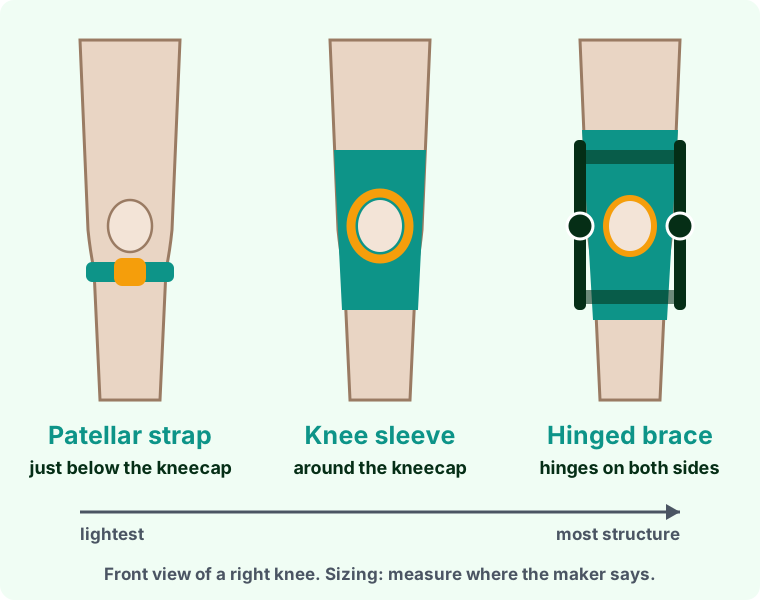
| Patellar strap | Compression sleeve | Hinged brace | |
|---|---|---|---|
| What it is | Band with a pad on the tendon below the kneecap | Knitted sleeve with a ring or pad around the kneecap | Sleeve or wrap with hinges or stays on both sides, plus straps |
| Makers’ stated uses (examples) | Patellar tendonitis (“jumper’s knee”), pain at the front of the knee | Knee pain and swelling, mild instability | Instability, after ligament injuries |
| Bulk and warmth | Lowest | Medium | Highest |
| Movement | Unrestricted | Unrestricted | Sideways movement limited by design |
| Examples below | Bauerfeind GenuPoint, Push Sports Patella Brace | Bauerfeind GenuTrain | Push Sports Knee Brace, McDavid 429X |
More structure is not automatically better. A hinged brace is built to resist sideways movement of the knee; if you don’t have that problem, it is extra weight and heat for three sets of lunges and split-steps. If a physio has examined your knee, their advice beats any table.
Step 2: measure where the maker says
Knee braces are sized by circumference, and every maker measures at a different point. Get this wrong and the brace slides down by the second game or digs in behind the knee.
| Model | Where to measure (maker’s instructions) |
|---|---|
| Bauerfeind GenuPoint | Circumference immediately below the kneecap |
| Push Sports Patella Brace | One size; no measurement needed |
| Bauerfeind GenuTrain | Thigh 14 cm above and lower leg 12 cm below the centre of the knee, knee relaxed and slightly bent |
| Push Sports Knee Brace | Lower leg, just below the knee (four sizes) |
| McDavid 429X | Around the largest part of the knee, over the kneecap, leg slightly bent (S 33–35.6 cm up to XXL 44.5–48.3 cm) |
When you put it on, check it doesn’t fold at the edges or pinch behind the knee in a deep lunge. Tingling, numbness or a cold foot means it is too tight.
Five current knee braces
Specs come only from each maker’s product page. “Maker’s stated use” repeats what the manufacturer says; it is not our recommendation for your knee.
Bauerfeind GenuPoint — patellar strap
A knee strap with a patella pad that sits on the patellar tendon. It fastens with hook-and-loop on both sides, so you can tighten it evenly. Sized by the circumference immediately below the kneecap. Maker’s stated use: patellar tendonitis (jumper’s knee) and pain at the front of the knee. Bauerfeind GenuPoint product page
Push Sports Patella Brace — one-size strap
A strap with a pressure pad on the knee tendon; the kneecap fits in a recess in the pad. One size, for either knee. Push Sports’ fitting instructions: bend the leg, place it immediately below the kneecap, close it as tightly as possible without pinching. Maker’s stated use: patellar tendinitis, jumper’s knee, patellofemoral pain syndrome, Osgood-Schlatter disease. Push Sports Patella Brace product page
Bauerfeind GenuTrain — knit sleeve
A knitted compression sleeve with an Omega+ pad that surrounds the kneecap, plastic side stays with flexible bending zones to stop it slipping, and pull-on aids. One sleeve per pack, wearable on either knee; measured at two points (see the table above). Maker’s stated use: joint pain and swelling, mild osteoarthritis, tendonitis, feelings of instability, meniscus tear. Bauerfeind GenuTrain product page
Push Sports Knee Brace — leaf-spring hinges
A brace with non-axial leaf-spring hinges on both sides of the knee, which Push Sports says counter sideways movement without hindering bending and straightening, a U-shaped pad around the kneecap and two hook-and-loop fasteners. Four sizes, either knee, sized by the lower-leg circumference just below the knee. Maker’s stated use: knee instability, residual instability after a collateral ligament injury, arthrosis with mild instability, meniscus injury, patellofemoral pain syndrome. Push Sports Knee Brace product page
McDavid 429X — hinged neoprene brace
A latex-free neoprene brace with bilateral polycentric hinges and steel supports on both sides, elastic crossing straps plus top and bottom straps, and a padded buttress around the kneecap. Sizes S to XXL by knee circumference; fits either knee. Maker’s stated use: ligament injuries, severe instability, rehabilitation after surgery or trauma; McDavid itself tells buyers to consult a doctor for diagnosis and treatment. McDavid 429X product page
What we removed from this page
The earlier version had price ranges, “support level” ratings, claims about professional players and statements about which knee conditions are “most common in padel” that we couldn’t source. Those are gone. The Zamst ZK-7 was removed because the maker sells it for moderate to severe ligament sprains, not for the uses we had described. The Mueller jumper’s knee strap and the Push “Knee Brace Ortho” were removed because we couldn’t match them to a current manufacturer page.
When to see someone instead
The NHS advises seeing a GP if knee pain doesn’t improve within a few weeks, and getting urgent advice if the knee is very painful, you can’t put weight on it, it is badly swollen or has changed shape, or it locks, gives way or painfully clicks. A physio can tell you whether a strap, sleeve or hinged brace makes sense, and what strength work to do alongside it.
Related guides
Was this page helpful?
Thanks for your feedback!
Free beginner PDF + rule updates
Get the 4-page beginner guide to the 2026 padel rules, then one short email a week for four weeks and a monthly newsletter.
More in Padel Equipment
Best Padel Elbow Brace 2026: Strap or Sleeve? 4 Models
Padel elbow brace guide: counterforce strap vs compression sleeve, how each should sit, sizing, and 4 current models with specs checked on the maker site.
Padel Shoulder Support 2026: How to Choose + 3 Models
Padel shoulder support guide: what a shoulder brace can and can't do, how it should fit for overhead shots, and 3 current models checked with the maker.
Best Padel Wristbands 2026: Sweatbands vs Wrist Supports
Padel wristbands explained: sweatband vs wrist wrap vs wrist brace, which hand to wear them on, sizing, and 5 current models checked on the maker's site.
Adidas Padel Rackets & Shoes 2026 — Complete Brand Guide
Adidas padel in 2026: the Metalbone racket line, Barricade and Adizero shoes, brand history, and which Adidas gear suits your level.