 PADEL RULES
Best Padel Elbow Brace 2026: Strap or Sleeve? 4 Models
7 min read
Quick Answer
There are two main kinds of elbow support for padel: a counterforce strap (a band with a pad worn on the forearm just below the elbow) and a compression sleeve that covers the joint. A strap is lighter and quicker to put on; a sleeve covers more. Current examples: Bauerfeind EpiPoint, Push Sports Elbow Brace and Zamst Elbow Band (straps), Bauerfeind EpiTrain (sleeve). A brace is not a diagnosis or a treatment plan: if elbow pain lasts, see a doctor or physio.
Settling an argument? Send this rule to your padel group.
There are two main kinds of elbow support for padel: a counterforce strap, which is a band with a pad worn on the forearm just below the elbow, and a compression sleeve, which covers the joint itself. A strap is lighter and easier to adjust; a sleeve covers more and holds its own position. This page explains how to choose between them and how each should sit, then lists four current models whose specs we checked on the makers’ own sites.
Not medical advice. A brace is not a diagnosis or a treatment plan. If elbow pain lasts more than a couple of weeks, keeps coming back, or you can’t grip the racket normally, see a doctor or physiotherapist before you buy anything. For causes and rehab, read our padel elbow injury guide.
We checked every product spec below on the manufacturer’s product page on 4 November 2026. We haven’t tested these braces and we don’t score or rank them. We don’t list prices because they change too often. This page has no affiliate links.
Why the elbow?
A 2023 systematic review of padel injury studies (Dahmen et al., BMJ Open Sport & Exercise Medicine, 8 studies, 2,022 players) found that the elbow was the most frequently reported injury site in all five studies that broke injuries down by location, and that tennis elbow (common extensor tendinopathy, also called lateral epicondylitis) was the most frequently reported specific diagnosis. The authors note the evidence is limited and mostly from Spain. That is why elbow braces are among the most searched padel accessories. It does not mean that a brace prevents or treats tennis elbow; the review didn’t test braces.
Step 1: strap or sleeve?
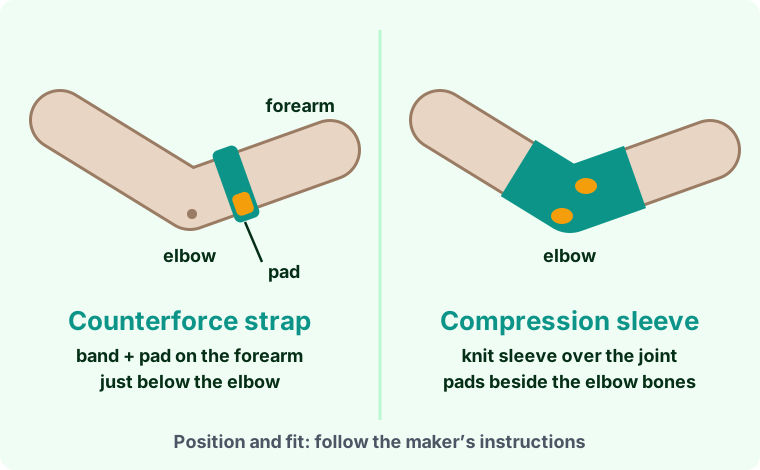
| Counterforce strap | Compression sleeve | |
|---|---|---|
| What it is | Narrow band with a firm pad | Knitted tube over the elbow, often with built-in pads |
| Where it sits | Forearm muscles, a few centimetres below the elbow | Over the joint, from upper arm to forearm |
| Sizing | Often one size, adjustable (e.g. Push Sports, EpiPoint) | Sized by arm circumference — measure as the maker says |
| Adjust during a match? | Yes, between points or games | Not really; it is either on or off |
| Warmth | Minimal | Covers more skin, so warmer on hot courts |
| Examples below | Bauerfeind EpiPoint, Push Sports Elbow Brace, Zamst Elbow Band | Bauerfeind EpiTrain |
Some players use a strap when they play and nothing in between; others prefer the feel of a sleeve. There is no rule that says one type is right for padel. If a physio has examined your elbow, follow their advice on which type to try.
Step 2: fit it properly
A brace in the wrong place or at the wrong tension is just an armband. The makers’ own instructions are specific:
- Position: Push Sports says to place its strap on the forearm muscles about six centimetres below the elbow, pad on the outside for tennis elbow (inside for golfer’s elbow), and to keep the strap ring out of the elbow crease. Other straps differ slightly, so read the leaflet that comes with yours.
- Tension: Push Sports says you should feel pressure when the arm is bent and the forearm muscles are tightened, and no tension when the muscles are relaxed. Bauerfeind’s EpiPoint has a red warning section that appears when the strap is too tight.
- Sizing a sleeve: Bauerfeind sizes the EpiTrain by the circumference of the widest part of the forearm. Measure with a soft tape rather than guessing from your T-shirt size.
- Warning signs: tingling, numbness, colour change or a throbbing hand mean it is too tight. Take it off.
Step 3: check the rest of your set-up
A brace is one small piece. If your elbow hurts after padel, these are worth checking too, and our elbow injury guide covers them in more detail:
- Grip size and overgrips: see grip and overgrip.
- Racket weight and balance: see the padel racket buying guide.
- How much you play and whether you warm up: see our warm-up routine and injury prevention guide.
Four current elbow braces
Specs below come only from each maker’s product page. “Maker’s stated use” repeats what the manufacturer says the product is for; it is not our recommendation for your condition.
| Model | Type | Sizing (maker) | Left/right |
|---|---|---|---|
| Bauerfeind EpiPoint | Strap with five-point pad | Universal size | Either arm (pad rotates) |
| Push Sports Elbow Brace | Strap with pad | One size | Either arm |
| Zamst Elbow Band | Strap with soft pad | S, M, L | Not stated |
| Bauerfeind EpiTrain | Knit compression sleeve with two pads | Sized by forearm circumference | Either arm |
Bauerfeind EpiPoint — adjustable strap
A forearm strap with a five-point viscoelastic pad. The pad can be rotated and re-fastened, so the same strap works on the left or right arm; an indicator shows which side it is set for. A red warning section shows when you have pulled it too tight. Universal size. Maker’s stated use: tennis elbow and golfer’s elbow. Bauerfeind EpiPoint product page
Push Sports Elbow Brace — one-size strap
A strap with a pad that Push Sports says applies pressure to specific forearm muscles. One size, for either arm. The fitting instructions are the clearest we found: about six centimetres below the elbow, pad outside for tennis elbow, pressure felt only when the muscles are tensed. Push Sports lists padel among the sports it is intended for. Maker’s stated use: tennis elbow and golfer’s elbow. Push Sports Elbow Brace product page
Zamst Elbow Band — strap in three sizes
A strap with a soft pad and an adjustable band for setting the compression. Zamst rates its support level as moderate and sells it in S, M and L (check the maker’s size guide). Maker’s stated use: elbow pain from tendonitis. Zamst Elbow Band product page
Bauerfeind EpiTrain — compression sleeve
A knitted compression sleeve with two viscoelastic pads placed beside the elbow bones, with a softer knit at the crook of the elbow. Sized by the circumference of the widest part of the forearm; the package contains one sleeve that can be worn on either arm. Bauerfeind sells a separate EpiTrain Forearm Strap to add to it. Maker’s stated use: tennis and golfer’s elbow, elbow strains or sprains, arthritis, elbow pain and swelling. Bauerfeind EpiTrain product page
What we removed from this page
The earlier version listed six braces with price ranges, “support level” ratings and claims such as “the most effective support available”. We couldn’t verify those, so they are gone. The BandIT, Simien and Mueller straps were removed because we couldn’t confirm the exact current model and specs on a manufacturer page. The Push Sports product is now described as what the maker sells today (a strap), not a sleeve-and-strap combination.
When to see someone instead
The NHS advises seeing a GP if you still have elbow pain after resting it and trying self-care for at least two weeks. Get checked sooner if the pain followed a fall or a blow, the elbow is swollen or deformed, or you have numbness or weakness in the hand. A physio can tell you whether a strap, a sleeve or neither makes sense for your elbow.
Related guides
Was this page helpful?
Thanks for your feedback!
Free beginner PDF + rule updates
Get the 4-page beginner guide to the 2026 padel rules, then one short email a week for four weeks and a monthly newsletter.
More in Padel Equipment
Best Padel Knee Brace 2026: Strap, Sleeve or Hinged?
Padel knee brace guide: patellar strap vs sleeve vs hinged brace, where each sits, how to measure, and 5 current models with specs from the maker.
Padel Shoulder Support 2026: How to Choose + 3 Models
Padel shoulder support guide: what a shoulder brace can and can't do, how it should fit for overhead shots, and 3 current models checked with the maker.
Best Padel Wristbands 2026: Sweatbands vs Wrist Supports
Padel wristbands explained: sweatband vs wrist wrap vs wrist brace, which hand to wear them on, sizing, and 5 current models checked on the maker's site.
Adidas Padel Rackets & Shoes 2026 — Complete Brand Guide
Adidas padel in 2026: the Metalbone racket line, Barricade and Adizero shoes, brand history, and which Adidas gear suits your level.