 PADEL RULES

Best Padel Balls 2026: FIP-Approved Picks and How to Choose
9 min read
Quick Answer
Buy a ball on the FIP's approved list, then match it to your conditions: in cold weather or on slow courts a livelier speed ball (Wilson Premier Padel Speed, HEAD Padel PRO S+); in heat, on fast courts or at altitude a control ball (Wilson Premier Padel, HEAD Padel PRO+). Bullpadel Premium Pro and NOX NERBO are also on the FIP list. For a competition, use the brand and type the organisers announce (FIP Rule 17).
Settling an argument? Send this rule to your padel group.
Buy a ball that is on the FIP’s list of approved balls, then pick it for your conditions. In slow conditions (cold weather, a slow court, low altitude) a livelier speed ball keeps rallies moving. In fast conditions (heat, a fast court, altitude) a control ball slows the game down. If you play a competition, use the brand and type the organisers announce: under FIP Rule 17 they must say so in advance.
The six balls below are current models that appear on the FIP approved list. We checked each maker’s own page and the FIP list on 4 November 2026. We haven’t lab-tested them, we don’t score them and we give no prices or durability figures. Some links are affiliate links (see the disclosure at the end).
What the FIP rules require of a padel ball
“The balls used for official competitions are those approved by FIP for the game of Padel.” — FIP Rules of Padel (2026), The Ball
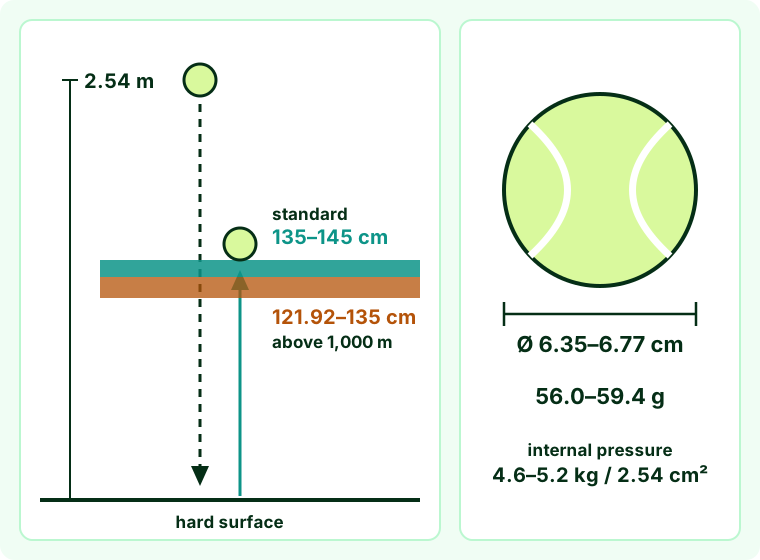
The same section sets the specification every approved ball must meet:
| Property | FIP requirement | Rule |
|---|---|---|
| Material and colour | Rubber sphere, uniform surface, white, yellow or another colour with clear contrast to the court | The Ball, 1 |
| Diameter | 6.35–6.77 cm | The Ball, 1 |
| Weight | 56.0–59.4 g | The Ball, 1 |
| Bounce (new ball, dropped 2.54 m onto a hard surface) | 135–145 cm | The Ball, 2 |
| Internal pressure | 4.6–5.2 kg per 2.54 cm² | The Ball, 3 |
| Altitude ball (above 1,000 m) | Bounce more than 121.92 cm and less than 135 cm | The Ball, 4 |
2026 rule change: The lower-bounce altitude ball was allowed above 500 m in the 2021 rules. The 2026 edition raises the threshold to 1,000 m. Using it is allowed, not compulsory. More in padel ball requirements.
The FIP’s certification document adds that a standard ball may be pressurised or pressureless; pressureless approved balls are filled with a micro-cellular material that simulates internal pressure. All the balls below are standard balls.
How to choose
1. Approved or not?
For official competitions the ball must be FIP-approved, and the organisers announce the brand and type, the number of balls (2 or 3) and the ball change policy before the event (Rule 17.1). For club play and friendlies any padel ball is allowed, but an approved one is the safest way to get the bounce the rules describe. The full list, with approval dates, is in our FIP-approved padel balls guide and in the FIP’s own document. Look for the FIP Approved logo on the can: the FIP lets certified brands print it.
2. Speed ball or control ball?
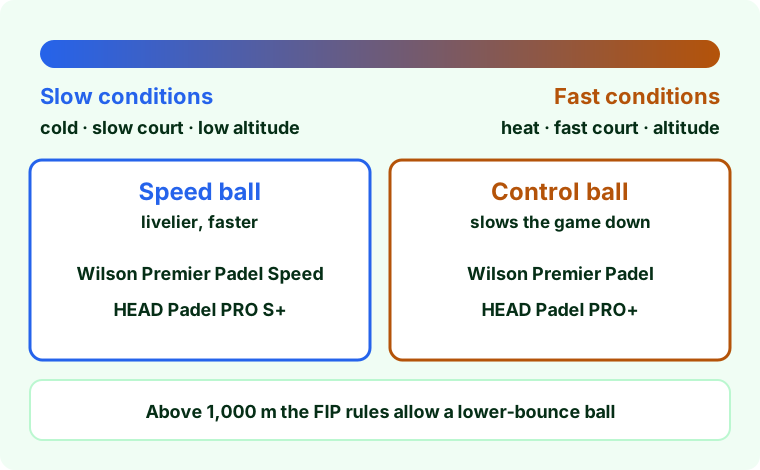
Several makers now sell their top ball in two versions. Wilson describes Premier Padel Speed as built for slower court surfaces and colder conditions, and Premier Padel as slowing the game on faster surfaces and suited to high altitude and hot, humid conditions. HEAD sells Padel PRO S+ for speed and Padel PRO+ for control. If your club’s courts play slow and you play through the winter, start with a speed ball. If you play outdoors in summer heat, try a control ball.
3. When to change balls
There is no fixed number of games. A ball is past its best when it bounces clearly lower than a new one or its felt has gone bald. A simple check: drop an old ball and a new ball side by side from the same height and compare the bounce. Pressurised balls start to lose pressure once the can is opened, so open a new can for a match that matters.
The shortlist: 6 FIP-listed padel balls
| Ball | Type (maker’s description) | On FIP list as | What the maker says |
|---|---|---|---|
| Wilson Premier Padel Speed | Speed | Wilson — Premier PadelSpeed | Official Premier Padel ball; for slower courts and cold conditions |
| Wilson Premier Padel | Control | Wilson — Premier Padel | Official Premier Padel ball; slows play on fast courts; heat, humidity, altitude |
| HEAD Padel PRO S+ | Speed | HEAD — Padel Pro S | Thicker natural rubber core, compact felt |
| HEAD Padel PRO+ | Control | HEAD — Padel Pro | Thinner synthetic rubber core, high-friction felt |
| Bullpadel Premium Pro | Speed | Bullpadel — Premium Pro | Synthetic felt, high-density rubber core |
| NOX NERBO | Speed | Nox Padel — Nerbo Speed Ball | FIP approved; official ball of the A1 Padel circuit |
Wilson Premier Padel Speed
Wilson’s livelier version of the Premier Padel ball, which Wilson says is built for slower court surfaces and colder conditions. It uses Wilson’s Dura-Weave felt with HiVis colouring and comes in 3-ball cans. It is on the FIP list as “Premier PadelSpeed”. Manufacturer specs.
Fits: winter play, slow courts, players who want a faster game.
Wilson Premier Padel
The official ball of Premier Padel since Wilson’s partnership with the tour was announced in January 2024. Wilson says it is meant to slow the game down on faster surfaces and is suited to high altitude and hot, humid conditions. Dura-Weave felt, 3-ball cans; Wilson lists the composition as 80% rubber and 20% wool. Manufacturer specs.
Note: Wilson’s own product pages describe the surface each ball suits inconsistently; we follow Wilson’s launch article, which is the clearer of the two.
Fits: summer play, fast courts, players who want more control.
Check availability at Padel Market →
HEAD Padel PRO S+
HEAD’s speed ball. HEAD says it has a thicker natural rubber core for better pressure retention and a compact felt. On the FIP list it appears as HEAD “Padel Pro S”; HEAD now sells it as PRO S+, so check the can for the FIP Approved logo if you need it for competition. Manufacturer range page (Spanish).
Fits: players who like a fast ball in any conditions.
HEAD Padel PRO+
HEAD’s control ball, with a thinner synthetic rubber core and a high-friction felt; HEAD says it is more durable than the PRO S+. It is on the FIP list as HEAD “Padel Pro”. Manufacturer range page (Spanish).
Fits: players who want a slower, more controllable ball, especially in heat.
Bullpadel Premium Pro
Bullpadel describes the Premium Pro as a high-speed ball made with synthetic felt and a high-density rubber core meant to limit pressure loss. It comes in 3-ball packs and is on the FIP approved list. Manufacturer specs.
Fits: players who want a fast ball from one of the biggest padel brands.
Check availability at Padel Market →
NOX NERBO
NOX says its NERBO ball is approved by the FIP and is the official ball of the A1 Padel professional circuit, aimed at a fast, attacking game. NOX doesn’t publish felt or core details. It appears on the FIP list as “Nerbo Speed Ball”. Manufacturer page.
Fits: players who want a fast ball.
What happens if…?
…a ball splits during a point? The point is a let and is replayed (Rule 10.1 a).
…a ball is lost or goes dead in the middle of a match? A replacement must be put into play as soon as possible; play never continues with only one ball. If it happens within the first two games after a ball change, a new ball is used; after that, a used ball of similar wear (Rule 17.1 e).
2026 rule change: In 2021 a lost or damaged ball was replaced with one “in the same condition as those in play”. Since 2026 it depends on timing: a new ball within the first two games after a change, otherwise a used ball of similar wear.
…the ball in play hits a spare ball lying in the opponents’ half? The return is good and play continues (Rule 14.1 f), unless the spare ball moves in a way that could interfere with play or be dangerous: then it is a let (Rule 10.1 d). Pocket spare balls or put them off court.
…a ball from the next court rolls onto ours mid-point? An element that is not part of the game has invaded the court, so it is a let (Rule 10.1 b). Call it straight away: if you play on, you lose the right to a let (Rule 10.1 e).
…our club is at 1,200 m altitude? The rules allow a ball with a lower bounce (more than 121.92 cm and less than 135 cm) above 1,000 m (The Ball, item 4). Whether one is used is up to the organisers.
Related guides
- Padel ball requirements
- FIP-approved padel balls
- Change of balls
- Best padel rackets 2026
- Best padel bags 2026
- Padel rules 2026
Affiliate disclosure: we earn a small commission at no extra cost to you if you buy through our links.
Was this page helpful?
Thanks for your feedback!
Free beginner PDF + rule updates
Get the 4-page beginner guide to the 2026 padel rules, then one short email a week for four weeks and a monthly newsletter.
More in Padel Equipment
Adidas Padel Rackets & Shoes 2026 — Complete Brand Guide
Adidas padel in 2026: the Metalbone racket line, Barricade and Adizero shoes, brand history, and which Adidas gear suits your level.
Babolat Padel Rackets 2026 — Best Models & Technology Guide
The Babolat padel racket range for 2026: compare the Viper, Counter and Technical lines, with prices, player endorsements and our picks.
Padel Ball Specifications: Why Balls Matter
FIP padel ball specifications control bounce, durability and consistency. How balls differ from tennis, why altitude matters, why approved balls are used.
Best Padel Bags 2026: How to Choose + 5 Verified Picks
How to choose a padel bag: backpack or racket bag, racket capacity, thermal and shoe pockets. Plus 5 current bags with specs checked on makers' sites.