 PADEL RULES

Padel Court Etiquette: 8 Rules Every Player Must Know
3 min read
Court etiquette in padel is not purely a matter of informal custom. Several key behaviours are codified in the FIP rules and carry real consequences during competitive play. This article distinguishes what is a formal rule from what is accepted convention.
Continuous Play (Rule — FIP)
The FIP rules require that play be continuous from the first serve of a match until the match ends. Players must not engage in deliberate time wasting between points.
The permitted rest intervals are:
- Between points: play should resume promptly; the server should not delay unreasonably
- At changeovers (every two games): up to 90 seconds
- Between sets: up to 120 seconds
- Medical timeout: permitted at the referee’s discretion for genuine injury; see medical timeout rules
Deliberate time wasting is a code violation and is penalised under the progressive penalty system.
Server Must Wait for Receiver
The server must not serve until the receiver is ready. If the receiver signals unreadiness and the serve is played anyway, the point should be replayed.
The receiver is responsible for signalling readiness. Delaying readiness without a genuine reason can itself constitute time wasting.
Ball Retrieval Between Points
By convention, the team that committed the last error (i.e., the point-losing team) is expected to retrieve balls and return them to the server. In practice this is universally observed. Deliberately refusing to return balls in a timely manner is time wasting.
Hindrance (Rule — FIP)
Players must not deliberately distract or hinder opponents during a point. This includes:
- Making unnecessary noise or movements during an opponent’s shot
- Shouting or calling out during a rally (other than calling the ball out)
- Moving in a way intended to break the opponent’s concentration
If deliberate hindrance occurs, the point is awarded to the opposing team. If a player claims unintentional hindrance, the referee may call a let. Repeated instances are treated as a code violation. See interference for the full rules.
Calling the Ball Out
Players are responsible for calling balls on their side of the net. A ball called out during a rally means the point stops immediately. If a player calls a ball out and it is later disputed, the point is replayed only if there is genuine doubt — the benefit of the doubt goes to the opponent.
In matches without a referee, players must agree on close calls. Disputes should be resolved calmly; see Code of Conduct for the penalty framework.
Adjacent Court Balls
If a ball from an adjacent court enters the playing area during a point, any player may call “let” and the point is replayed. Continuing play with a foreign ball on the court is unsafe and not required.
Conduct on Court
Behaviour expectations during a match — including racket abuse, audible obscenities, and arguing with referees — fall under the formal Code of Conduct and Violations, not etiquette. Violations carry a structured penalty: warning, then point penalty, then disqualification. See penalties and sanctions for the full ladder.
Stay in the loop
Get padel rule updates and tournament news — no spam.
More in Player Guidelines
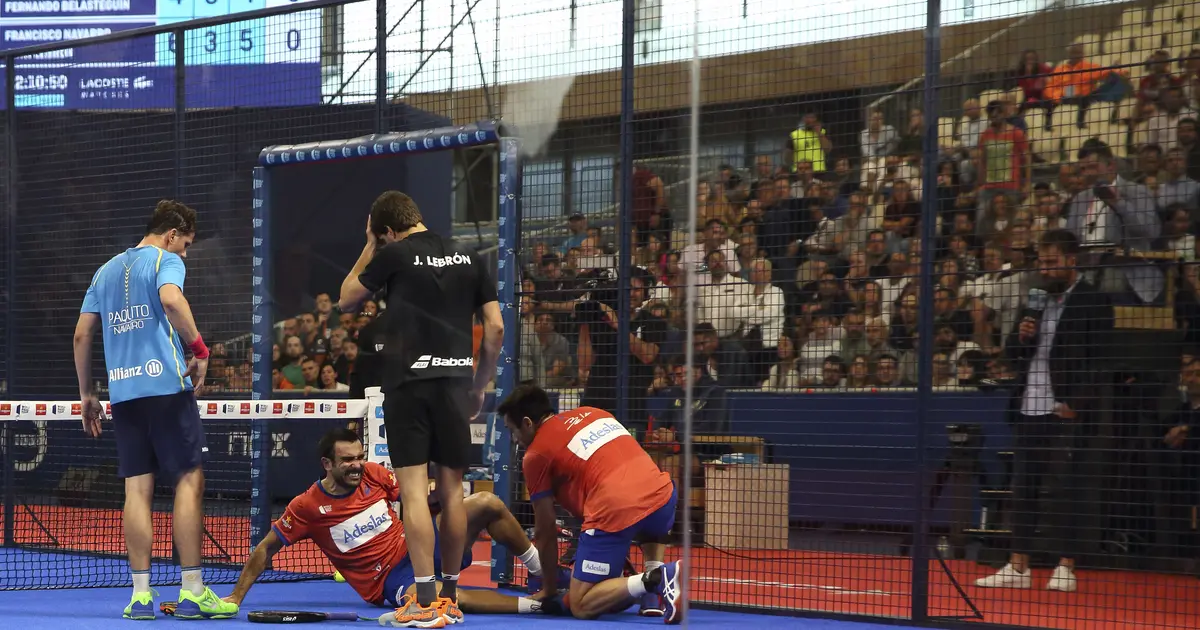
Medical Timeouts: How Padel Balances Injury Care and Fair Play
Players get one 3-minute medical timeout per match to treat injuries. Learn when it applies, what counts as medical vs. abuse, heat/cramp rules, and why no warm-up is allowed after treatment.
Common Padel Injuries and How to Prevent Them
A guide to the most common padel injuries — including padel elbow, shoulder problems, ankle sprains, and knee pain — with practical prevention strategies.
Proper Attire
FIP regulations require non-marking footwear and appropriate sports clothing. Professional events have additional branding and sponsor requirements.
Padel Wrist Straps: Mandatory Safety Equipment & Why Length Matters
Wrist straps are mandatory safety equipment in padel. Learn why they're non-negotiable, what makes a strap tournament-legal (max 35 cm, non-elastic), what happens if it breaks, and how to maintain them safely.