 PADEL RULES
Who Serves First in Padel? — Service Order Rules Explained
5 min read
Quick Answer
The server stands behind the service line, bounces the ball, then strikes it at or below waist height — no overhand serves allowed. The ball must land diagonally in the opponent's service box, and each server gets two attempts per point.
The serve is the shot that starts every point in padel, and it is governed by a specific set of rules that differ significantly from tennis.
The Service Sequence
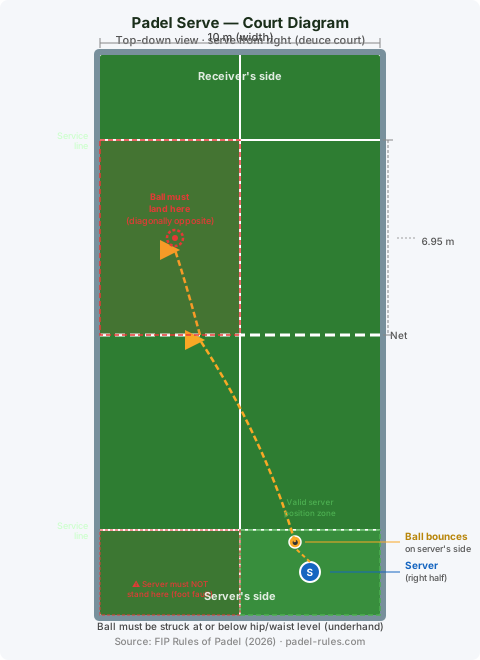
- The server stands behind the service line, between that line and the back wall, in the half corresponding to the side being served
- The server bounces the ball on the ground within their service half (the ball must hit the ground before being struck)
- The server strikes the ball at or below hip/waist level
- The ball must cross the net and land in the diagonally opposite service box
Key Requirements
Server Position
- At the start of the service, the server must stand with at least one foot behind the service line, between the imaginary extension of the central service line and the side wall, and must remain in this position until the ball has been struck
- Feet must not touch or cross the service line, the imaginary central line, or the service reception box on the server’s own side of the court before the ball is struck
2026 rule change: The 2021 rules required the server to stand with both feet behind the service line. The January 2026 revision changed this to one foot — making the requirement easier to observe and reducing disputes over minimal foot movement. The additional clarification on not touching the own reception box was also added at the same time.
The Strike
- The ball must be struck underhand — the racket head must be at or below the level of the server’s hip at the moment of contact
- The ball must be struck with a downward or sideways motion (no overhead serve)
- The serve is hit after one bounce on the ground on the server’s side
- The ball may not cross the service line or the imaginary central line extension before it is struck — contact must be made while the ball is still on the server’s side
2026 rule change: The ball trajectory restriction was not stated explicitly in the 2021 rules. The January 2026 revision added this requirement to close a technical loophole where servers could let the ball drift past the centre line before making contact, effectively shortening the distance the ball had to travel across the net. The new rule standardises the serve motion across all levels of play.
Where the Ball Must Land
- It must land in the diagonally opposite service box (right half of server → left box of receiver, and vice versa)
- If the ball touches the net or the net post and then lands correctly in the service box, it is a “net” (let) and the serve is replayed
Two Attempts
The server has two attempts (first serve and second serve) to land the ball correctly. A failed first serve (a fault) does not cost a point — only two consecutive faults on the same point result in a double fault and loss of the point.
Net / Let (Service Replay)
If the served ball touches the net or net post and then lands correctly in the service box (without touching the metallic fence before the second bounce), the serve is called a “net” and must be replayed.
A let is also called if:
- The serve is delivered when the receiver is not ready
- If the let occurs on the first serve, the entire point is replayed — the server has two serves
- If the let occurs on the second serve, only the second serve is replayed
Starting Side
- The first serve of each game is from the right side (deuce court)
- Sides alternate with each point — right, left, right, left…
- After a let, the serve is replayed from the same side
Service Order
See Service Order for how the four players rotate serving duties.
Common Faults
A fault is called when:
- The ball does not land in the correct service box
- The server’s foot crosses the service line, centre line, or touches the own reception box before striking the ball
- The ball crosses the service line or imaginary central line before being struck
- The ball is struck above hip/waist level
- The ball is not bounced before being struck
- The ball hits a wall or fence on the server’s side before going over the net
For the complete fault list and let rules, see faults and lets. For server and receiver positioning, see position of players. For how the receiving team plays the serve, see return of serve.
For a comparison of how the padel serve differs from the tennis serve, see Padel vs Tennis — Key Rule Differences. New to the sport? See What is Padel?.
Choosing the Right Racket for Your Serve
The underhand serve in padel demands racket control rather than raw power. A round-shaped racket with a low balance point makes it easier to keep the strike below hip level and direct the ball accurately into the service box. Beginners who struggle with serve faults often benefit from switching to a lighter racket (350–365 g) — see our padel racket buying guide for a breakdown of weight, shape, and balance. If you are just starting, our best padel racket for beginners 2026 guide picks the top options for serve consistency and all-round control. A fresh grip or overgrip also prevents the racket from twisting in your hand during the serve motion.
Stay in the loop
Get padel rule updates and tournament news — no spam.
More in Basic Rules
What Happens If the Ball Hits a Player in Padel?
If the ball hits a player's body in padel, that player's team loses the point — with limited exceptions. Full FIP rule breakdown with scenarios.
What Happens When the Ball Goes Out of the Court in Padel?
When the ball leaves the padel court through an open door or over the fence, the point may continue if a player can retrieve it.
Can the Ball Bounce Twice in Padel?
No — if the ball bounces twice on your side of the court, you lose the point. Learn the one-bounce rule, wall rebounds, and the exceptions every padel.
Padel Fault Rules and Lets
A fault is an invalid serve — two faults lose the point. A let means the serve is replayed with no penalty. Covers every fault type and the let rule.