 PADEL RULES
Padel vs Pickleball — Courts, Rules & Equipment Compared (2026)
6 min read
Padel and pickleball are both booming globally, and players often ask which rules they share and where the two sports diverge. Despite surface similarities — enclosed or bounded courts, doubles-friendly formats — the differences are significant. This article covers every major rule distinction.
The Court
Both sports are played on smaller courts than tennis, but the similarities end there.
| Padel | Pickleball | |
|---|---|---|
| Dimensions | 20 m × 10 m | 13.4 m × 6.1 m |
| Enclosure | Glass walls + metal mesh on all sides | Low boundary lines only (no walls) |
| Net height at centre | 88 cm | 86 cm |
| Net height at posts | 92 cm | 86 cm (uniform) |
| Surface | Artificial grass | Hard court (concrete or asphalt) |
| Format | Always doubles (4 players) | Singles or doubles |
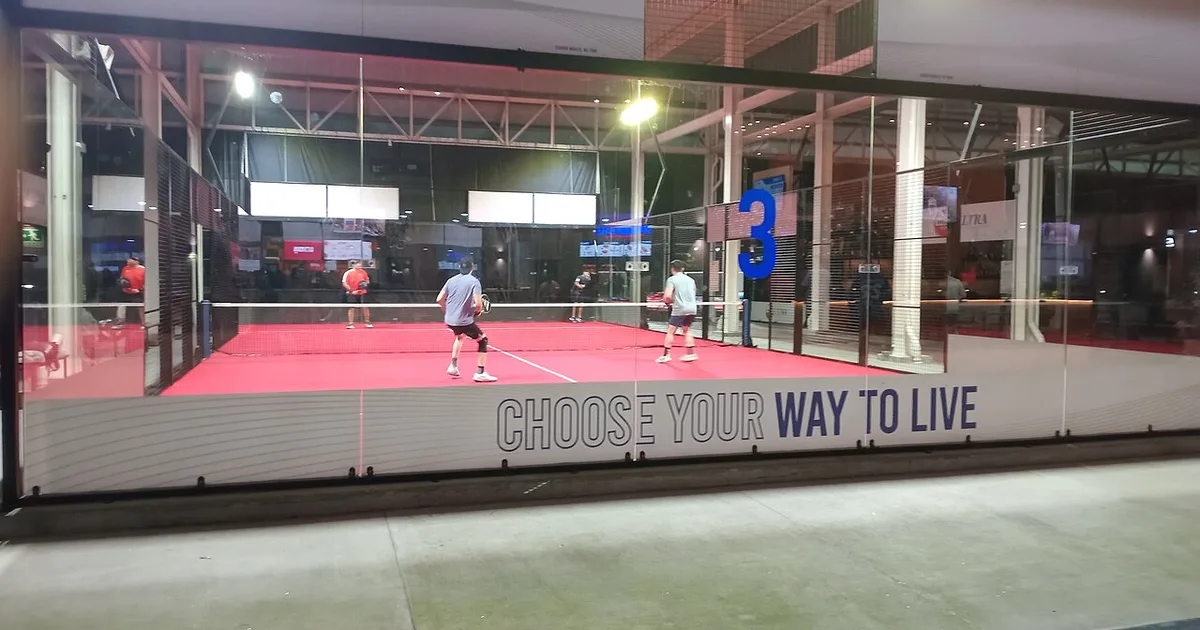
Padel courts are significantly larger. The walls in padel are a core part of gameplay; pickleball has no walls — out-of-bounds is out of bounds.
Ball and Racket
The equipment is entirely different.
Padel:
- Solid racket (pala) — no strings, perforated face, approximately 45–47 cm long
- Pressurised rubber ball, similar to a tennis ball but slightly smaller and with lower internal pressure
- Wrist strap is mandatory
Pickleball:
- Solid paddle — composite or graphite face, shorter than a padel pala
- Hollow plastic ball with holes (similar to a wiffle ball)
- No wrist strap requirement
The padel ball bounces higher and faster than a pickleball. Padel rallies tend to be longer and more physical; pickleball rallies can be very fast at the kitchen line but softer overall.
Scoring
This is one of the biggest differences between the two sports.
Padel uses tennis scoring:
- Points: 15, 30, 40, game
- Games: first to 6 (tie-break at 6-6)
- Sets: best of 3 (or 5 at professional level)
- Deuce and advantage (or Star Point under FIP 2026 rules — see Star Point Rule)
Pickleball uses rally-point scoring (in most formats):
- Points are scored by the serving team only (in traditional scoring) or by either team (rally scoring)
- Games are played to 11, win by 2
- Matches are best of 3 games to 11 (or one game to 15/21 in some formats)
- No love/15/30/40 structure
The rally-point format makes pickleball scores faster to accumulate. A padel set can last 40+ minutes; a pickleball game to 11 can be over in 10.
The Serve
Both sports require a serve below shoulder height, but the specifics differ.
Padel serve:
- Ball dropped and bounced off the floor, struck at or below waist (hip) height
- Served diagonally into the opposite service box
- Ball must land in the correct service box and can hit the side wall after bouncing
- Two attempts before a double fault
Pickleball serve:
- Traditional (volley) serve: ball struck with an upward arc below the waist without bouncing
- Drop serve: ball dropped and bounced, then struck with no restriction on height (as of current rules)
- Served diagonally, must clear the non-volley zone (kitchen) and land in the diagonal service box
- One serve attempt (fault on first miss)
In pickleball, only one fault ends the serve; in padel you get two attempts.
The Kitchen (Non-Volley Zone)
Pickleball’s most distinctive rule is the kitchen — a 2.13 m zone on each side of the net where volleys are not allowed. Players cannot volley the ball while standing in or touching the kitchen line.
Padel has no equivalent non-volley zone. Volleys can be played anywhere on the court (except on the serve, where you cannot volley the return).
Wall Play
This is perhaps the biggest gameplay difference between the two sports.
- Padel: Walls are integral to play. After a ball bounces on your side, it can hit the back or side walls and you can still hit it. Players routinely play balls off the back glass. You can even exit the court through a door opening to retrieve a ball.
- Pickleball: No walls. The court boundary is defined by lines only. Any ball landing outside the lines (including after bouncing on the fence) is out.
The wall element makes padel significantly more three-dimensional tactically.
Double-Bounce Rule (Pickleball Only)
Pickleball has a unique double-bounce rule: after the serve, both the return of serve and the server’s response must be played as groundstrokes (let the ball bounce once). Only after those two bounces can either team begin volleying.
Padel has no equivalent restriction after the serve — volleys can be played immediately.
Spin and Power
Padel’s stringless solid racket generates less topspin than a tennis racket, but slice and cut shots are very effective off the walls. Pickleball paddles can generate significant spin; the plastic ball makes topspin less effective than in tennis but dinking (soft drops into the kitchen) is a major tactical element.
Summary: Key Rule Differences
| Rule | Padel | Pickleball |
|---|---|---|
| Court size | 20 × 10 m | 13.4 × 6.1 m |
| Walls | Core part of gameplay | No walls |
| Scoring system | Tennis (15/30/40, sets) | Rally points to 11, win by 2 |
| Serve | Bounce serve, below waist, 2 attempts | Below waist (volley or drop), 1 attempt |
| Non-volley zone | None | Kitchen (2.13 m from net) |
| Double-bounce rule | None | Yes (serve + return must bounce) |
| Ball | Pressurised rubber (tennis-like) | Hollow plastic with holes |
| Format | Always doubles | Singles or doubles |
Which Sport Should You Try First?
If you already play tennis, padel will feel more familiar — the scoring, the net, and the footwork are closely related. If you prefer a slower entry point with simpler scoring, pickleball’s rally-point system and smaller court make it easier to pick up.
Both sports are doubles-friendly and highly social. Many players end up enjoying both.
Stay in the loop
Get padel rule updates and tournament news — no spam.
More in Basic Rules
What Happens If the Ball Hits a Player in Padel?
If the ball hits a player's body in padel, that player's team loses the point — with limited exceptions. Full FIP rule breakdown with scenarios.
What Happens When the Ball Goes Out of the Court in Padel?
When the ball leaves the padel court through an open door or over the fence, the point may continue if a player can retrieve it.
Can the Ball Bounce Twice in Padel?
No — if the ball bounces twice on your side of the court, you lose the point. Learn the one-bounce rule, wall rebounds, and the exceptions every padel.
Padel Fault Rules and Lets
A fault is an invalid serve — two faults lose the point. A let means the serve is replayed with no penalty. Covers every fault type and the let rule.