 PADEL RULES
How to Build a Padel Court — Complete Construction Guide for Clubs and Developers
9 min read
Building a padel court is a significant but achievable project for clubs, sports centres, hotels, and property developers. The sport’s rapid global growth means that well-located courts consistently achieve high utilisation rates. This guide covers everything you need to know to take a project from site assessment to opening day.
Site Assessment: What You Need Before Anything Else
Before engaging contractors or ordering equipment, your site must be evaluated across four critical dimensions.
Minimum Space Requirements
A single padel court requires:
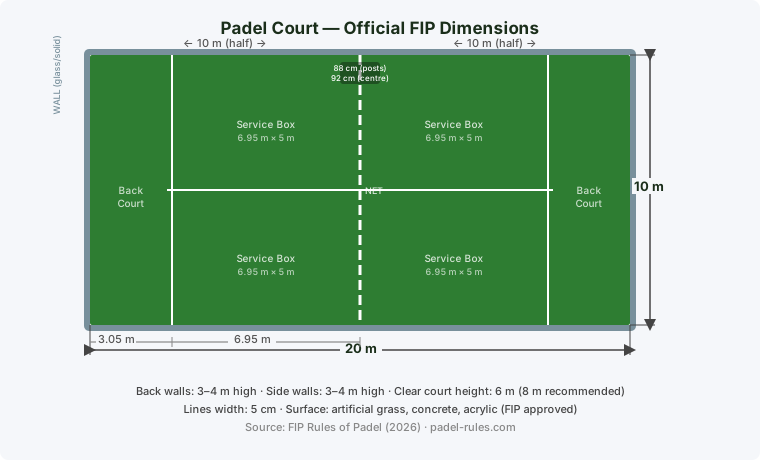
- Playing area: 20 m × 10 m (standard FIP specification)
- Total footprint including run-off: minimum 22 m × 12 m
- Access clearance: allow at least 1 m on all sides beyond the 22 m × 12 m footprint for maintenance, player access, and spectator circulation
For multiple courts, position them side by side (sharing end walls is not standard — courts need independent structures) with approximately 3 to 5 m between court centrelines beyond the shared run-off. A two-court installation requires approximately 22 m × 26 m.
For full specification details, refer to our court dimensions guide.
Ground Conditions
The base must be:
- Flat and level — maximum acceptable gradient is typically 0.5% for drainage purposes
- Load-bearing — capable of supporting a reinforced concrete slab and the court structure
- Well-drained — standing water beneath the slab causes frost heave in cold climates and accelerates surface degradation
Conduct a geotechnical survey on any site where ground conditions are uncertain. Soft ground, made ground, or sites with significant topsoil require more substantial base preparation.
Drainage
Outdoor courts need drainage channels to remove surface water after rain. The concrete slab should be laid with a slight fall (0.5 to 1%) toward drainage channels at the perimeter. An inadequate drainage plan is one of the most common — and most expensive — mistakes in padel court construction.
Access and Services
Ensure the site has:
- Vehicle access for concrete trucks and equipment delivery during construction
- Electrical supply for lighting (outdoor courts require a 3-phase supply in most cases for LED floodlights)
- Water supply for surface maintenance
Court Types: Panoramic vs Standard
The first major structural decision is the court type. This affects cost, appearance, and spectator experience significantly.
Standard Court
A standard padel court has:
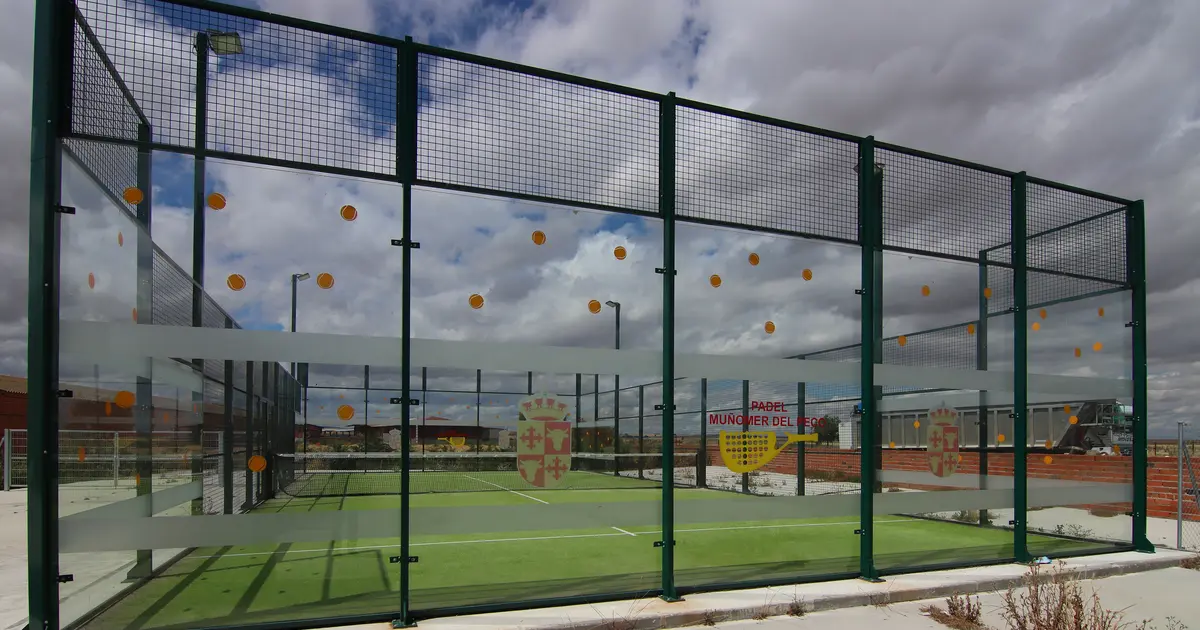
- Tempered glass walls on the back walls and lower sections of the side walls (typically up to 3 m height)
- Metal mesh panels on the upper sections of the side walls and end walls (above the glass)
- A steel frame supporting both the glass and mesh components
Standard courts are more affordable and are the most common type for recreational clubs, school installations, and community sports centres. They are fully FIP-compliant and provide excellent playing conditions.
Best for: clubs where cost management is a priority, community installations, school and university facilities.
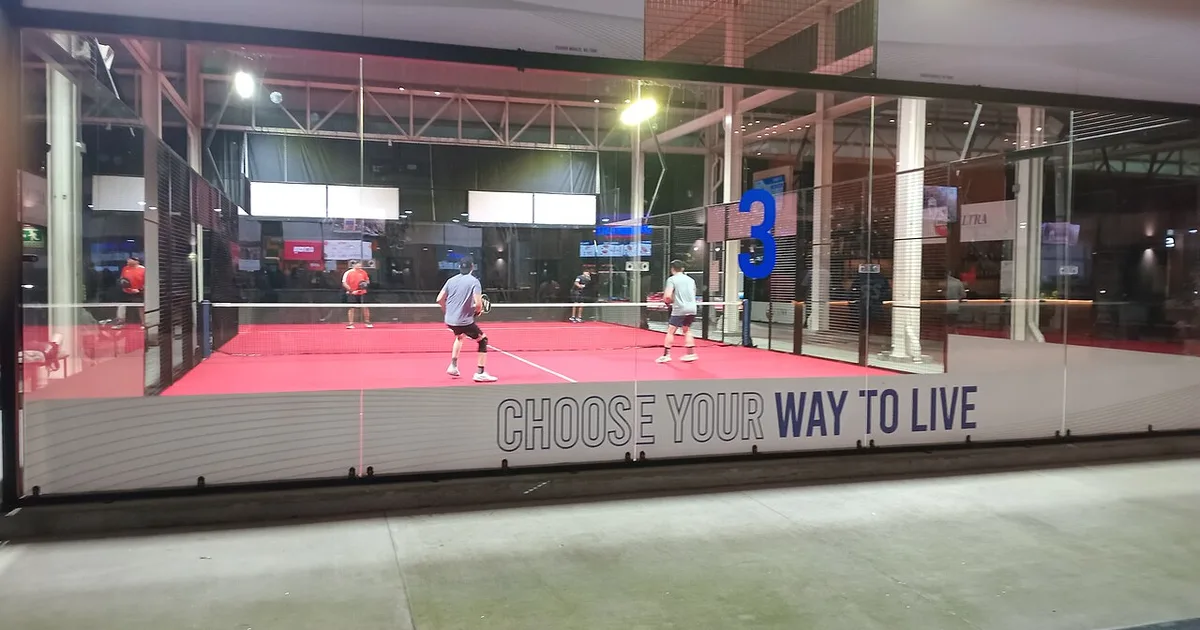
Panoramic Court
A panoramic court replaces all mesh panels with full glass walls, giving an uninterrupted glass enclosure from floor to top. Some panoramic designs use large tempered glass panels; others use structural glass systems without a visible frame.
Panoramic courts:
- Offer better spectator visibility and a premium aesthetic
- Photograph and broadcast more attractively
- Are significantly more expensive (typically 30 to 50% more than a standard court of equivalent quality)
- Require higher-quality glass (usually 12 mm tempered, sometimes laminated for added safety)
Best for: commercial clubs targeting premium positioning, hotel and resort facilities, indoor centres where aesthetics are important, venues hosting professional or semi-professional events.
Indoor Courts
Indoor padel uses the same structure as outdoor — either standard or panoramic — but requires:
- Minimum ceiling height of 8 to 10 metres (6 m is the absolute minimum; 9 m is preferred for professional play)
- Adequate lighting integrated into the building structure or suspended from ceiling gantries
- Ventilation — padel generates heat and humidity; a good HVAC system is essential for player comfort and surface longevity
Indoor installations are more expensive due to building requirements but offer year-round play regardless of weather — a significant commercial advantage in northern Europe, Canada, and similar climates.
Materials and Specifications
Tempered Glass
Tempered glass is the standard for all padel court walls. Key specifications:
- Thickness: 10 mm (minimum for standard courts), 12 mm (premium and panoramic)
- Safety standard: must comply with EN 12150 (Europe) or equivalent national standard
- Treatment: all glass edges are polished; panels use toughened safety glass that, if broken, shatters into small rounded fragments rather than dangerous shards
- Anti-reflective coating: optional but improves playability in low-light conditions
Do not accept non-tempered glass or glass that does not carry the appropriate safety certification. This is both a safety issue and a regulatory compliance issue.
Steel Structure
The steel frame is the skeleton of the court. Quality varies significantly between manufacturers:
- Hot-dipped galvanised steel is the minimum acceptable specification for outdoor courts. Untreated or powder-coated-only steel will corrode in outdoor environments.
- Steel section sizes should be specified by the manufacturer and verified against local wind load requirements — particularly important in exposed or coastal sites
- Joints, welds, and fixings should all be stainless steel or hot-dipped galvanised
Artificial Grass Surface
The playing surface for padel courts is almost universally short-pile artificial grass with silica sand infill:
- Pile height: 12 to 16 mm for padel (shorter than football astroturf)
- Fibre material: polyethylene or polypropylene; polyethylene is softer and more comfortable
- Sand infill: silica sand brushed into the fibres to provide stability and the correct playing characteristics
- UV stabilisation: outdoor surfaces must be UV-stabilised to prevent fibre degradation from sunlight
Premium surfaces use a blend of silica sand and rubber granules for improved cushioning and playing feel. These last longer but cost more upfront.
Net and Posts
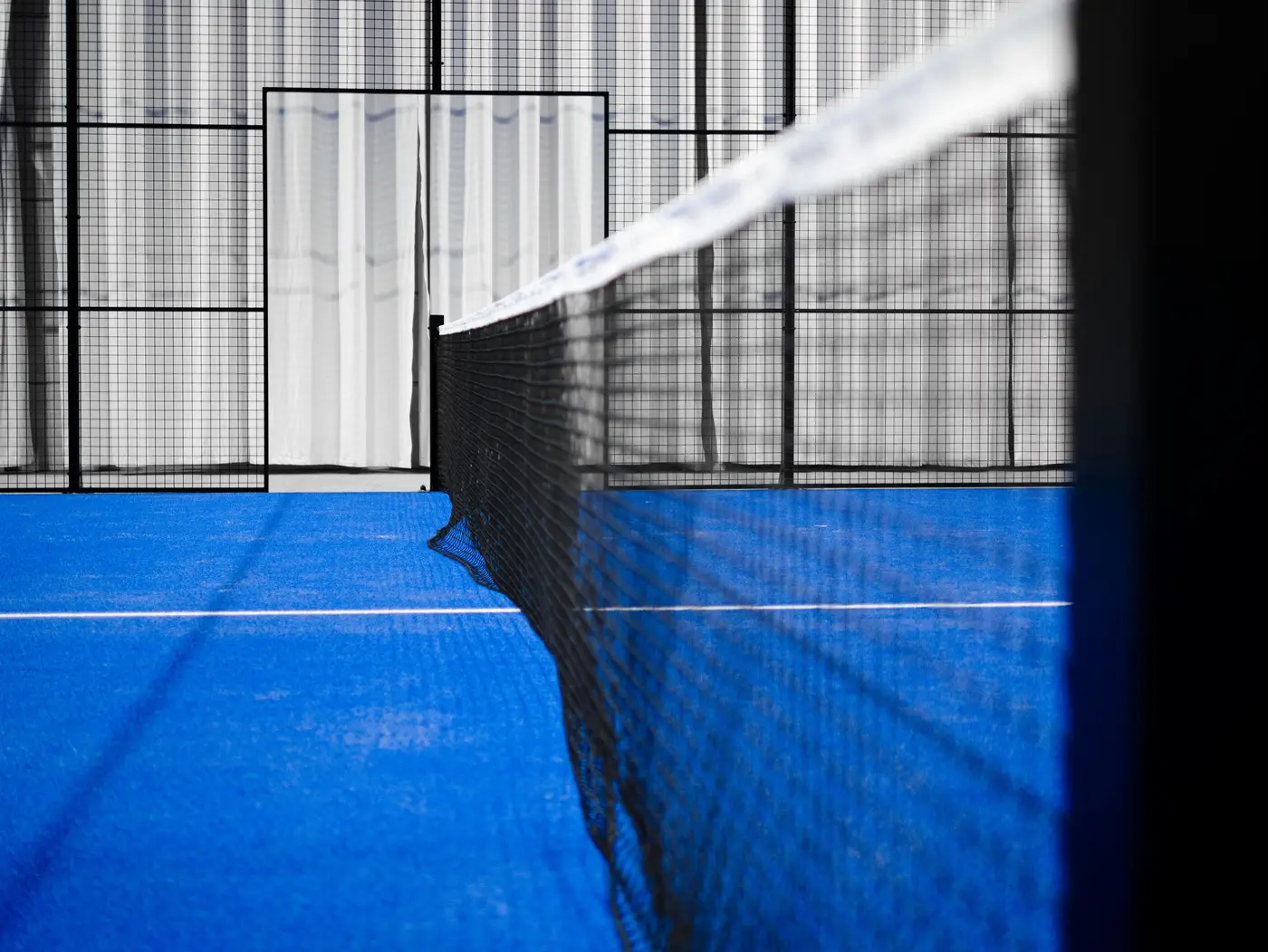
The net must comply with FIP specifications: 88 cm high at the posts, 88 cm at the centre (unlike tennis, padel uses a flat net with no dip in the centre). Posts are typically steel, anchored to the court surface or to the side wall frame.
Construction Timeline
A typical padel court project follows this sequence:
| Phase | Duration | Description |
|---|---|---|
| Site preparation and groundwork | 1–2 weeks | Excavation, levelling, drainage installation |
| Concrete base | 1 week + curing | Reinforced concrete slab, 150–200 mm depth |
| Concrete curing | 3–4 weeks | Slab must reach full strength before installation |
| Court structure installation | 1–2 weeks | Steel frame, glass, and mesh |
| Surface installation | 3–5 days | Artificial grass laid, trimmed, and sand-infilled |
| Lighting installation | 3–5 days | Mast foundations, electrical work, LED fixtures |
| Net, markings, and snagging | 2–3 days | Line markings, net installation, final checks |
Total elapsed time: 8 to 14 weeks from ground-breaking to first play. If the concrete slab already exists (e.g., converting an existing hard court), the timeline reduces to 3 to 5 weeks.
Choosing a Contractor or Manufacturer
The padel court industry has grown rapidly and the quality of manufacturers and installation contractors varies considerably. When selecting a supplier:
- Use established manufacturers — companies with a significant track record, a portfolio of completed installations, and genuine after-sales support
- Ask for references — visit completed courts and speak to the club operators about quality of installation and after-sales service
- Check glass certification — request documentation confirming glass meets the required safety standard
- Clarify the warranty — a quality court manufacturer should offer a minimum 2-year structural warranty and guidance on surface warranty
- Verify installation experience — the structural elements must be installed by a team with padel-specific experience; a general builder without padel experience is a risk
Major European manufacturers include Altaplana, Padelix, StarPadel, and several others. Spanish manufacturers dominate the premium end of the market given Spain’s decades-long head start in the sport.
Planning Permission
Planning requirements vary widely by country and local authority. As a general guide:
- Outdoor floodlit courts almost always require planning permission due to light spillage and mast height
- Unlit outdoor courts may be permitted development in some jurisdictions depending on fence/glass height
- Indoor courts within existing buildings typically do not require planning consent for the court itself, though change of use of the building might
- Noise — glass-walled courts can reflect sound significantly; planning authorities in residential areas may require acoustic assessment
Engage your local planning department early. A pre-application consultation before submitting a formal planning application can identify issues and save months of delay.
Indoor vs Outdoor: Key Considerations
| Factor | Indoor | Outdoor |
|---|---|---|
| Year-round play | Yes | Weather-dependent |
| Construction cost | Higher (building required) | Lower |
| Lighting | Integrated | Requires floodlights |
| Planning complexity | Often lower for court itself | Usually requires consent |
| Maintenance | More controlled environment | Surface exposed to weather |
| Player experience | Consistent, sheltered | Preferred by many for fresh air |
In climates with cold winters or frequent rain (northern and central Europe, Canada), indoor courts achieve significantly higher utilisation rates and justify the premium construction cost through revenue consistency.
Multi-Court Considerations
Building two or more courts significantly improves the economics of the project:
- Shared infrastructure — a single electrical supply, drainage system, and car park serves multiple courts
- Volume discounts — court manufacturers typically offer 10 to 15% per-court discounts for multi-court orders
- Community effect — multiple courts allow simultaneous play, coaching sessions alongside matches, and social round-robin events that drive membership and repeat bookings
For clubs seriously considering padel, a minimum of two courts is widely considered the threshold for viable commercial operation. A single court limits flexibility for scheduling and cannot generate the social dynamic that drives word-of-mouth growth.
For detailed cost projections, see our padel court cost guide, which covers construction, installation, and annual running costs in full.
Stay in the loop
Get padel rule updates and tournament news — no spam.
More in Court Dimensions
Padel Court Dimensions 2026 — Official Measurements & Diagram
Official padel court dimensions: 20m × 10m (200 m²). See the labelled diagram with wall heights, net specs, and service box measurements — FIP 2026 standard.
Glass Wall Height & Design: Why 4 Metres Defines Padel Strategy
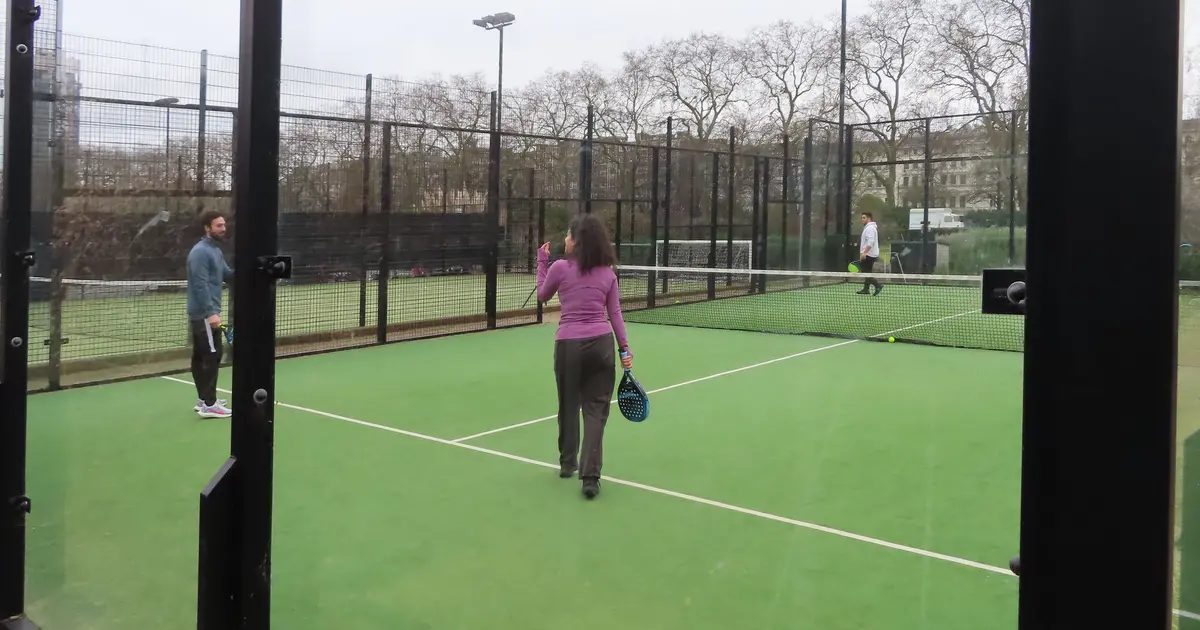
Padel court back walls are 4 metres high to enable lob play and wall rebounds. Learn how wall height affects strategy, glass vs opaque trade-offs, safety standards, and spectator experience.
Padel Court Net Specifications: How Net Height Affects Your Game
FIP net height (88–92 cm) is lower than tennis to encourage aggressive net play. Learn how net height affects strategy, why the slope matters, and what makes a compliant net.
Playing Surface
The padel court surface must be uniformly flat with a maximum deviation of 3mm per 3 metres in any direction, and must ensure regular ball bounce.