 PADEL RULES
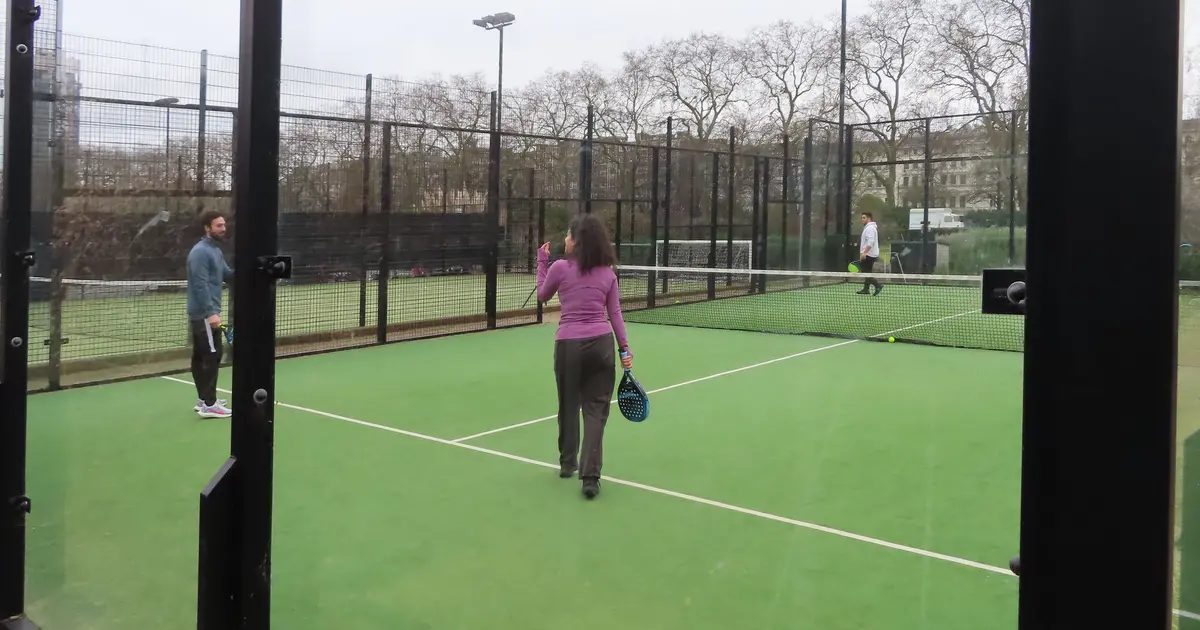
Glass Wall Height & Design: Why 4 Metres Defines Padel Strategy
8 min read
The 4-metre back wall is one of padel’s defining architectural features. Unlike tennis (which has no walls), squash (which has 4.5–5.5m walls), or racquetball (9m walls), padel’s 4-metre wall creates a completely unique tactical game.
At this height, players can execute lobs, defensive wall passes, and aggressive drives — all hitting the back wall in controlled ways. The wall is short enough that basic technique works, but tall enough that it remains a serious challenge. This balance is central to why padel developed as a skill-intensive, entertaining sport.
How Wall Height Shapes Padel Strategy
Why 4 Metres, Not 3 Metres?
At 3 metres, a skillfully hit lob would consistently clear the wall. The court would become:
- Lob-dominant — aggressive players would eliminate lobs by hitting them over the wall
- Baseline-focused — without wall play, rallies would be shorter and less varied
- Less defensive — no back-wall recovery shots available
- Less strategic — the game would simplify to baseline power exchange
At 4 metres, lobs stay in play when hit correctly but exit when hit too aggressively:
- Lobs require precision — you can’t just launch the ball randomly; it must be placed correctly
- Back-wall play is viable — defensive players can pass balls off the back wall
- Extended rallies — wall play allows longer, more exciting exchanges
- Skill differentiation — good lob technique separates skilled from casual players
Why Not 5 Metres or Taller?
At 5+ metres, the wall becomes:
- Too defensive — lobs would virtually never clear, making the back wall overused
- Too expensive — building costs increase non-linearly with height (structural support, materials)
- Impractical for facilities — many club spaces (converted buildings, retrofitted tennis courts) can’t accommodate 5m walls
- Spectator obstruction — taller walls block views for spectators outside the court
The 4-metre height is a sweet spot — tall enough to enable interesting wall play but short enough to remain practical and affordable.
Wall Composition: 3m Solid + 1m Mesh
The back wall uses a two-layer design:
| Section | Height | Material | Purpose |
|---|---|---|---|
| Solid panel | 3 metres | Glass or opaque | Primary rebound surface for balls |
| Mesh section | 1 metre | Metallic mesh | Allows visibility to outside/above; spectator sightlines |
Why This Split Design?
Solid (0–3m):
- All serious play happens here — most lobs, wall passes, and rebounds occur below 3m
- Solid material ensures consistent ball bounce
- Protects areas that take the most impact
Mesh (3–4m):
- Balls that reach this height are defensive or exploratory
- Mesh allows spectators outside to see the court
- Light passes through, reducing glare
- Still bounces the ball back if it reaches this height, but these are rare plays
The transition point (3m): This is roughly the peak height of most lobs. Players know that hitting a ball to the 3–3.5m zone requires precision. This creates a tactical skill gradient — easier to hit low wall shots, harder to place high ones precisely.
Glass vs Opaque Walls: Trade-offs
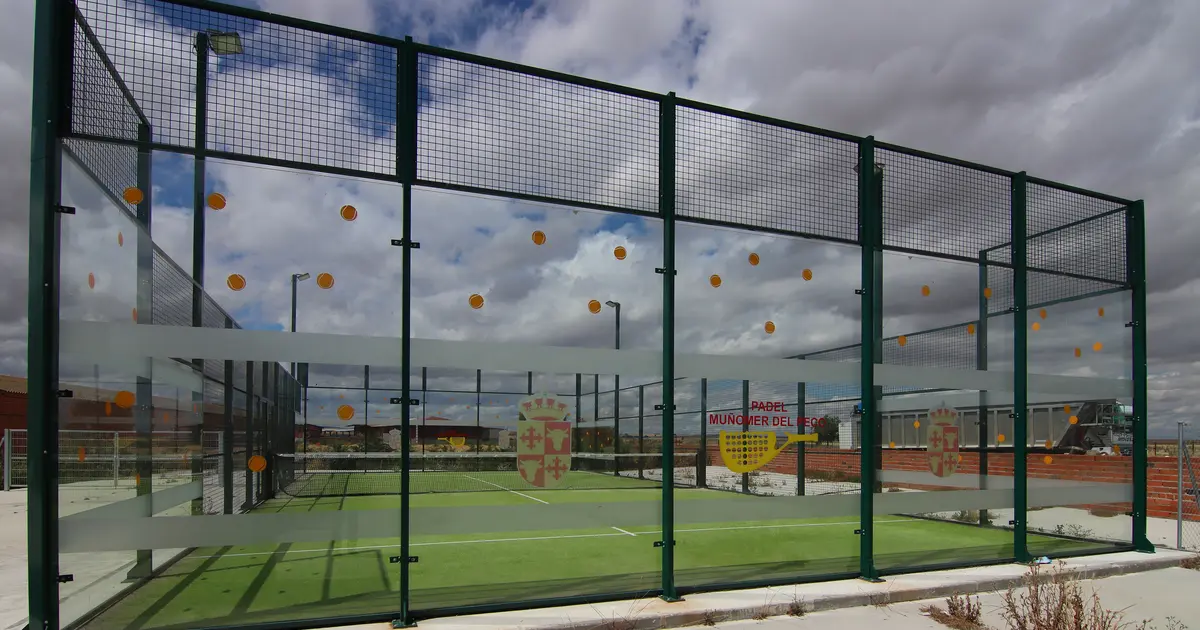
Glass Walls (Most Common)
Advantages:
- Spectator visibility — fans outside can watch the action through the glass
- Broadcast potential — TV cameras can film through the glass, showing wall plays clearly
- Ball visibility — you can see the ball trajectory better against a clear background
- Modern appearance — glass courts look sleek and professional
- Reflections add strategy — ball behaviour off glass is slightly different, creating micro-variations
Disadvantages:
- Expensive — tempered safety glass costs €5,000–€15,000 per wall
- Maintenance — glass requires cleaning to prevent glare and reduce visual obstruction
- Glare issues — direct sunlight on glass creates reflective glare that affects play
- Durability concerns — repeated high-impact ball strikes can degrade the glass over time
- Safety regulations — must comply with EN 12150-1 tempered safety standards
Opaque Walls (Less Common, Cost-Saving)
Advantages:
- Cheaper — opaque panels (plastic, composite, or painted walls) cost 30–50% less than glass
- Easy maintenance — simple to repaint or clean
- No glare issues — no reflections causing visual problems
- Consistent bounce — uniform material doesn’t vary with lighting
- Durability — some materials (like composite) last longer under impact
Disadvantages:
- No spectator visibility — fans and cameras can’t see through to the back court
- Broadcast restrictions — TV broadcasts can’t use wall-side camera angles
- Ball visibility challenges — depending on colour, the ball can be hard to see against opaque backdrops
- No external viewing — people watching from outside the facility can’t see matches
- Less modern appeal — opaque courts feel more utilitarian, less professional
Colour Choices for Opaque Walls
If a club chooses opaque walls, colour selection matters:
- Dark blue — excellent ball contrast for yellow balls (industry standard)
- Dark green — works well for yellow or white balls
- White — poor choice (ball blends in on sunny days)
- Black — difficult (creates glare and reflection issues)
Material Standards and Safety
Tempered Safety Glass (EN 12150-1)
Standard: EN 12150-1 (European standard; equivalent to ANSI Z97.1 in the USA and AS 1288 in Australia)
Requirements:
- Glass must be thermally tempered — heated to 600°C+ then rapidly cooled, creating internal stress that makes it stronger
- Breaking pattern: When hit hard, tempered glass breaks into small, relatively blunt cubes rather than sharp shards
- Impact resistance: 4–6x stronger than regular glass against ball impacts
- Thickness: Typically 10–12mm for padel courts (thicker = more expensive but more durable)
Safety advantage: If tempered glass breaks (rare), it fragments into small pieces. This minimizes injury compared to regular annealed glass, which shatters into long, sharp shards.
Opaque Wall Materials
If using opaque walls, FIP requires:
- Hard and smooth surface — for consistent ball bounce
- Uniform colour — so ball is equally visible across the entire wall
- Contrasting with court surface — typically dark walls on light courts or vice versa
- No gaps or joints that would affect ball rebound
Materials commonly used:
- Composite panels (polycarbonate, acrylic composite)
- Painted plywood or particle board (lower cost)
- Aluminum panels with paint or coating
Logo Placement (Advertising)
The rules allow one logo per wall panel, but with restrictions:
- Logo must not obstruct players’ ability to see the ball
- Logo must not impair visibility for spectators
- Logo must not create glare or reflection issues
- Maximum size is typically regulated in tournament rules
Clubs use wall logos for:
- Club branding — displaying the club name
- Sponsorship — local businesses paying for exposure
- Broadcaster branding — for professional matches
Impact on Player Development and Tactics
The 4-metre wall height has shaped how padel players develop their skills:
- Lob technique is critical — players spend thousands of hours practicing lob placement and consistency
- Wall defence is a fundamental skill — mastering wall passes separates intermediate from advanced players
- Reading wall angles becomes instinctive — players learn to predict ball rebound angles
- Wall awareness is constant — even advanced players are always thinking about “using the wall”
Shorter courts (3m or less) would eliminate this entire skill dimension. Padel wouldn’t exist as we know it.
Historical Context: Why 4 Metres?
Padel was invented in Mexico in the 1970s, initially on converted tennis courts and small enclosures. The 4-metre height was chosen as a practical middle ground:
- High enough to keep lobs in play (enabling wall strategy)
- Low enough to build on existing facilities (converted tennis court spaces have limited vertical clearance)
- Affordable for clubs building new courts
As padel spread globally, this dimension became standardized. Today, it’s as central to padel as the net height is to tennis.
Building Considerations for Club Owners
When designing a new padel court facility:
If budget allows: Glass walls enable professional tournaments, TV broadcasting, and spectator experiences. Initial cost is 20–30% higher, but it opens revenue streams.
If cost is critical: Opaque walls are cheaper, and recreational padel is perfectly playable on them. Many clubs worldwide use opaque walls successfully.
Hybrid approach: Some clubs build glass walls on 2–3 courts (for tournaments/broadcast) and opaque walls on practice courts (for members), balancing cost and functionality.
Summary
| Aspect | Why It Matters |
|---|---|
| 4-metre height | Optimal for lob play and wall strategy; not too tall (cost), not too short (reduces game complexity) |
| 3m solid + 1m mesh split | Solid area handles main play; mesh allows visibility and maintains fairness at higher balls |
| Glass walls | Enable spectator viewing and broadcast; costly but professional |
| Opaque walls | Cheaper; reduces glare but blocks external viewing |
| Tempered safety glass | Breaks safely into small pieces; meets EN 12150-1 standard |
| Consistent bounce | Material must be hard and smooth regardless of type |
| Logo placement | One per wall, must not obstruct ball visibility |
The back wall isn’t just a boundary — it’s a defining feature of padel’s strategic and tactical depth. Its height and design enable the sport’s unique character.
Learn More About Padel
- Rules & Gameplay — How to play
- Top Players — Professional padel
- Getting Started — Beginner”s guide
Stay in the loop
Get padel rule updates and tournament news — no spam.
More in Court Dimensions
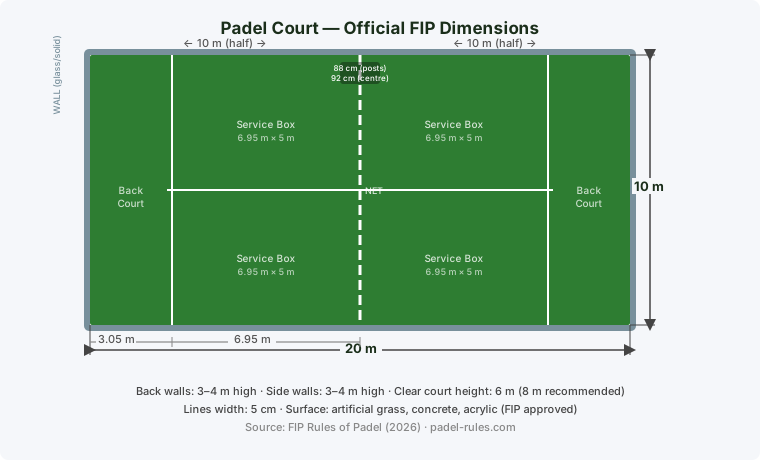
Padel Court Dimensions 2026 — Official Measurements & Diagram
Official padel court dimensions: 20m × 10m (200 m²). See the labelled diagram with wall heights, net specs, and service box measurements — FIP 2026 standard.
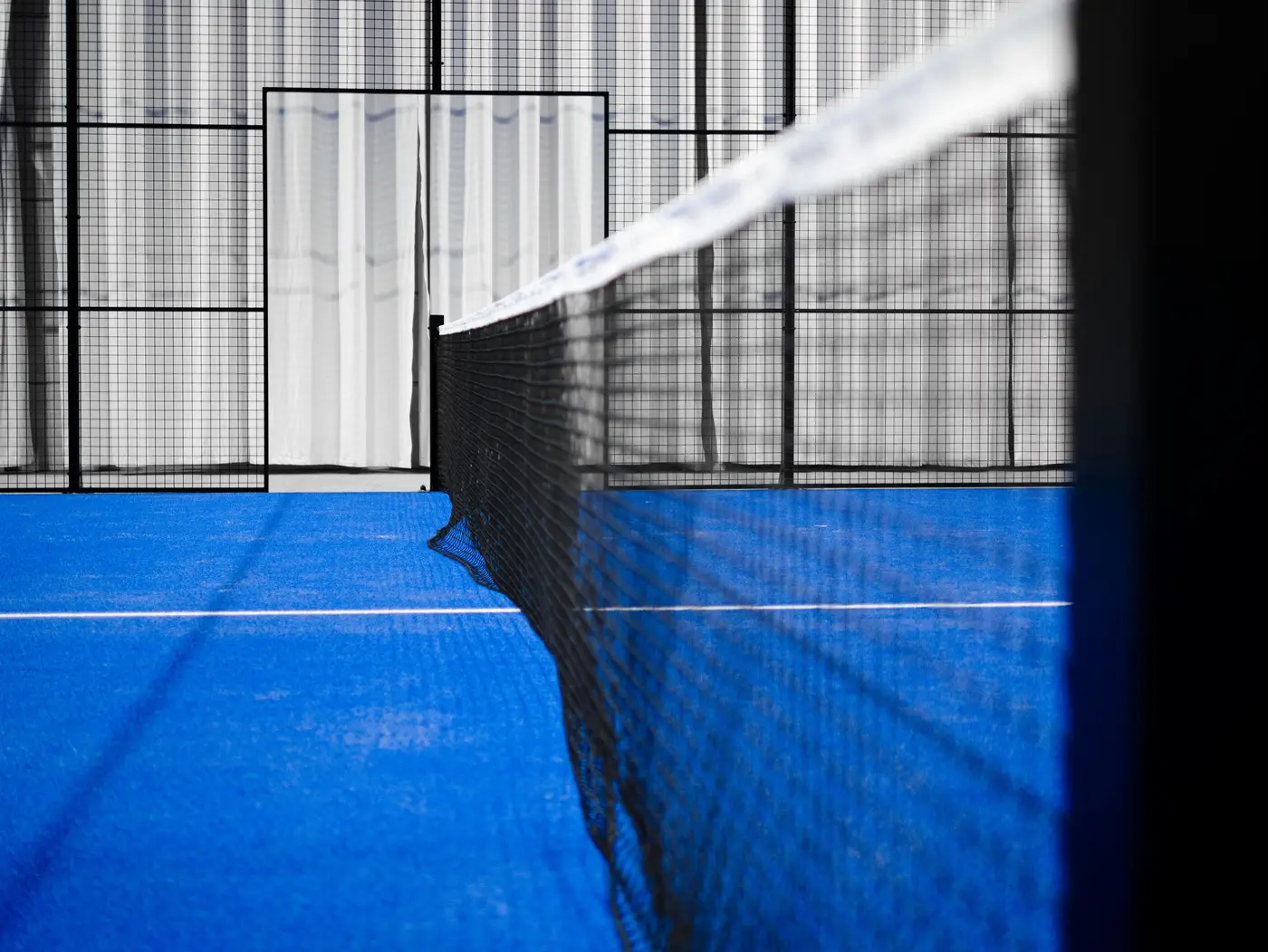
Padel Court Net Specifications: How Net Height Affects Your Game
FIP net height (88–92 cm) is lower than tennis to encourage aggressive net play. Learn how net height affects strategy, why the slope matters, and what makes a compliant net.
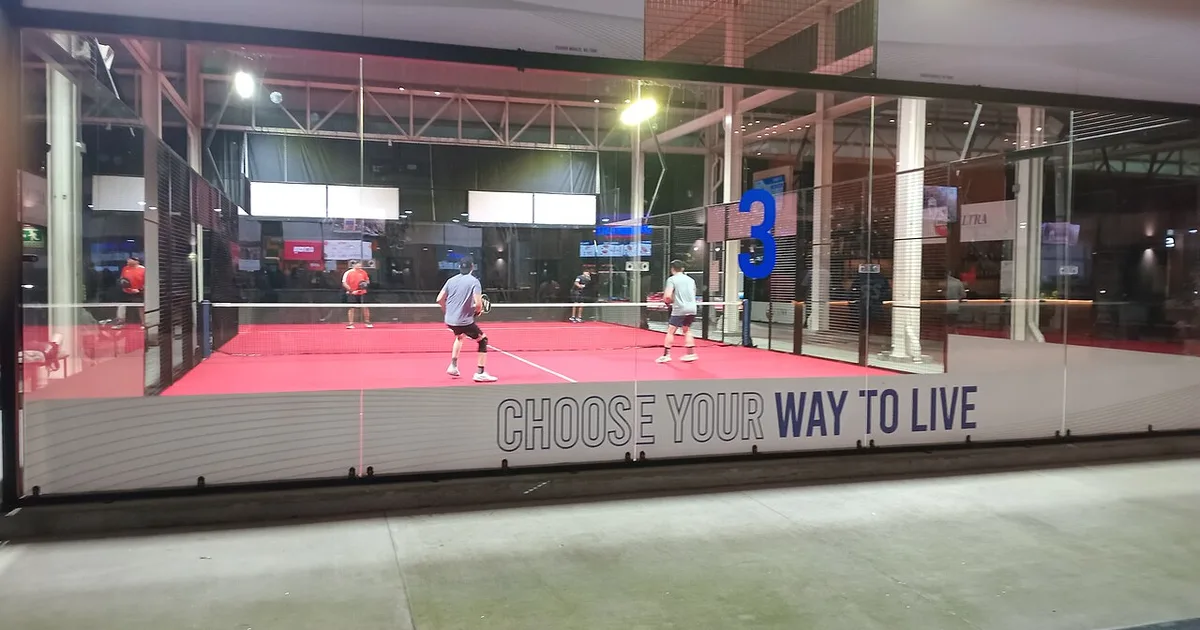
How to Build a Padel Court — Complete Construction Guide for Clubs and Developers
Complete padel court construction guide: site requirements, panoramic vs standard court types, materials, build timeline (4-8 weeks), planning permission.
Playing Surface
The padel court surface must be uniformly flat with a maximum deviation of 3mm per 3 metres in any direction, and must ensure regular ball bounce.